Bernoulli equation / fluid flow / finding height

Click For Summary

Homework Help Overview

The discussion revolves around fluid flow and the application of the Bernoulli equation, specifically in the context of a hose connected to a nozzle with varying diameters. Participants are tasked with calculating dynamic and static pressures, as well as determining the height to which a nozzle is raised based on pressure changes.

Discussion Character

  • Exploratory, Conceptual clarification, Assumption checking

Approaches and Questions Raised

  • Participants discuss the calculation of dynamic and static pressures, questioning how changes in height affect pressure readings. There is a focus on the implications of maintaining constant mass flow and the potential effects on velocity.

Discussion Status

The conversation is ongoing, with participants exploring different interpretations of how pressure and velocity interact when the nozzle is raised. Some guidance has been offered regarding the assumptions about pressure changes and the role of the pump, but no consensus has been reached.

Contextual Notes

Participants are considering the effects of height changes on pressure measurements and the assumptions regarding the constancy of flow mass. There is also mention of the variability in pump behavior under different pressure conditions.

Polarbear10
Messages
10
Reaction score
2
Homework Statement
Bernoulli equation / fluid flow
find height using Bernoulli equation
Relevant Equations
Bernoulli equation
Qv = V/t = A*V
Hi, everyone! Doing some fluid flow/Bernoulli tasks.

Ok, so the task is:
«A hose with a radius of 0,035m is connected to a nozzle, which reduces the radius of the hose to 0,018m (2). The hose carries (qv) 0,0075 m3/sec and the totalpressure (3) in the wide section (1) is 211 kPA. The density of the water is set at 1000 kg/m3.””

  • 1: Task one is to find the dynamic pressure in the wide section. I found the velocity to be 1,95 m/s, using V1 = qv/A1. Then calculated the dynamic pressure using Pd = ½ * ρ * v^2 and got 1,89 kPa.
  • 2: Second task was to calculate the static pressure. Using Pt = Pd – Ps, and found that PS = 209kPa.
  • 3: Then the third task was to find the pressure in the pressure gauge (4). I then calculated the velocity2, using V2=A1*V1/A2, and got 7,37 m/s. I then used Bernouli-equation to calculate the pressure that would be in the gauge (4), and found P2 to be 186 kPa.

4: But the last task: “The nozzle is raised to a higher level. The pressure gauge (3) has a pressure on 241,2 kPa. How high was the nozzle raised”?
I'm struggling to see where I would start. What happens to the pressure in the pressure gauge (4)? Does it change when the nozzle is raised, or will it be the same as in task 3, with P2 being 186 kPa. Also, does the velocity change?

Here is a drawing of the situation, before the nozzle gets lifted.
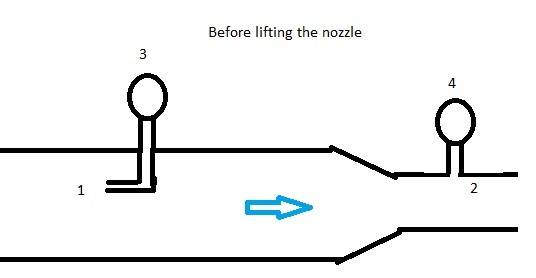
task1.jpg
c
 
  • Like
Likes   Reactions: Chestermiller
Physics news on Phys.org
The velocity can’ change, as the flowmass must be constant.
You should accont for the additional pressure differential induce by the different height new locations of the gauges.
 
Lnewqban said:
The velocity can’ change, as the flowmass must be constant.
You should accont for the additional pressure differential induce by the different height new locations of the gauges.
Hi! Did you mean that the velocity can or can't change since the flowmass must be constant?

But would it be correct to say that P1; is the new pressure on the pressure gauge (3) = 241,2kPa?
And P2 being what I calculated in task 3?
 
Polarbear10 said:
Hi! Did you mean that the velocity can or can't change since the flowmass must be constant?

But would it be correct to say that P1; is the new pressure on the pressure gauge (3) = 241,2kPa?
And P2 being what I calculated in task 3?
I meant can’t; sorry.
It seems that the pump making the fluid move could compensate for the additional pressure of lifting the hose, by increasing P1 and P3 and keeping the same mass flowing through the pipe.
I seems that we can assume that the original values of P2 and P4 have remained constant.
 
Lnewqban said:
I meant can’t; sorry.
It seems that the pump making the fluid move could compensate for the additional pressure of lifting the hose, by increasing P1 and P3 and keeping the same mass flowing through the pipe.
I seems that we can assume that the original values of P2 and P4 have remained constant.
Thanks! That's what I reckon too, so I set up the equation using P1 as 241,2kPa and P2 being 186kPa.
Ended up getting a height (h2) of 3 meters (rounded)..
 
  • Like
Likes   Reactions: Lnewqban
Lnewqban said:
It seems that the pump making the fluid move could compensate for the additional pressure of lifting the hose, by increasing P1 and P3 and keeping the same mass flowing through the pipe.
Isn't it more likely that the motor maintains constant power, i.e. volumetric flow rate times static pressure?
 
haruspex said:
Isn't it more likely that the motor maintains constant power, i.e. volumetric flow rate times static pressure?
Thank you, Sir.
Your question has made me realize that my example about pumps may not be the best, as different types of pumps react differently to increasing pressure in the systems they feed.
Perhaps lifting an imaginary supply tank in the same amount as the end of the hose of our problem has been relocated could be a better example.
 

Similar threads

  • · Replies 13 ·
Replies
13
Views
1K
  • · Replies 16 ·
Replies
16
Views
2K
  • · Replies 4 ·
Replies
4
Views
2K
  • · Replies 1 ·
Replies
1
Views
2K
  • · Replies 6 ·
Replies
6
Views
2K
  • · Replies 1 ·
Replies
1
Views
3K
Replies
1
Views
2K
  • · Replies 5 ·
Replies
5
Views
4K
Replies
2
Views
2K
  • · Replies 3 ·
Replies
3
Views
2K