Best fit to an oscillating function

Click For Summary
SUMMARY

The discussion focuses on fitting a numerical function with oscillations characterized by high frequency ##\omega_0## and a lower frequency envelope ##\omega_1##. The proposed functional form is $$A\sin(\omega_1 t/2)^2(1+\cos(\omega_0t/2))^2$$, but participants suggest using a Fourier transform of the original signal to better understand its composition. Additionally, downshifting the carrier frequency by multiplying the signal with ##e^{-\omega_2 t}##, where ##\omega_2## is slightly less than ##\omega_0##, is recommended to facilitate the Fourier transform process.

PREREQUISITES
  • Understanding of oscillatory functions and their parameters (e.g., frequency, amplitude).
  • Familiarity with Fourier transforms and their application in signal processing.
  • Knowledge of numerical integration techniques for solving ordinary differential equations (ODEs).
  • Experience with software tools like Mathematica for data analysis and visualization.
NEXT STEPS
  • Research the application of Fourier transforms in analyzing oscillatory signals.
  • Learn about downshifting techniques in signal processing to manage high-frequency components.
  • Explore numerical integration methods for ODEs to generate oscillatory functions.
  • Investigate how to convert bitmap images to vector data using Mathematica.
USEFUL FOR

Researchers, physicists, and engineers working with oscillatory functions, signal processing, and numerical methods in computational analysis.

kelly0303
Messages
573
Reaction score
33
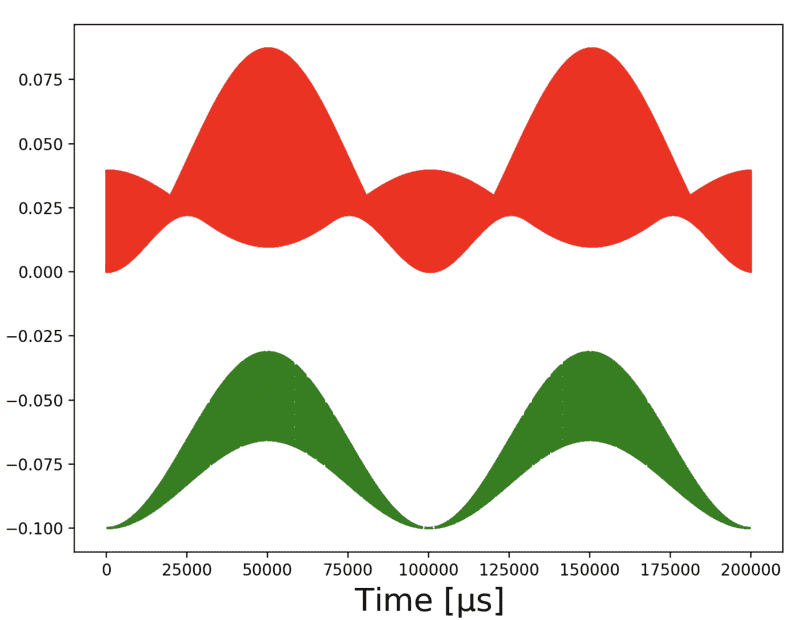
Hello! I have a plot of a function, obtained numerically, that looks like the red curve in the attached figure. It is hard to tell, but if you zoom in enough, inside the red shaded area you actually have oscillations at a very high frequency, ##\omega_0##. On top of that you have some sort of envelope, with a lower frequency, ##\omega_1##. I am trying to find a function that comes as close as possible to this. In green is what I obtained using:

$$A\sin(\omega_1 t/2)^2(1+\cos(\omega_0t/2))^2$$
where ##A## is just an overall amplitude (and I shifted everything for clarity). However I am not sure how to get the rest of the behaviour, basically fill in the gaps in my function relative to the red one. Can someone advice me on what functional form would I need to add to my expression to get that? Thank you!
func.png
 
Physics news on Phys.org
Have you considered a Fourier transform?
 
  • Like
Likes   Reactions: Scottpm, berkeman, FactChecker and 1 other person
DaveE said:
Have you considered a Fourier transform?
Thank you! What exactly do you mean? Fourier transform of what?
 
kelly0303 said:
Thank you! What exactly do you mean? Fourier transform of what?
Fourier transform of your original signal. It will tell you how to write it as a sum of sines and cosines. If you absolutely to have it as an envelope times a constant oscillation, it will take a bit more work.

If you don't mind sharing the data (at least privately), I would like to take a go at it.
 
DrClaude said:
Fourier transform of your original signal. It will tell you how to write it as a sum of sines and cosines. If you absolutely to have it as an envelope times a constant oscillation, it will take a bit more work.

If you don't mind sharing the data (at least privately), I would like to take a go at it.
Ah I see, thank you I will look into that. There is no actual data. The red-line is generated by numerically integrating on ODE, but I am attaching below the points used in that plot.
 

Attachments

If each low-frequency cycle contains thousands (or even hundreds) of high frequency cycles, you may have numerical problems with the Fourier transform. You will have to process way more samples than are really needed to answer your question.

Instead, shift the signal down so that your ##\omega_0 ## is lower, keeping your ##\omega_1## structure the same. (Then when you plot it, you will be able to see, let's say 20 cycles of ##\omega_0 /2## within one cycle of ##\omega_1##. After this down shift the signal will be more amenable to Fourier transform with a moderate number of samples.

You can down shift the "carrier" frequency by multiplying the original signal by ##e^{-\omega_2 t}## where ##\omega_2## is a few percent less than ##\omega_0##.

Edit:
As hutchpd has said, you need an 'i' in the exponential.

Downshifting will be a bit more complicated than I have indicated above... I will post later with more details, or maybe someone can fill in the details.
 
Last edited:
You need an "i" in the exponential yes?
 
hutchphd said:
You need an "i" in the exponential yes?
Yup.

Edit: Wait, I believe there was an i in the original... But anyway.
 
  • Like
Likes   Reactions: hutchphd
It will probably work if you just take every 10th or 100th sample (leaving you with say 20 samples per "big" cycle) and pretend that's your actual signal.
 
  • #10
Just for fun, I asked Mathematica to find the edges in the OP's plot:

1678151257093.png


I am now trying to find out if Mathematica can convert the bitmap edges to vectors. Any ideas?

Also, is it correct that the desired low freq. signal is the average of the upper and lower boundaries of the outlines above?
 

Similar threads

  • · Replies 17 ·
Replies
17
Views
3K
  • · Replies 1 ·
Replies
1
Views
3K
Replies
9
Views
2K
Replies
3
Views
1K
  • · Replies 2 ·
Replies
2
Views
1K
  • · Replies 1 ·
Replies
1
Views
2K
  • · Replies 4 ·
Replies
4
Views
2K
  • · Replies 2 ·
Replies
2
Views
2K
Replies
8
Views
2K
Replies
7
Views
1K