"Biot-Savart equivalent" of Faraday's Law?

Click For Summary
SUMMARY

The discussion centers on the inquiry of a "Biot-Savart equivalent" of Faraday's Law, exploring the relationship between Ampere's Law and the Biot-Savart Law. The user proposes a formula for the electric field due to a changing magnetic field, suggesting that traditional Maxwell's equations may not fully encapsulate this relationship. The conversation references the Jefimenko equations as a potential solution for understanding the electric and magnetic field interactions in time-dependent scenarios.

PREREQUISITES
  • Understanding of Maxwell's equations
  • Familiarity with the Biot-Savart Law
  • Knowledge of Jefimenko's equations
  • Basic concepts of electromagnetic fields
NEXT STEPS
  • Research the derivation of the Jefimenko equations
  • Study the implications of time-dependent magnetic fields on electric fields
  • Examine the relationship between Ampere's Law and the Biot-Savart Law
  • Explore advanced applications of Maxwell's equations in electromagnetism
USEFUL FOR

Students and professionals in physics, particularly those focusing on electromagnetism, electrical engineering, and applied mathematics, will benefit from this discussion.

greswd
Messages
764
Reaction score
20
This is a repeat of this thread https://www.physicsforums.com/threads/biot-savart-version-of-maxwell-faraday-equation.855423/

That thread was dominated by one verbose poster. I am repeating this thread so as to hear the opinions of others.Ampere's Law can be derived from the Biot-Savart Law.
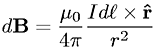
0246.png


Faraday's Law is similar to Ampere's Law.

Is there a "Biot-Savart equivalent" of Faraday's Law?

I imagine it might look something like this: (not taking into account Coulomb's Law)

\frac{d\vec{E}}{dV}=\frac{-\left(\frac{∂\vec{B}}{∂t}\right)×\vec{1_r}}{4\pi r^2}
 
Last edited:
Physics news on Phys.org
Without an equation like the one above, how can we construct the entire E-vector field due to a changing magnetic field?
 
Maxwell's equations include ##∇×B=\mu_0 J## and ##∇×E=-\frac{∂B}{∂t}##

##∇×B=\mu_0 J## cannot adequately describe the Biot-Savart Law, the same with ##∇×E=-\frac{∂B}{∂t}##, which is why I've conceived the above.
 
jedishrfu said:
It seems there's not much response here.
Also have you checked with your profs?
Yeah, but I don't think that this is a boring question.

Prof is asleep. No response.
The wiki doesn't have anything on this.

I thought of this question because of the parallel between E and M and I also want to construct the entire E-vector field due to a changing magnetic field
 
Try finding a prof who isn't asleep maybe an applied mathematics profs or one in EE.
 
Well, if the magnetic field is time dependent then also very likely the electric field is, and then you need (generally) the full Maxwell equations. So the Ampere law should be used as the full Ampere-Maxwell Law,
$$\vec{\nabla} \times \vec{B}-\frac{1}{c} \partial_t \vec{E}=\frac{1}{c} \vec{j}.$$
The Maxwell equations for given charge-current distributions are solved by the retarded propagator (aka Jefimenko equations):

https://en.wikipedia.org/wiki/Jefimenko's_equations
 
  • Like
Likes   Reactions: jedishrfu
vanhees71 said:
The Maxwell equations for given charge-current distributions are solved by the retarded propagator (aka Jefimenko equations):

https://en.wikipedia.org/wiki/Jefimenko's_equations

Ooh, thanks for bringing that to my attention. I had conceived Jefimenko's idea independently, now I know of the equations.

is the formula below (after taking into account Coulomb's Law) consistent with the Jefimenko equations?

\frac{d\vec{E}}{dV}=\frac{-\left(\frac{∂\vec{B}}{∂t}\right)×\vec{1_r}}{4\pi r^2}
 

Similar threads

  • · Replies 21 ·
Replies
21
Views
5K
Replies
8
Views
1K
  • · Replies 4 ·
Replies
4
Views
3K
  • · Replies 1 ·
Replies
1
Views
2K
  • · Replies 3 ·
Replies
3
Views
3K
  • · Replies 4 ·
Replies
4
Views
2K
  • · Replies 4 ·
Replies
4
Views
3K
  • · Replies 7 ·
Replies
7
Views
5K
  • · Replies 2 ·
Replies
2
Views
2K
  • · Replies 26 ·
Replies
26
Views
3K