Discussion Overview
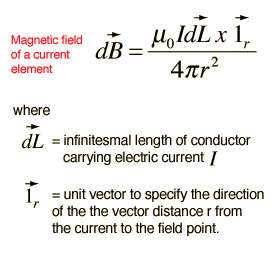
The discussion revolves around the possibility of deriving a "Biot-Savart equivalent" of Faraday's Law, exploring the relationship between the Biot-Savart Law and the Maxwell-Faraday equation. Participants examine theoretical implications, mathematical formulations, and the practicality of such an equivalent in various contexts, including electromagnetic theory.
Discussion Character
- Exploratory
- Technical explanation
- Debate/contested
Main Points Raised
- Some participants propose that a Biot-Savart type solution for the electric field E could be derived from the curl E = -dB/dt, but express concerns about the practicality of such a formulation.
- Others argue that while the Biot-Savart Law can be applied to magnetic fields, isolating a similar form for the electric field may be impractical due to the nature of the integral solutions involved.
- A few participants note that textbooks often overlook the integral form of the Biot-Savart Law as a solution to the curl equations, suggesting that this omission is significant in understanding electromagnetic theory.
- One participant mentions the need for a homogeneous solution when applying the Biot-Savart Law to certain curl equations, indicating that this adds complexity to the discussion.
- Several participants express interest in whether literature exists that addresses the proposed Biot-Savart equivalent of Faraday's Law, indicating a gap in available resources.
- A participant shares their extensive study of electromagnetism and their findings regarding the Biot-Savart integral, suggesting that there may be a lack of awareness or acceptance of these ideas in the physics community.
Areas of Agreement / Disagreement
Participants do not reach a consensus on the existence or practicality of a Biot-Savart equivalent of Faraday's Law. Multiple competing views remain regarding the feasibility and implications of such a formulation.
Contextual Notes
Some limitations include the dependence on specific mathematical formulations and the potential need for additional solutions in certain contexts, such as the inclusion of homogeneous solutions in curl equations.
Who May Find This Useful
This discussion may be of interest to students and professionals in electromagnetism, theoretical physics, and those exploring advanced topics in electromagnetic theory.