SUMMARY
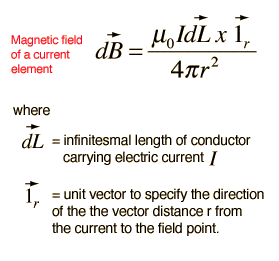
The discussion centers on the exploration of a "Biot-Savart equivalent" for Faraday's Law, highlighting the relationship between Ampere's Law and the Biot-Savart Law. Participants assert that while the Biot-Savart Law can be derived from Maxwell's equations, particularly the curl equations, creating a similar integral solution for the electric field (E) from a changing magnetic field (B) is impractical. The conversation emphasizes the need for a homogeneous solution to fully address the electric field in systems with static charges, as well as the oversight of such integral solutions in many textbooks.
PREREQUISITES
- Understanding of Maxwell's equations, particularly curl E = -dB/dt and curl B = μ₀J.
- Familiarity with the Biot-Savart Law and its application in electromagnetism.
- Knowledge of Stokes' theorem and its relevance in electromagnetic theory.
- Basic concepts of electric and magnetic fields, including the distinction between homogeneous and inhomogeneous solutions.
NEXT STEPS
- Research the application of Stokes' theorem in deriving electromagnetic field equations.
- Study the integral solutions to curl equations in electromagnetism, focusing on the Biot-Savart Law.
- Explore advanced textbooks on electromagnetism that address magnetic surface currents and their implications.
- Investigate the role of displacement current density in Maxwell's equations and its impact on electromagnetic theory.
USEFUL FOR
Physicists, electrical engineers, and students of electromagnetism seeking a deeper understanding of the relationships between electric and magnetic fields, particularly in the context of Maxwell's equations and their applications.