Bivariate normal distribution- converse question

Click For Summary

Discussion Overview

The discussion centers around the bivariate normal distribution, specifically the conditions under which the joint probability density function can be inferred from the marginal distributions and the correlation coefficient. Participants explore the theoretical implications of this relationship and question the validity of certain assumptions.

Discussion Character

  • Exploratory, Technical explanation, Debate/contested

Main Points Raised

  • One participant questions how the joint probability density function can be established from the marginal distributions and the correlation coefficient, suggesting that the converse may not always hold true.
  • Another participant references a Wikipedia article that claims that if the correlation coefficient is zero, the marginal normality does not imply independence, indicating a potential limitation in the assumptions being made.
  • There is mention of a book that uses this technique to prove the independence of certain statistics, prompting a request for clarification on the exact statement of the proof.
  • A participant shares a scanned proof related to the discussion, indicating a desire to provide additional context for the claims made in the book.

Areas of Agreement / Disagreement

Participants express differing views on the implications of marginal normality and correlation, particularly in the case of zero correlation. The discussion remains unresolved regarding the validity of the assumptions and the relationship between the joint and marginal distributions.

Contextual Notes

The discussion highlights limitations in the assumptions regarding independence and correlation, particularly in cases where the correlation coefficient is zero. There is also a dependence on the definitions and interpretations of the bivariate normal distribution.

bobby2k
Messages
126
Reaction score
2
bivariate normal distribution-"converse question"

Hello, I have a theoretical question on how to use the bivariate normal distribution. First I will define what I need, then I will ask my question.

pics from: http://mathworld.wolfram.com/BivariateNormalDistribution.html

We define the bivariate normal distribution, (1):
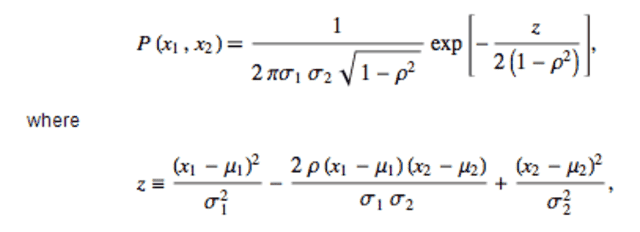
image.png


From this we get the marginal distributions:
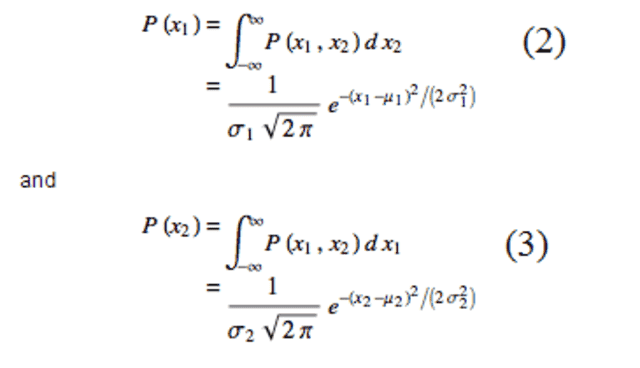
image.png


No comes my question:

Let's say that we have 2 random variables x1 and x2, and we know that each marginal distribution satisfies (2) and(3), that is, we know they are normal, and we know their mean, and variance. Suppose we also know their correlation-coefficient p. How can we now say that equation (1) is the joint probability density function. I mean, we defined it one way, and got the marginals, what is the justification that if we have 2 marginals and their p, we can go back? I mean, it is not allways true that the converse is true, why can we assume the converse here?

They used this technique in my book when proving that \bar{X} and S^{2} are independent.
 
Last edited:
Physics news on Phys.org
http://physicsforums.bernhardtmediall.netdna-cdn.com/images/physicsfor[/b]

bobby2k said:
How can we now say that equation (1) is the joint probability density function.

A Wikipedia article claims we can't say that in the case \rho = 0. http://en.wikipedia.org/wiki/Normally_distributed_and_uncorrelated_does_not_imply_independent.

However, it is possible for two random variables X and Y to be so distributed jointly that each one alone is marginally normally distributed, and they are uncorrelated, but they are not independent;

Perhaps you should give the exact statement of what your book proves.
 
Last edited by a moderator:
Here I have scanned the proof.
http://i.imgur.com/naRsk9s.jpg

The proof starts inside the green line, and the quote I am interested in starts inside the red line. I have however added some information that is before this, so you can see where it all comes from.
 

Similar threads

  • · Replies 2 ·
Replies
2
Views
2K
  • · Replies 32 ·
2
Replies
32
Views
10K
  • · Replies 1 ·
Replies
1
Views
2K
  • · Replies 5 ·
Replies
5
Views
7K
  • · Replies 30 ·
2
Replies
30
Views
5K
  • · Replies 7 ·
Replies
7
Views
2K
  • · Replies 31 ·
2
Replies
31
Views
4K
Replies
5
Views
6K
  • · Replies 3 ·
Replies
3
Views
2K
  • · Replies 2 ·
Replies
2
Views
2K