sc8
- 7
- 0
- Homework Statement
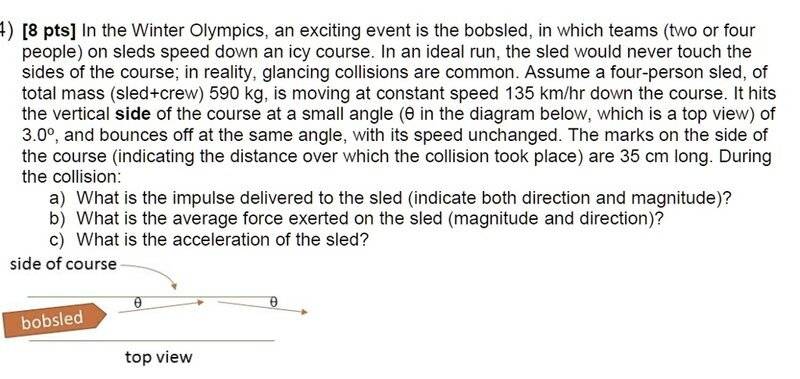
- In the Winter Olympics, an exciting event is the bobsled, in which teams (two or four people) on sleds speed down an icy course In an ideal run; the sled would never touch the sides of the course; in reality, glancing collisions are common. Assume a four-person sled, of total mass (sled+crew) 590 kg; is moving at constant speed 135 km/hr down the course. It hits the vertical side of the course at a small angle (0 in the diagram below, which is a top view) of 3.00, and bounces off at the same angle, with its speed unchanged The marks on the side of the course (indicating the distance over which the collision took place) are 35 cm long: During the collision: a) What is the impulse delivered to the sled (indicate both direction and magnitude)? b) What is the average force exerted on the sled (magnitude and direction)? c) What is the acceleration of the sled? side of course top view bobsled
- Relevant Equations
- delta p=F*t
I attempted to do mvf-mvi to find the impulse, but had trouble figuring out what to use as v (where does the angle of 3degrees come in?), and thought that there had to be more to the problem considering the other details I was given. I then attempted to maybe calculate the kinetic energy lost, but on the exam it said that the collision was ELASTIC so I knew momentum AND kinetic energy had to be conserved.
Because this is elastic, would the momentum in the y direction just be reversed as the sled is moving slightly upwards at one point and down the other?
As for force, I was knew that distance had to come into play to find it, but I did not have time to get to that part before the exam finished. Would greatly appreciate if someone could help me understand how to approach this, thank you!
Because this is elastic, would the momentum in the y direction just be reversed as the sled is moving slightly upwards at one point and down the other?
As for force, I was knew that distance had to come into play to find it, but I did not have time to get to that part before the exam finished. Would greatly appreciate if someone could help me understand how to approach this, thank you!