Bouyancy Question: Two weights on strings, with one weight submerged

Click For Summary
The discussion revolves around a physics problem involving buoyancy and the manipulation of equations related to weights on strings, with one submerged. A participant struggles to express their final solution solely in terms of water density and the tensions T1 and T2. They receive guidance on using variables and the definition of density to simplify their equation. The mentor suggests replacing mg with T1 to achieve the correct answer but also prompts for alternative manipulation methods. The conversation highlights the importance of proper formatting and the use of LaTeX for clarity in presenting mathematical work.
norcal36
Messages
8
Reaction score
0
Homework Statement
You have two scales with a weight suspended from them on a string. Scale one has a tension of T1 and scale two has its mass submerged in water with tension T2. If you have T2<T1, find the density of the weight in terms of only density of the water, T1 and T2.
Relevant Equations
Density = mass/volume
Volume = mass/density
mass = density*volume
Buoyancy = Density of liquid*Volume Displaced*gravity
Hi new to the physics world and the symbiology is hard to understand completely. Attached is the work I've done to a final solution but I can't seem to get the answer in terms of only density of water and T1 and T2. Thank you for any assistance.

[ Mentor Note -- Word file replaced with a screenshot. Please use PDF or JPEG format for posting files. ]
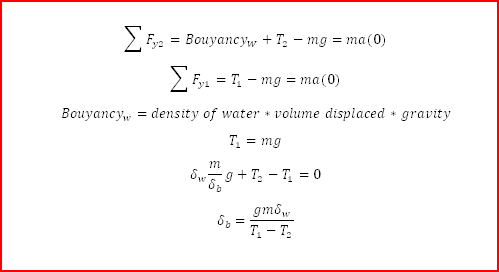
1575213822688.png

 
Last edited by a moderator:
Physics news on Phys.org
Hello norcal, ##\qquad## :welcome: ##\qquad## !

If you can use MS equation, you can use ##LaTeX## too -- makes ist much easier to assist :rolleyes:

I love your word 'symbiology'
-- in this context I propose you create a variable ##V## for the volume of the weight. Definition of density ##\rho## (using a ##\delta## is confusing to others) is ##m = \rho V## . Rings a bell in the algebraic treatment ? [edit] greyed out after a cup of coffee and a decent read of your word doc :smile:

[edit] never mind, you are nearly there already: your last line reads $$\rho_b = {mg\; \rho_w\over T_1-T_2}$$ and to get it in the required form, you need something else for ##mg##. Guess ...
 
Last edited:
  • Like
Likes norcal36
Thank you for that insight. With that I do get the correct answer with replacing the mg with T1. However, is there a way to manipulate the equation without just replacing that mg with T1? Again thank you for the insight!
 
Also I apologize for my inexperience with formatting . I don't know what LaTeX is and only way I could show my work was to use Word Possessor.
 
norcal36 said:
Also I apologize for my inexperience with formatting . I don't know what LaTeX is and only way I could show my work was to use Word Possessor.
Click the link @BvU provided in post #2 for LaTeX.
Or use the pull-downs above the text entry panel:
##\sqrt x## for Greek letters, math symbols..
... for subscripts and superscripts.
 
  • Like
Likes norcal36
Thanks!
 
The book claims the answer is that all the magnitudes are the same because "the gravitational force on the penguin is the same". I'm having trouble understanding this. I thought the buoyant force was equal to the weight of the fluid displaced. Weight depends on mass which depends on density. Therefore, due to the differing densities the buoyant force will be different in each case? Is this incorrect?

Similar threads

  • · Replies 75 ·
3
Replies
75
Views
7K
  • · Replies 7 ·
Replies
7
Views
3K
  • · Replies 152 ·
6
Replies
152
Views
10K
  • · Replies 3 ·
Replies
3
Views
3K
  • · Replies 2 ·
Replies
2
Views
2K
  • · Replies 19 ·
Replies
19
Views
8K
Replies
17
Views
5K
  • Sticky
  • · Replies 0 ·
Replies
0
Views
11K
  • · Replies 54 ·
2
Replies
54
Views
7K
  • · Replies 33 ·
2
Replies
33
Views
7K
