Boyle's Law [mmHg]: Solving Atmospheric Pressure with a Mercury Barometer

  • Thread starter Thread starter Magma828
  • Start date Start date
  • Tags Tags
    Boyle's law Law
Click For Summary
SUMMARY

The discussion centers on using Boyle's Law to solve for atmospheric pressure using a mercury barometer. A mercury column height of 760 mm corresponds to an atmospheric pressure of 1.0x10⁵ Pa. The experiment involves a capillary tube where the trapped air column changes from 82 mm to 78 mm when the tube orientation changes from horizontal to vertical. By applying Boyle's Law (p1V1 = p2V2), participants conclude that the pressure on the trapped air increases due to the additional weight of the mercury in the vertical position, leading to a calculated pressure increase of approximately 1.05 atmospheres.

PREREQUISITES
  • Understanding of Boyle's Law and its mathematical representation.
  • Familiarity with basic principles of pressure (force/area).
  • Knowledge of the properties of mercury and its use in barometers.
  • Basic skills in algebra for solving equations related to pressure and volume.
NEXT STEPS
  • Study the derivation and applications of Boyle's Law in gas behavior.
  • Learn about the construction and functioning of mercury barometers.
  • Explore the relationship between pressure, volume, and temperature in gases using the Ideal Gas Law.
  • Investigate safety regulations and modern alternatives to mercury in educational experiments.
USEFUL FOR

Students in physics or chemistry, educators teaching gas laws, and anyone interested in experimental physics and atmospheric pressure measurement.

Magma828
Messages
28
Reaction score
0
A simple mercury barometer consists of a vertical glass tube sealed at its upper end containing a column of mercury. The space between the top of the mercury column and the upper end of the tube is a vacuum. A mercury column height of 760 mm is equivalent to atmospheric pressure 1.0x10⁵ Pa.

A school experiment to find atmospheric pressure befotre the days of modern health legislation was as follows. A length of air was trapped in a capillary tube sealed at one end by a thread of mercury. When the tube was held horizontally, the length of the trapped air column was 82 mm and the length of the thread of mercury was 39 mm.

When the tube was held vertically with the open end upwards, the air column was squashed to 78 mm.
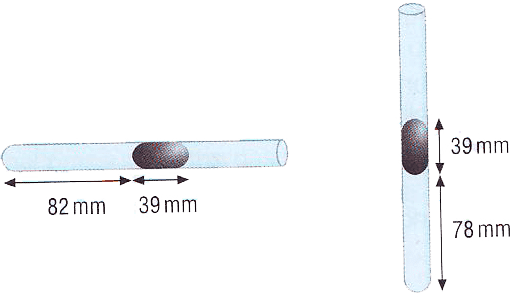
111s386.png


Find the value of atmospheric pressure in mm of mercury (mmHg).


We're given this statement (Boyle's Law):
The volume of a fixed mass of gas is inversely proportional to the pressure exerted on it, provided the temperature is kept constant.

I imagine this constructs an equation like this: p1V1 = p2V2

I can't really relate this to the question though, it's probably something really simple I'm missing.
 
Physics news on Phys.org
What is the pressure on the air (in the sealed part of the tube) in the two cases?
 
mgb_phys said:
What is the pressure on the air (in the sealed part of the tube) in the two cases?

That's all the information it gives, sorry.

There are a few rogue questions in our textbook because they are published so quickly for the changing syllabus, so it appears it hasn't been very well checked. Maybe this is another one of those questions, where they didn't give needed information?
 
No they give you all the information you need - it's a very simple and elegant experiment.
i was asking you to think about pressure = force / area, what's the difference in the force and hence the pressure on the trapped air in the two cases/
 
This is a really cool question. I was stumped for a few minutes before I started thinking about what additional effects are present when the capillary tube is vertical that were not there before. Do you remember in which direction pressure acts?
 
it's a very neat experiment. it's a pity you can't do it anymore because if you allowed a few grams of mercury into schools billions would instantly be killed.
 
mgb_phys said:
No they give you all the information you need - it's a very simple and elegant experiment.
i was asking you to think about pressure = force / area, what's the difference in the force and hence the pressure on the trapped air in the two cases/

Well the area and force will be the same in both, won't they? It doesn't actually give the surface area of the tube, and the force provided by the weight of the mercury is anyone's guess.

I'm not having difficulty understanding how the experiment works, I just don't know how to quantize everything.
 
In the horizontal case the mercury is being pushed toward the sealed end of the tube by the outside atmosphere and the air is pushing back with an equal force. So the air trapped in the tube is under one atmosphere of pressure.

In the second case the mercury is pushing down with one atmosphere of pressure PLUS the weight of the blob of mercury.
So the air in the tube is under 1 atmosphere + X of pressure.
From boyles law we know that if the volume has dereased by 78/82 then the pressure must have gone up by 82/78 = 1.05.

if you work out the weight of the mercury you know this is (82/78-1) of an atmosphere you can work out what an atmosphere of pressure is.

hint; since we are talking about pressure (force/area) the width of the tube doesn't matter - can you see why?

hint2: the drawing is a little bad - you aren't expected to take into account the curved ends of the mercury bead.
 

Similar threads

  • · Replies 6 ·
Replies
6
Views
978
  • · Replies 1 ·
Replies
1
Views
2K
  • · Replies 7 ·
Replies
7
Views
2K
  • · Replies 1 ·
Replies
1
Views
2K
Replies
1
Views
3K
Replies
10
Views
2K
  • · Replies 10 ·
Replies
10
Views
5K
Replies
3
Views
3K
  • · Replies 10 ·
Replies
10
Views
7K
Replies
2
Views
2K