Brushing up on calc to prepare for QM

  • Thread starter robertjford80
  • Start date
  • Tags Tags
    Prepare Qm
7 replies · 3K views · last reply
robertjford80
Messages
388
Reaction score
0
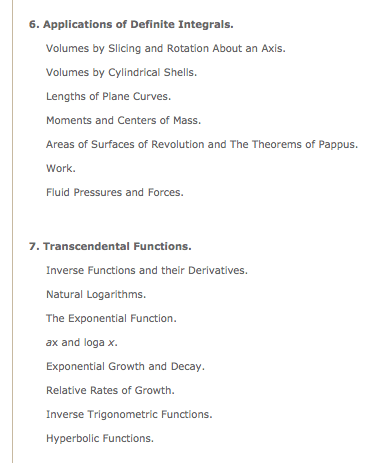
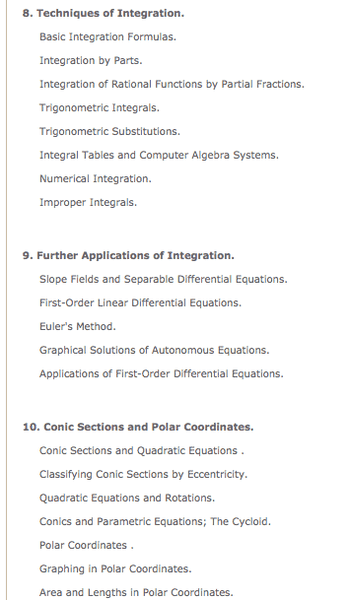
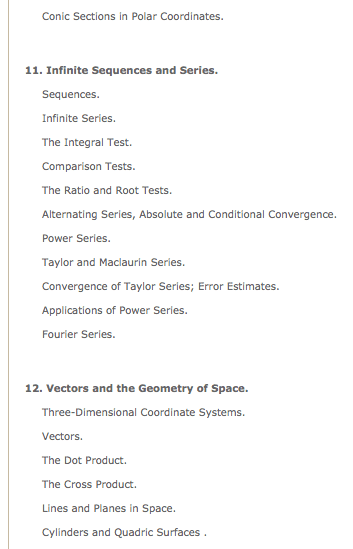
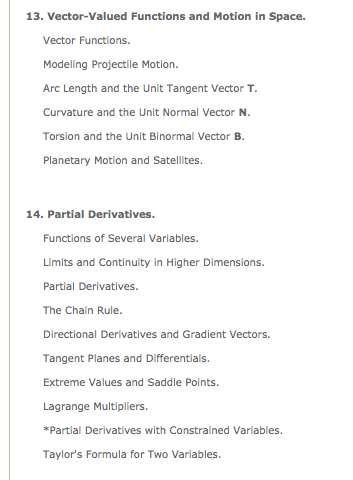
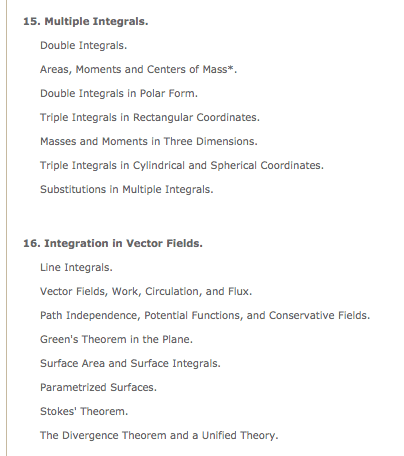
I make way too many mistakes in calc so I'm going to go back and brush up so as to prepare for the exciting moment when I finally start studying QM. I'm using the Thomas text on calc, it's contents are listed below. What sections do you think I should really master. Plus David Griffiths' book uses Legendre, Hermite and Laguerre polynomials, spherical harmonics, Bessel, Neumann and Hankel functions, Airy functions and even the Riemann zeta function, plus Fourier transforms, Hilbert spaces, hermitian operators, Clebsch-Gordan coefficients and Lagrange multipliers, so you don't need to recommend studying those.
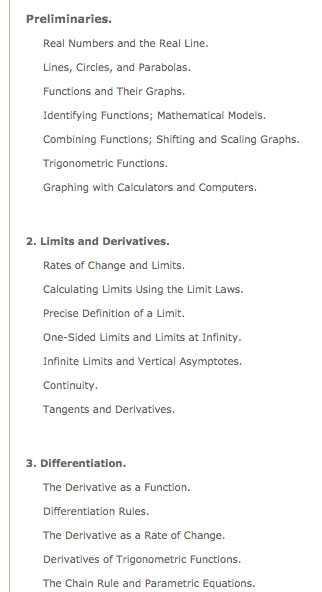
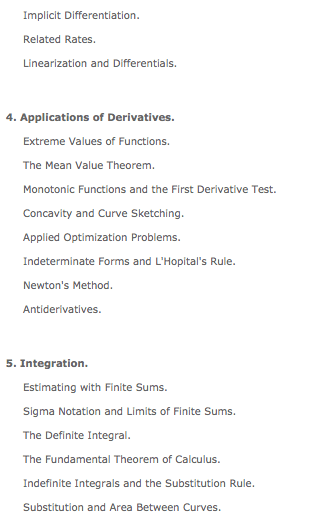
Table of contents listing chapters and sections of a calculus textbook, starting with Preliminaries, then 2. Limits and Derivatives, then 3. Differentiation.


Table of contents from a calculus textbook listing chapter sections: Implicit Differentiation, Related Rates, Linearization and Differentials; Applications of Derivatives; Integration, with subsections through Substitution and Area Between Curves.


Table of contents list from a calculus textbook: section 6 Applications of Definite Integrals (volumes, plane curves, moments, surfaces of revolution, work, fluid forces) and section 7 Transcendental Functions (inverse functions, logarithms, exponential, ax and log a x, growth and decay, inverse trig, hyperbolic functions).


Table of contents from a calculus textbook, chapters 8 to 10: Techniques of Integration, Further Applications of Integration, and Conic Sections and Polar Coordinates, with their section titles listed beneath each.


Table of contents list from a calculus textbook, including Infinite Sequences and Series (Sequences, Infinite Series, Taylor and Maclaurin Series, Fourier Series) and Vectors and the Geometry of Space (Dot Product, Cross Product, Lines and Planes in Space).


Table of contents listing chapters 13 and 14 of a calculus text: Vector-Valued Functions and Motion in Space, and Partial Derivatives, with their section titles.


Table of contents excerpt listing chapter 15 Multiple Integrals and chapter 16 Integration in Vector Fields with their section titles.
 
I just finished my first quantum mechanics course and really you should be comfortable with all of these topics. More than anything we used math from linear algebra and PDE's so calculus is just one area of math that you should study to prepare for quantum mechanics.
 
Uuuugh, stay away from Griffiths buddy, for your own good

Pick yourself up a copy of M Boas' Mathematical Methods in the Physical Sciences and read up on whatever you need to know when you encounter it.

I'd also recommend the first third of Landau and Lifgarbagez book on non relitivistic QM as an intro to QM over Griffiths' book.
 
genericusrnme said:
[...]

Pick yourself up a copy of M Boas' Mathematical Methods in the Physical Sciences and read up on whatever you need to know when you encounter it.
[...]

To me Arfken and Weber's book is a valid alternative, too.
 
as for Griffith's book, yea, I looked at it and it looked extremely poor on explanations which is what I hate more than anything. I'm just going to use that book in case I can't find a problem explained elsewhere, or maybe that will be the last book I read before I move on to QFT. As for Arken, that book gets really bad reviews on Amazon.com. I think the solution manual has no answers. I hate books without answers. There's no point in doing exercise if you can't find out if you've done it right.
 
robertjford80 said:
as for Griffith's book, yea, I looked at it and it looked extremely poor on explanations which is what I hate more than anything. I'm just going to use that book in case I can't find a problem explained elsewhere, or maybe that will be the last book I read before I move on to QFT. As for Arken, that book gets really bad reviews on Amazon.com. I think the solution manual has no answers. I hate books without answers. There's no point in doing exercise if you can't find out if you've done it right.

You could try Schaum's Outline of Advanced Mathematics for Engineers and Scientists by Spiegel or Advanced Engineering Mathematics by Kreizig; both have the same maths as Boas but they are both far more organized and less wordy so they get straight to the point. The schaum's is chock full of fully solved problems and examples; Kreizig is too and I believe it has a separate solution manual.
 
If your goal is calculus for physics then make sure you have developed your geometric/physical intuition for calculus. What does the derivative mean physically (usually)? The integral? What's the logic behind the derivative tests?

Otherwise - outside of knowing how to take derivatives and integrals - specifically review integration by parts, polar and spherical coordinates, and complex numbers.
 
Jorriss said:
If your goal is calculus for physics then make sure you have developed your geometric/physical intuition for calculus. What does the derivative mean physically (usually)? The integral? What's the logic behind the derivative tests?
That's the hardest part, but I'm working on that.