Buoyancy and Archimedes's Principle Based Question

  • Thread starter Thread starter shinnsohai
  • Start date Start date
  • Tags Tags
    Buoyancy Principle
Click For Summary

Discussion Overview

The discussion revolves around a physics homework problem involving buoyancy and Archimedes's principle, specifically calculating the force required to hold a submerged cylinder bucket at a certain depth in water. The problem includes considerations of pressure, volume, and the behavior of trapped air as the bucket is submerged.

Discussion Character

  • Homework-related
  • Mathematical reasoning
  • Technical explanation
  • Debate/contested

Main Points Raised

  • One participant expresses uncertainty about their initial calculations and seeks guidance on how to approach the problem.
  • Another participant suggests using the equation P1V1=P2V2 to relate the pressure and volume of the trapped air, indicating that this will lead to a quadratic equation for the height of the air in the bucket.
  • A later reply emphasizes the importance of using absolute pressures in the equations and corrects a previous depth measurement, suggesting that the depth to the water-air interface should be 3.5 + h.
  • One participant mentions a potential solution involving a trapped air height of 0.25m and seeks further assistance on how to calculate the force required.
  • Multiple participants provide additional equations and methods for determining the force using Archimedes's principle and the relationship between pressure and volume.
  • There is a question raised about the application of Boyle's Law in the context of the problem, indicating some confusion about the concepts involved.
  • One participant expresses surprise at a specific calculation related to the height of the trapped air, indicating a potential misunderstanding of the problem setup.

Areas of Agreement / Disagreement

Participants do not reach a consensus on the correct approach or solution to the problem, with various interpretations and methods proposed. There is ongoing uncertainty and discussion about the calculations and principles involved.

Contextual Notes

Participants mention the need for absolute pressure in calculations and the importance of correctly setting up the equations. There are unresolved mathematical steps and assumptions regarding the behavior of the trapped air and the application of physical principles.

Who May Find This Useful

This discussion may be useful for students studying buoyancy, pressure, and gas laws, particularly in the context of homework problems involving fluid mechanics and thermodynamics.

shinnsohai
Messages
41
Reaction score
0
I've this to be handed in by tomorrow
Please give some guidelines...

I think that my working is completely wrong !

Homework Statement


An empty cylinder bucket, 30cm in diameter and 50cm long, whose wall thickness and weight can be considered negligible is forced, open end first, into water until its lower edge is 4m below the surface as shown in the picture. Calculate the force F which is required to hold t he bucket in this position assuming the trapped air will remain at constant temperature during the entire operation.
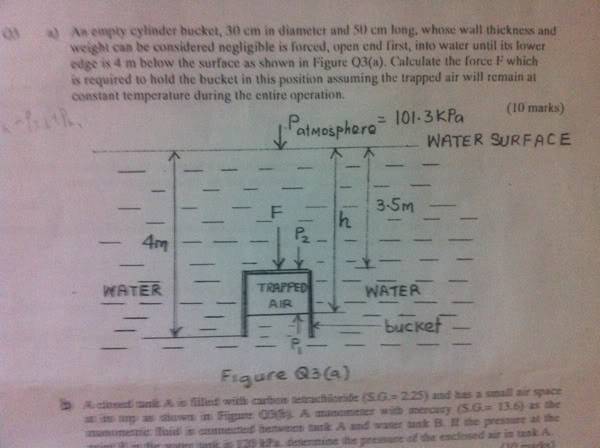
image3-1.jpg

Homework Equations


P=ρ x G x H

The Attempt at a Solution


P1V1=P2V2
(4-h)ρg(∏(0.15^2))(4-h) = 3.5ρg (∏ (0.15^2))(h-3.5)
(4-h)^2(0.0707)= 3.5(0.0707)(h-3.5)
(16-8h+h^2)(0.0707)= 0.24745h-0.866075
0.0707h^2-0.565h+1.1312= 0.24745h-0.866075
0.0707h^2-0.81305h+1.997275= 0
(3.5ρg+101.3k)∏(0.15^2)(h-3.5)
(4-H)^2ρg(∏(0.15^2))= 3.5ρg(∏0.15^2)(h-3.5)

0.5=h-3.5+4-h
h-3.5=0.5
h=3.5/0.5
h=7
 
Last edited:
Physics news on Phys.org
To solve this problem you will need to determine the volume of the trapped air in the pail. You have the equation P1*V1=P2*V2 so you can relate the final volume to the intial volume for the air in the pail. In turn, this can be related to depth at the water-air interface inside the pail (depth times density being pressure, P2). Doing this will result in a quadratic equation for the height (h) of the cylinder of air in the pail if you represent the total depth as 3.5+h. Knowing the height of the air, you can easily determine the volume of air. From that you determine, via Archimedes Principle, the force necessary to hold the can under water at the specified depth.
 
Last edited:
Thanks Lawrence for replying
At Least A Hope !
Gonna Re-Solve This!
 
When you set up your equation relating pressure and volume, pressures must be absolute. Also notice the slight change I made in my previous post. The 4 meters should have been 3.5 meters making the interface depth 3.5+h.
 
Erms Lawrance..
I Think that I do mistake all the time , but hoping no this time :D

DSC01654.jpg

DSC01653.jpg


Maybe the 2nd photo having the correct ans
Where small h=3.75
Therefore Trapped Air Height is 0.25m

what's the next step to find force(Brain Stuck!)
It's so tiring ~~
2am~
i shall continue tomorrow , hoping you could give me the answer ASAP

Thx for helping anyway!
 
Here is some more help:

P1V1=P2V2 where P2 is trapped air pressure and V2 is volume of trapped air.

Let d = depth to top of can (3.5 m)
h2= depth of compressed air in top of can
Pa= atmospheric pressure

So P2=rho(d+h2)+Pa

V2=Ah2=P1V1/P2=P1V1/(rho(d+h2)+Pa)
A=area of can cross section
Solve above quadraticfor h2. It is written as
Ah2=P1V1/(rho(d+h2)+Pa)
and should be put in standard quadratic form so you can use formula.

Knowing h2 you can get the force from Archimedes Principle or by evaluating pressure at air-water interface and multiplying it by the area followed by subtracting the pressure force pushing down on the top of the pail. The difference is the force needed.

If you work out the equations in symbols it is less messy and therefore less error prone. Plug in the numbers at the end. Make sure your units agree.
 
LawrenceC said:
Here is some more help:

P1V1=P2V2 where P2 is trapped air pressure and V2 is volume of trapped air.

Let d = depth to top of can (3.5 m)
h2= depth of compressed air in top of can
Pa= atmospheric pressure

So P2=rho(d+h2)+Pa

V2=Ah2=P1V1/P2=P1V1/(rho(d+h2)+Pa)
A=area of can cross section
Solve above quadraticfor h2. It is written as
Ah2=P1V1/(rho(d+h2)+Pa)
and should be put in standard quadratic form so you can use formula.

Knowing h2 you can get the force from Archimedes Principle or by evaluating pressure at air-water interface and multiplying it by the area followed by subtracting the pressure force pushing down on the top of the pail. The difference is the force needed.

If you work out the equations in symbols it is less messy and therefore less error prone. Plug in the numbers at the end. Make sure your units agree.

may I know why are you using Boyle's Law ..? I don't get the concept ..


*I was quite in shocked when I looked at this ..
0.5=h-3.5+4-h
h-3.5=0.5
h=3.5/0.5
h=7
 
PV^n=constant

For an isothermal process, n=1
For an isentropic process, n=k
etc...
 

Similar threads

  • · Replies 5 ·
Replies
5
Views
2K
  • · Replies 4 ·
Replies
4
Views
3K
  • · Replies 14 ·
Replies
14
Views
3K
  • · Replies 6 ·
Replies
6
Views
3K
  • · Replies 39 ·
2
Replies
39
Views
5K
  • · Replies 3 ·
Replies
3
Views
3K
  • · Replies 1 ·
Replies
1
Views
5K
  • · Replies 3 ·
Replies
3
Views
2K
  • · Replies 1 ·
Replies
1
Views
4K
  • · Replies 7 ·
Replies
7
Views
3K