C as Energy Conversion Constant: Conservation Law Explained

Click For Summary

Discussion Overview

The discussion revolves around the law of conservation of energy, particularly in the context of the universe as a whole and the implications of the speed of light (C) as a conversion constant in energy transformations. Participants explore the relationship between energy, matter, and the constraints of general relativity, examining both theoretical and conceptual aspects of energy conservation.

Discussion Character

  • Exploratory
  • Debate/contested
  • Conceptual clarification

Main Points Raised

  • One participant suggests that the conservation of energy implies a fixed amount of energy in the universe, which transforms rather than being created or destroyed.
  • Another participant counters that conservation of energy does not apply globally in general relativity, indicating that the speed of light (C) serves as a universal speed limit rather than merely a conversion ratio.
  • A different viewpoint emphasizes that while energy is conserved locally, defining the total energy of the universe is ambiguous, thus complicating the application of conservation laws on a universal scale.
  • There is a clarification regarding the equation E = mc², where one participant notes that mass (m) represents mass and not matter, and that the equation refers to rest energy rather than total energy.

Areas of Agreement / Disagreement

Participants express differing views on the applicability of energy conservation to the universe as a whole, with some arguing for a fixed amount of energy and others highlighting the complexities introduced by general relativity. The discussion remains unresolved with multiple competing perspectives.

Contextual Notes

Participants note limitations in defining total energy in the universe and the implications of local versus global conservation laws, which are not fully resolved in the discussion.

xcom2112
Messages
2
Reaction score
0
I was thinking about the law of conservation of energy, states that energy can neither be created nor destroyed.

Then I thought about it more broadly, it actually states that the universe was created with a fixed amount of energy (and this energy only transforms from one form to another)

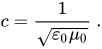
And then I thought a little more, in the big bang the universe was formed from energy, part of that energy became matter, according to the famous equation E = mc2

or Electromagnetic waves
f83cb831ce59c5745ee4e7af60b4f68710405b6b


so C is not the speed of electromagnetic waves (in a vacuum) or anything like that, it is simply the ratio in which energy becomes something else.

And if the energy in the universe is constant (as I assumed at the beginning), which for me is the only axiom, then if the waves will move faster than C , the energy conservation law will simply be violated.

Maybe someone already put it this way? (I've never seen, at least not at university, a way of looking at things like that)
 
Physics news on Phys.org
Conservation of energy does not apply to the universe as a whole - there is no global energy conservation in general relativity.
xcom2112 said:
so C is not the speed of electromagnetic waves (in a vacuum) or anything like that, it is simply the ratio in which energy becomes something else.
It is related to both. But more fundamentally, it is the universal speed limit.
xcom2112 said:
then if the waves will move faster than C , the energy conservation law will simply be violated.
That doesn't make sense.
 
xcom2112 said:
And if the energy in the universe is constant (as I assumed at the beginning), which for me is the only axiom
That's a natural assumption, but it turns out not to be correct. It's not so much that energy isn't conserved (it is - see below) but that there is no unambiguous way of defining "the total amount of energy in the universe" so nothing we can point to and say "this quantity is conserved".

We can reword the law of conservation of energy to be more precise: Imagine an arbitrarily small box. At some moment it contains a certain amount of energy, and a moment later it contains a different amount. The difference between the two will be exactly equal to the amount of energy that left or entered the box. In this form the law of conservation of energy works just fine, but it is also clear that it cannot be extended to cover the entire universe. For a bit more detail, you might be interested in http://math.ucr.edu/home/baez/physics/Relativity/GR/energy_gr.html
 
xcom2112 said:
part of that energy became matter, according to the famous equation E = mc2

The ##m## in the expression ##mc^2## represents mass, not matter. The Einstein mass-energy equivalence teaches us that mass is not a measure of the quantity of matter because the mass of a composite body is made up in at least part by the energies of the constituents.

And ##mc^2## is not equal to the total energy of a body. It's equal to the rest energy.
 
  • Like
Likes   Reactions: Imager and SiennaTheGr8

Similar threads

  • · Replies 11 ·
Replies
11
Views
2K
  • · Replies 17 ·
Replies
17
Views
3K
  • · Replies 7 ·
Replies
7
Views
2K
  • · Replies 3 ·
Replies
3
Views
2K
  • · Replies 21 ·
Replies
21
Views
3K
  • · Replies 21 ·
Replies
21
Views
3K
  • · Replies 71 ·
3
Replies
71
Views
11K
  • · Replies 1 ·
Replies
1
Views
3K
  • · Replies 18 ·
Replies
18
Views
4K
  • · Replies 4 ·
Replies
4
Views
2K