Calculate ##P(C|A')## in the given probability problem

  • Thread starter Thread starter chwala
  • Start date Start date
  • Tags Tags
    Probability
Join the discussion
Registration is free. Ask a follow-up in this thread, or start your own.
2 replies · 1K views · last reply
chwala
Gold Member
Messages
2,854
Reaction score
436
Homework Statement
See attached ( textbook question).
Relevant Equations
Understanding of conditional probability
Printed textbook problem: part (b) asks to calculate P(C | A'), where A' is the event that A does not occur, labelled (OCR, adapted). Preceding text gives P(A)=0.3, B independent of A, P(B)=0.4.
My interest is on part ##b## only. We know that ##A## and ##B## are independent and not mutually exclusive events therefore,

##P(C)=0.7×0.6=0.42##

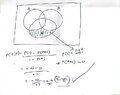
##P(C|A')=\dfrac{P(C)-P(A∩C)}{P(A')}=\dfrac{0.42-(0.3×0.42)}{0.7}=\dfrac{0.294}{0.7}=0.42## which is wrong according to textbook solution.

Where is my mistake? cheers.
 
Attachments

  • Printed exam question part (b): Calculate P(C | A'), where A' is the event that A does not occur. Above it, P(A) = 0.3 and P(B) = 0.4 are given in part 2 of the question (OCR, adapted).
    1677584634429.png
    18.5 KB · Views: 169
Last edited by a moderator:
Physics news on Phys.org
@scottdave wawawawawawa this was a nice one man! Phew. Seen it...
 
Attachments
  • Handwritten Venn diagram of three overlapping circles labeled A, B and C inside a rectangle, with region C shaded; beneath it, the derivation P(C|A') = (P(C) - P(A and C)) / (1 - P(A)), giving 0.62 - 0 over 0.7 = 0.6, marked Bingo with a checkmark.
    CamScanner 03-01-2023 13.18.jpg
    33.4 KB · Views: 173