fabiancillo
- 27
- 1
Thread moved from the technical forums to the schoolwork forums
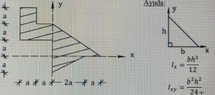
The discussion revolves around calculating the moment of inertia for a painted area with respect to the x and y axes, as well as determining the principal inertias. The subject area pertains to mechanics and specifically the properties of shapes in relation to their mass distribution.
The conversation includes attempts to clarify the approach to calculating the inertias, with some participants expressing confusion and seeking guidance. There is no explicit consensus yet, but hints and suggestions for breaking down the problem have been provided.
Participants mention the need for additional equations for rectangles and the potential requirement to decompose shapes into triangles for calculation purposes. There is an indication of being blocked in the problem-solving process.