Calculate Reactant Concentration from Chemical Equilibrium Moles

Click For Summary

Discussion Overview

The discussion revolves around calculating reactant concentration from chemical equilibrium moles, specifically addressing the validity of a calculated concentration of 8000 M and the implications of equilibrium constants in the context of a chemical reaction. The scope includes theoretical considerations and practical applications in chemistry.

Discussion Character

  • Debate/contested
  • Technical explanation
  • Conceptual clarification

Main Points Raised

  • One participant questions the validity of an 8000 M concentration, suggesting it is illogical and sounds ridiculous.
  • Another participant confirms that their calculations yield a specific value when substituted back into the equilibrium expression, though they express uncertainty about the reasonableness of the result.
  • Concerns are raised about the lack of units for the equilibrium constant, with suggestions that it should have specific dimensions based on the reaction.
  • Some participants argue that under certain conditions, such as high pressure, an 8000 M concentration might not be unreasonable, indicating that the problem lacks sufficient information about the reaction process.
  • There is a discussion about the dimensionality of equilibrium constants, with one participant asserting that in general chemistry, these constants are treated as dimensionless, while another recalls the use of physical units in biochemistry.
  • One participant proposes an alternative calculation approach that yields a different concentration value, which they argue is still high for practical applications.
  • Participants express uncertainty about the accuracy of the numbers involved and suggest potential transcription errors in the problem setup.

Areas of Agreement / Disagreement

Participants do not reach a consensus on the validity of the calculated concentration or the appropriate treatment of equilibrium constants. Multiple competing views remain regarding the interpretation of the problem and the implications of the results.

Contextual Notes

There are limitations regarding the assumptions made about the reaction conditions, the definitions of equilibrium constants, and the potential for transcription errors in the problem statement.

ohms law
Messages
70
Reaction score
0
If someone could check my work on this, I'd appreciate it:
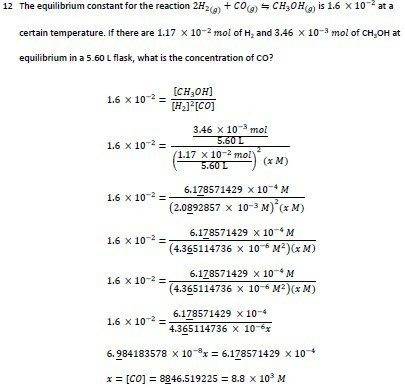
ScreenHunter_04 Oct. 18 13.36.jpg


Thanks!
 
Physics news on Phys.org
Number fits the data given, but is an insult to the logic - 8000M concentration doesn't make sense.
 
That's what made me question the answer myself. 8000 mol/L sounds ridiculous.
I quadruple checked the work though, and put the 8.8x10^3 value back into the original equilibrium expression, and it does come out to 1.60773043 × 10^(-2) (2 s.f. in that, as well), so I guess that it's correct. *shrug*
 
Well at least congratulations on realizing the answer was ridiculous, a criterion and useful habit not every student realizes and puts to use.

The reciprocal of 8,000 is, I don't know if right, but not so ridiculous.

The other thing that you needed to recognize was that you have quoted (or misquoted) an equilibrium constant without any units. But an equilibrium constant for that reaction should have units like M2 or M-2 and if you are given that - I very much doubt you weren't - it is informative about which way up you should be writing your equation. ;)
 
@epenguin, it's an equilibrium constant (K), not a rate constant (k).
:)

One thing about this reaction that someone at school mentioned was that in real life it takes place in a pressurized system, so 8000 Molarity CO isn't that ridiculous if we're talking about a system at 100 atmospheres. Supposedly they use catalysts as well (which, I know, shouldn't actually affect concentrations, but I bring it up just to drive home the point that this problem isn't providing all of the information about the reaction process).
 
Check what would be the density of 8000 M CO. Compare that to the density of osmium.
 
ohms law said:
@epenguin, it's an equilibrium constant (K), not a rate constant (k).
:)

Think again about that though. If I had thought it was a rate constant I would have been looking for time as well as possibly molarity in the dimensions, e.g sec-1 or M-1sec-1 etc.

Only if you have the same number of molecules on both sides of the reaction as in A ⇔ B,
or A + B ⇔ C + D , which is common but not your case, is the molar dimension of an equilibrium constant zero, you could call it dimensionless.

So that constant should not have been given you without dimensions. Can you trace to where you got it from? If not does the constant upside-down give results that are reasonable by any way you can check?
 
Gen chem, so all equilibrium constants are dimensionless. Period.
You're talking about stuff in physical chem. I have enough on my plate without adding unnecessary complexity, thanks.
:)

Here's a more complete explanation, though:
ScreenHunter_12 Oct. 29 13.46.jpg


Besides, this problem was about finding the concentration of one of the reactants. The units work out to Molarity^1, which makes perfect sense, so... what's the problem?

To Borek: ok, fine. This is an actual reaction that is used in industry every day, so how about you tell us all what the "real" concentration is supposed to be?
 
Last edited:
ohms law said:
Gen chem, so all equilibrium constants are dimensionless. Period.
You're talking about stuff in physical chem. I have enough on my plate without adding unnecessary complexity, thanks.
:)

Here's a more complete explanation, though:
View attachment 52439

Besides, this problem was about finding the concentration of one of the reactants. The units work out to Molarity^1, which makes perfect sense, so... what's the problem?

I could not come back earlier, for one thing I could not see your inserts on my device.

Maybe I am out of date then but I remember we always used physical units for equilibrium constants in biochemistry and biophysics as far as I remember. We seem to be finding that a disadvantage of the convention you quote is that we cannot do or check the calculation so I wouldn't agree it has simplified life. Unfortunately I could not find this equilibrium constant in a Wiki search.

You are following the implicit convention of your quoted text K = (product of concs. on right)/(product concs. on left) , then I get the same as your calculation
[CO] = 141.54/K which gives result agreeing with your absurd one.

I wondered if the convention were otherwise and K = 1/1.6*10-2. Then I get a more reasonable sounding 2.26M for the CO.

But still that is about 50 atm. In a flask?. The other concentrations are small fractions of atmospheric. Quite far from a reasonable concentration for an industrial operation and even a laboratory experiment.

All the numbers sound rather screwy, I wonder if anything has been mistranscribed at any stage. Unless your papers are marked by computers you get credit for showing you know when an answer is somehow wrong. I hope you will come back and tell us more if this is class work that is marked or discussed.

Edit: corrected a key typo :smile:
 
Last edited:

Similar threads

  • · Replies 7 ·
Replies
7
Views
3K
  • · Replies 2 ·
Replies
2
Views
2K
  • · Replies 5 ·
Replies
5
Views
5K
  • · Replies 1 ·
Replies
1
Views
3K
  • · Replies 11 ·
Replies
11
Views
5K
  • · Replies 2 ·
Replies
2
Views
2K
  • · Replies 1 ·
Replies
1
Views
2K
  • · Replies 4 ·
Replies
4
Views
2K
  • · Replies 1 ·
Replies
1
Views
2K