Calculate Rotational Energy of Ship's Anchor: 5000 N Weight

Click For Summary

Homework Help Overview

The problem involves calculating the rotational energy of a ship's anchor that weighs 5000 N, which is connected to a hollow cylindrical drum. The anchor drops a distance of 16 m, and the discussion centers around the energy considerations related to the drum's rotation rate when the anchor hits the water.

Discussion Character

  • Exploratory, Conceptual clarification, Mathematical reasoning

Approaches and Questions Raised

  • Participants are examining the relationship between the linear velocity of the anchor and the angular velocity of the drum. Questions arise regarding the assumptions made about the radius and angular velocity being the same for both the anchor and the cylinder, especially considering the anchor is not in direct contact with the drum as it falls.

Discussion Status

There is an ongoing exploration of the concepts of angular velocity and tangential speed. Some participants suggest that the linear speed of the anchor must equal the tangential speed of the cylinder, while others express confusion about the changing radius and angular velocity as the anchor falls. The discussion is productive, with participants seeking deeper understanding and clarification of the relationships involved.

Contextual Notes

Participants are navigating assumptions about the system, including the neglect of the cable's mass and the implications of the drum being mounted on a frictionless axle. There is a focus on the definitions of velocity and angular velocity in the context of the problem.

MathewsMD
Messages
430
Reaction score
7
60. A ship’s anchor weighs 5000 N. Its cable passes over a roller of negligible mass and is wound around a hollow cylindrical drum of mass 380 kg and radius 1.1 m, mounted on a frictionless axle. The anchor is released and drops 16 m to the water. Use energy considerations to determine the drum’s rotation rate when the an- chor hits the water. Neglect the cable’s mass.

Solution:
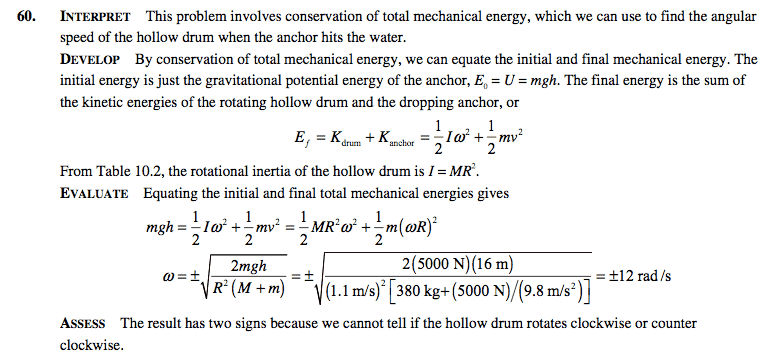
MtvmS2Q.png


Under "Evaluate" they say the kinetic energy of the anchor is 1/2m(ωR)2 but why do we assume R to be the radius of the cylinder and why do we consider the angular velocity of both the cylinder and anchor to be the same? Why can't the angular velocities be different? I may be visualizing it incorrectly, but I am slightly confused on why we assume R and ω to be the same for both the anchor and cylinder when they are not even in contact anymore.
 
Physics news on Phys.org
Hi MathewsMD! :smile:
MathewsMD said:
60. A ship’s anchor weighs 5000 N. Its cable passes over a roller of negligible mass and is wound around a hollow cylindrical drum of mass 380 kg and radius 1.1 m, mounted on a frictionless axle. The anchor is released and drops 16 m to the water.

Under "Evaluate" they say the kinetic energy of the anchor is 1/2m(ωR)2 but why do we assume R to be the radius of the cylinder and why do we consider the angular velocity of both the cylinder and anchor to be the same?

no, they aren't interested in the angular velocity of the anchor, only its actual velocity, v …

if you think about it, v must equal ωr whatever the angle that the cable makes! :wink:
 
tiny-tim said:
Hi MathewsMD! :smile:


no, they aren't interested in the angular velocity of the anchor, only its actual velocity, v …

if you think about it, v must equal ωr whatever the angle that the cable makes! :wink:

Hmmm...Well r would be different, wouldn't it? I can kind of understand how ω would be the same, but wouldn't it change as it is falling? If anyone could provide a more in-depth explanation that would be great!
 
The tangential speed of the rotating cylinder is ωr, where ω is the angular velocity of the cylinder and r is the cylinder radius.

The cable meets the cylinder tangentially. Thus the cable speed is equal to the tangential speed of the cylinder.

This is an important relationship that will come up quite often where you need to relate a linear speed or acceleration to a rotational speed or rotation.
 
yup …

forget about ω changing, it's only v (of the anchor) that we're interested in …

and v of the anchor = v of the rim :wink:
MathewsMD said:
… how ω would be the same, but wouldn't it change as it is falling?
 

Similar threads

Replies
1
Views
1K
  • · Replies 11 ·
Replies
11
Views
3K
Replies
2
Views
2K
  • · Replies 9 ·
Replies
9
Views
3K
  • · Replies 16 ·
Replies
16
Views
3K
  • · Replies 2 ·
Replies
2
Views
3K
Replies
30
Views
4K
  • · Replies 9 ·
Replies
9
Views
7K
  • · Replies 4 ·
Replies
4
Views
2K
  • · Replies 12 ·
Replies
12
Views
5K