Calculate Static Equilibrium: SOH/CAH/TOA?

Click For Summary

Discussion Overview

The discussion revolves around the application of trigonometric functions in calculating static equilibrium, specifically focusing on the use of SOH-CAH-TOA for resolving forces into their components. Participants explore the conditions under which sine and cosine are applied based on the angle's reference axis.

Discussion Character

  • Technical explanation
  • Debate/contested

Main Points Raised

  • One participant expresses confusion about consistently using sine for the Y-axis and cosine for the X-axis when resolving forces into components.
  • Another participant clarifies that the application of sine and cosine depends on the angle's reference axis, stating that if the angle is with respect to the x-axis, cosine is used for the x-component, and sine for the y-component, but this is reversed if the angle is with respect to the y-axis.
  • A participant confirms that in a specific example, the force component Fax is calculated using sine because the angle is measured from the y-axis.
  • Another participant warns that relying on a fixed rule may lead to difficulties when angles are not defined relative to either axis.

Areas of Agreement / Disagreement

Participants do not reach a consensus on a universal rule for applying SOH-CAH-TOA, as there are differing views on how to handle angles that are not aligned with the x or y axes.

Contextual Notes

Participants note the importance of understanding the reference point of angles when applying trigonometric functions, highlighting that misinterpretation can lead to incorrect calculations.

Mason98
Messages
27
Reaction score
1
Homework Statement
Sin for Y axis and Cos for X axis?
Relevant Equations
Sin = opp/hyp Cos = Adj / hyp
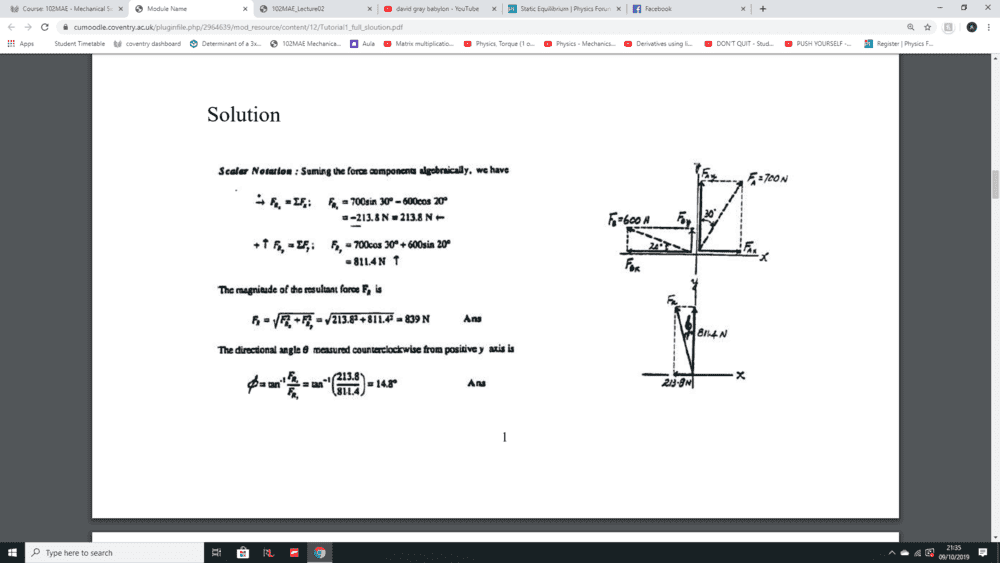
When calculating static equilibrium, i know that you have to split for example, F1 into F1x and F1y. when using soh/cah/toa is it always SIN for the Y axis and always Cos for the X axis? I've been following this method and getting it wrong some times it's really stressing me out, Thanks for any help in advance.
1570653357500.png
 
Last edited:
Physics news on Phys.org
Mason98 said:
when using soh/cah/toa is it always SIN for the Y axis and always Cos for the X axis?
No. It all depends on what angle you are using. If the angle is with respect to the x-axis, then fine: The x-component would use cosine, etc. But if the given angle is with respect to the y-axis, things are reversed.

Remember that sinθ = cos (90° - θ).
 
  • Like
Likes   Reactions: Mason98
so that is how in the picture Fax is sin because the angle given is in respect to the y-axis which would mean to use sin?
 
Mason98 said:
so that is how in the picture Fax is sin because the angle given is in respect to the y-axis which would mean to use sin?
Exactly!
 
  • Like
Likes   Reactions: Mason98
Doc Al said:
Exactly!
Thank you very much! I appreciate your help :)
 
But if you adopt this as a new rule-of-thumb, you'll still be in a pickle when the problem gives you an angle which is relative to neither the x nor y axis.
 

Similar threads

  • · Replies 31 ·
2
Replies
31
Views
4K
  • · Replies 1 ·
Replies
1
Views
2K
  • · Replies 3 ·
Replies
3
Views
2K
  • · Replies 1 ·
Replies
1
Views
3K
Replies
5
Views
1K
Replies
1
Views
6K
  • · Replies 3 ·
Replies
3
Views
2K
  • · Replies 6 ·
Replies
6
Views
2K
Replies
1
Views
2K
Replies
2
Views
3K