Calculate the direction of the current using Lenz Law/Other

Click For Summary
SUMMARY

This discussion centers on the application of Lenz's Law and alternative methods for determining the direction of induced current in a magnetic field. The user explores Lenz's Law, which states that the induced current opposes the change in magnetic flux, and contrasts it with a personal method that assumes electron movement aligns with the direction of applied force. Key insights reveal that Lenz's Law is applicable only when there is a change in magnetic flux, while the alternative method can be used under certain conditions. The conversation emphasizes the importance of understanding the context of magnetic flux changes in practical applications.

PREREQUISITES
  • Understanding of Lenz's Law and its implications in electromagnetism.
  • Familiarity with Faraday's Law of Induction and its relationship to induced electromotive force (emf).
  • Knowledge of magnetic flux and its behavior in various scenarios.
  • Basic grasp of the right-hand rule for determining current direction in magnetic fields.
NEXT STEPS
  • Study the relationship between Lenz's Law and Faraday's Law of Induction in detail.
  • Explore Maxwell's equations to gain a comprehensive understanding of electromagnetic theory.
  • Investigate practical examples of Lenz's Law in various configurations, such as coils and loops.
  • Learn about the implications of magnetic flux changes in real-world applications, such as electric generators.
USEFUL FOR

Students of physics, educators teaching electromagnetism, and engineers working with electromagnetic systems will benefit from this discussion. It provides clarity on the application of Lenz's Law and alternative methods for analyzing induced currents.

LegendF
Messages
29
Reaction score
0
Important:
Imagine that there is a wire connecting the two magnetic poles, (+,-) so there is an induced current and not only an ems.

Homework Statement


Hello there!

I'm wondering if I can use both of these methods to calculate the direction of the current.

The first one is Lenz Law. If I've understood the law currently, it helps me to determine the direction of the current, by knowing that the direction of the ''force'' that builds up is opposite the direction of the already there force, and therefore I can just use the right-hand rule and determine the direction of the current. So in this case( see image below), the force is pulling the object down, Lenz Law states that an opposite force should go upwards to prevent the movement of the object from going downwards, then I get that the direction of the force should go upwards, and give me that the current should go to the right.

However, this method is something I learned after my first one, which I've always thought should be used..

BUT! Can I also use this method?:

If I assume that the electrons are going in the same direction as the velocity I'm pulling the object downwards with, then the current should go UP, while the electrons move down. If I use the right-hand rule on this, I get that the Fm(Magnetic Force) should go to the left, this tells me that the right-end is the positive pole and the left-end is the negative pole.

Then I know that the current is flowing from + to - and from that method determine the direction. Is this possible?
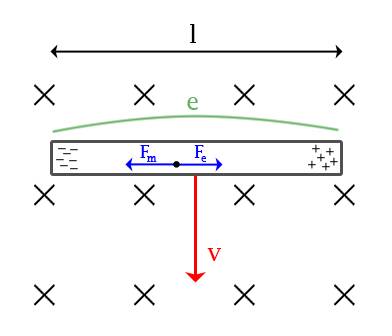

image001.jpg


Homework Equations


But! In the first method, when I used Lenz Law, I got that the magnetic force is going UPWARDS. However, in my second method, I got that the magnetic force is going to THE LEFT just like in the image.

Are these two different forces or what?


LegendF
 
Last edited:
Physics news on Phys.org
The two rules you are talking about describe different effects.
Lenses Law applies when the movement results in a change in flux density at the conductor.
In your example, the magnetic flux stays the same.
 
Simon Bridge said:
The two rules you are talking about describe different effects.
Lenses Law applies when the movement results in a change in flux density at the conductor.
In your example, the magnetic flux stays the same.


Weird, that's not mentioned anywhere in my book and it has not been used in the examples either.

So Lenz Law should only be applied when the magnetic flux changes?

But can I still use "my method" even if the flux changes?
 
Lenz’ Law (1845): “The voltage (emf) induced by a changing flux has a polarity
such that the current flowing gives rise to a flux which opposes the change of
flux”
emf= rate of change of magnetic flux from Faraday's law of induction, then Lenz' law says it is negative so that the emf created opposes the emf causing the change in flux.

Induction is a kind of “inertial reaction”: the system develops a current which
“tries” to maintain the flux constant.
 
Weird, that's not mentioned anywhere in my book and it has not been used in the examples either.
Which book is this?

I think you should go back over the examples carefully - is Lenzes law ever used in a situation where the magnetic flux does not change yet there is a net opposing force?

So Lenz Law should only be applied when the magnetic flux changes?
Lenzes law and Faradays law:
http://hyperphysics.phy-astr.gsu.edu/hbase/electric/farlaw.html

You can use it where the flux does not change - but that means: ##\Delta (BA)/\Delta T = 0##
So the force is zero. (see the link)

You'll notice that hyperphysics uses coils for their examples - your book should too.
You may have seen examples involving flat sheets of metal that could contribute to the confusion.

But can I still use "my method" even if the flux changes?
The rule you have seems to be from:
$$m\vec a =q(\vec v\times \vec B)$$ ... v is the velocity of the charge.

It does work if the flux changes - you just have to be more careful when you use it.
Probably later on you'll learn about Maxwell's equations and things will get more general.
 
I see, I see.

The issue is that the magnetic flux does infact change if I think about it, however it's nowhere mentioned that that it has anything to do with magnetic flux nor that the flux actually changes in the examples provided in my book. It just states that Lenz Law is that a force is ''created'' in the opposite direction of the existing one, in order to prevent the motion and thus we can obtain the direction of the current from that.

That's pretty much everything that Lenz Law states in my book. It's a book written in swedish.

But thank you once again, I'll perhaps just stick to using the other rule for now to determine the direction of the current.

Best regards & Thank you a lot for your help.
 
Oh yeah - technically Lenzes law is about the direction - Faraday's law states that the flux has to change.
In examples you should see that though ... do they have any examples for lenzes law where the flux does not change? Or maybe this is one of those conceptual physics courses?

That's pretty much everything that Lenz Law states in my book.
Really? No pictures or examples? Sounds like a textbook to be avoided.

Note: if the example involves moving towards or away from one pole of a bar magnet or an electromagnet, then the flux changes. They don't have to say - you are expected to understand that from the circumstances.

I'll perhaps just stick to using the other rule for now to determine the direction of the current.
The magnetic force law is not going to help you with coils much though. Say, instead of a bar, the moving conductor was a loop? What's the current?
 

Similar threads

Replies
4
Views
1K
  • · Replies 2 ·
Replies
2
Views
2K
  • · Replies 18 ·
Replies
18
Views
4K
  • · Replies 8 ·
Replies
8
Views
2K
Replies
12
Views
2K
Replies
3
Views
1K
  • · Replies 4 ·
Replies
4
Views
2K
  • · Replies 6 ·
Replies
6
Views
2K
  • · Replies 9 ·
Replies
9
Views
2K
  • · Replies 11 ·
Replies
11
Views
3K