Calculate the focal distance of the duplicate

Karl Karlsson
Messages
104
Reaction score
12
Homework Statement
Calculate the focal distance of the duplicate
Relevant Equations
Lensmaker's equation
The picture below shows a so-called chromatic doublet, which is designed to minimize chromatic aberration, ie the wavelength dependence of the refractive index of the glass. The first lens has a flat first surface and a concave second surface with radius of curvature R and index of refraction n1 . The second lens is double convex with curvature radius R (refraction index n2) and sits close to the first lens. The lenses can be considered thin.

Skärmavbild 2020-03-04 kl. 21.26.05.png
Calculate the focal distance of the duplicate

My try:
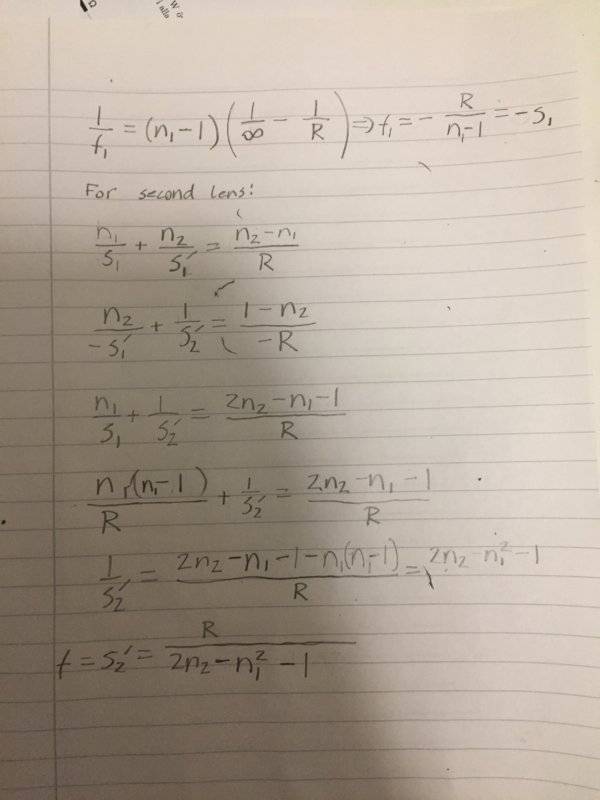
IMG_0591.jpeg


I seem to be getting the wrong answer. What am i doing wrong?

Correct answer is R/(2*n2 - n1 - 1)
 

Attachments

  • IMG_0590.jpeg
    IMG_0590.jpeg
    40.8 KB · Views: 228
Physics news on Phys.org
What did you use for the focal length of the second lens? Note that the figure shows a clear air gap between the two lenses. This means that you should find the two focal lengths as if the lenses were surrounded by air.

On edit: You need to adopt the standard strategy for solving compound lens problems of this kind: (a) Put an object at some finite distance ##s## in front of the combination; (b) find the position of the image ##s'##; (c) Treat the image as the object for the second lens (pay close attention to what is real and what is virtual); (d) find the position of the final image ##s''##; (e) let ##s## go to infinity and see what ##s''## becomes; (f) relate ##s''## to the focal length of the combination.

I tried this method for this problem and got the answer you quoted as correct.
 
Last edited:
Why does ##n_1## appear in the formula for lens 2 while ##n_2## does not appear in the formula for lens 1 ?

Does close together mean zero in between ?
 
kuruman said:
What did you use for the focal length of the second lens? Note that the figure shows a clear air gap between the two lenses. This means that you should find the two focal lengths as if the lenses were surrounded by air.

On edit: You need to adopt the standard strategy for solving compound lens problems of this kind: (a) Put an object at some finite distance ##s## in front of the combination; (b) find the position of the image ##s'##; (c) Treat the image as the object for the second lens (pay close attention to what is real and what is virtual); (d) find the position of the final image ##s''##; (e) let ##s## go to infinity and see what ##s''## becomes; (f) relate ##s''## to the focal length of the combination.

I tried this method for this problem and got the answer you quoted as correct.
My bad I can see my mistake as you pointed out now. I didn't think of the air gap between the lenses. Thanks!
 

Similar threads

  • · Replies 3 ·
Replies
3
Views
1K
  • · Replies 1 ·
Replies
1
Views
1K
  • · Replies 15 ·
Replies
15
Views
2K
Replies
4
Views
1K
  • · Replies 7 ·
Replies
7
Views
2K
  • · Replies 7 ·
Replies
7
Views
2K
Replies
2
Views
3K
Replies
3
Views
2K
  • · Replies 8 ·
Replies
8
Views
2K
  • · Replies 1 ·
Replies
1
Views
2K