Calculate the group velocity in EIT (famous paper: light speed 17m/s)

Click For Summary

Discussion Overview

The discussion revolves around the calculation of group velocity in the context of Electromagnetically Induced Transparency (EIT) as presented in a notable paper that reports a light speed reduction to 17 m/s. Participants are examining the discrepancies between their calculated values and the experimental results reported in the paper.

Discussion Character

  • Technical explanation
  • Debate/contested
  • Mathematical reasoning

Main Points Raised

  • One participant reports a calculated group velocity of 2.94 m/s using parameters from the paper, while the paper states a value of 32.5 m/s.
  • Another participant suggests that the peak density being higher than the average density could account for discrepancies in the results.
  • There is a discussion about the proper use of angular frequencies versus standard frequencies in calculations, with some participants indicating that the theoretical equation should yield values close to the experimental results.
  • Concerns are raised about the substitution of parameters in the equations, particularly regarding the Rabi frequency and the probing light frequency.
  • One participant emphasizes the importance of checking physical dimensions in calculations and notes that factors of 2π may be inconsistently applied.

Areas of Agreement / Disagreement

Participants express differing views on the reasons for the discrepancies in calculated versus experimental results. There is no consensus on the correct approach or resolution to the problem, as multiple competing explanations and methods are presented.

Contextual Notes

Some participants mention the need to consider the dimensional analysis of the equations used, and there are references to specific parameters and their definitions that may affect the calculations. The discussion highlights the complexity of the theoretical framework and the potential for variations in interpretation.

wangvivi
Messages
10
Reaction score
0
TL;DR
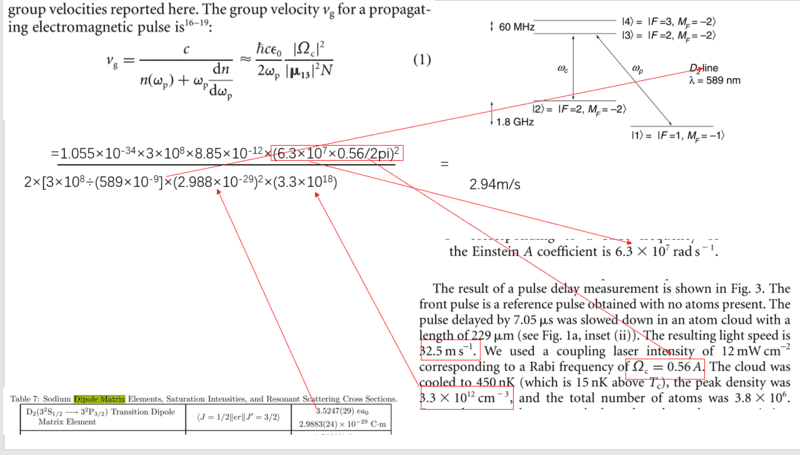
calculation about the group velocity in electromagnetic induced transparency(EIT) in the paper:Light speed reductionto 17 metres per second in an ultracold atomic gas.my result is not agreement with the published one.
hello everyone!
Recently,i'm reading a paper about slow light,that's really a famous work published in Nature.[Light speed reduction to 17 metrespersecond in an ultracold atomicgas].
But I'm trouble with some calculation about the velocity of slow light.here are below:
微信图片_20220707161259.png

i try to use the parameters in this paper and plug them into function(1) to caculate the group velocity of the slow light,the resulting light speed in this paper is 32.5m/s,but my result is 2.94m/s,i checked all the parameters but can't know where the problem is.
Other parameters are below:
function(1)is the group velocity of slow light. in this function,
h/bar is reduced Planck constant,
c is the light velocity in vaccum,
epsilon_0 is vacuum permittivity,
Omega_c is the rabi frequncy of coupling light,
omega_p is the frequncy of probing light,
u13 is the dipole matrix element between 1 and 3,
N is the atomic density.
paper has been attached.
by the way,maybe the dipole matrix element of sodium between zeeman state is not 2.988*10^-29 C·m?
can anybody tell me why my result is not in agreement with the experimental result in this paper?
thanks a lot!
hope everyone well!
 

Attachments

Physics news on Phys.org
Here is the paper

The peak density will be higher than the average density, which means the average speed is higher than the slowest speed. That could cause a discrepancy.

You could email the authors and ask if no one here finds a solution.
 
mfb said:
Here is the paper

The peak density will be higher than the average density, which means the average speed is higher than the slowest speed. That could cause a discrepancy.

You could email the authors and ask if no one here finds a solution.
thank you so much!actually I considered this situation.
I'll email the authers and post their answer if they reply me.
thank you!
 
hongqiaozhang said:
can anybody tell me why my result is not in agreement with the experimental result in this paper?
It seems the experimental result is simply calculated from ## v_g = L / \tau_\text{delay} = 229~{\rm \mu m} / 7.05~{\rm \mu s} = 32.5~{\rm m/s} ##. The theoretical equation (1) should produce values in the right ballpark, but is perhaps better used to estimate the density ## N ##.

I noticed that you substituted ## c/\lambda ## for ## \omega_p ##, but it should probably have been ## 2 \pi c/\lambda ##. Unfortunately that change goes in the wrong direction. I think it's also unusual to express the Rabi frequency ## \Omega_c ## in ## \rm rad~s^{-1} ##, rather than cycles per second, but I'm not an expert in the field and haven't studied the quoted publications.
 
But from the paper it seems that they exclusively work with angular frequencies rather than frequencies, as expected in the modern quantum-theoretical literature.
 
WernerQH said:
It seems the experimental result is simply calculated from ## v_g = L / \tau_\text{delay} = 229~{\rm \mu m} / 7.05~{\rm \mu s} = 32.5~{\rm m/s} ##. The theoretical equation (1) should produce values in the right ballpark, but is perhaps better used to estimate the density ## N ##.

I noticed that you substituted ## c/\lambda ## for ## \omega_p ##, but it should probably have been ## 2 \pi c/\lambda ##. Unfortunately that change goes in the wrong direction. I think it's also unusual to express the Rabi frequency ## \Omega_c ## in ## \rm rad~s^{-1} ##, rather than cycles per second, but I'm not an expert in the field and haven't studied the quoted publications.
thanks for your reply!
Actually,I considered what you said.
First,the time delay is an experimental result,so 32.5m/s is also an experimental result,you are right.what I want to do is use the function(1)as a theoretical result to compare with 32.5m/s.
Secondly,I analysed the dimension of this function.you can see my picture:
捕获.PNG

In the function(1),if you use rad/s for omega_p and rabi frequncy,you get rad·m/s,not m/s.is that right?so I considered the SI units when I used these parameters.
parameters are from:https://steck.us/alkalidata/sodiumnumbers.1.6.pdf;the relationship between international system of units is from:https://en.wikipedia.org/wiki/Farad
I don‘t know much about this field either.so thank you for your suggestion.I will use rad/s for rabi frequency.and to my calculation,maybe the peak density will be higher than the average one.
If you find any problems in my answer,could you please contact me?I’m very gald to discuss this question with you.
 
vanhees71 said:
But from the paper it seems that they exclusively work with angular frequencies rather than frequencies, as expected in the modern quantum-theoretical literature.
thank you.I noticed that.could you please read my reply to WernerQH?I just posted it.
If you find any problems in my answer,please contact me.thank you!
 
The only thing I see is that you attempt divide ##\Omega_c## by ##2 \pi##. That's not in the formula, but if you think it must be there, you better put it in parenthesis to make sure that both factors are in the denominator. Also rad=1 of course. Then you have ##\omega_{\text{P}}=c k_{\text{P}}=2 \pi c/\lambda_{\text{P}}##.
 
hongqiaozhang said:
In the function(1),if you use rad/s for omega_p and rabi frequncy,you get rad·m/s,not m/s.is that right?so I considered the SI units when I used these parameters.
It is always wise to check the physical dimensions. :smile:
But people are not always consistent, and then factors of ## 2 \pi ## can slip in.
I think vanHees71 is right that in this case you should set ## \text{rad} = 1 ##.

When in doubt, consult the given references (16-19).
 

Similar threads

  • · Replies 11 ·
Replies
11
Views
4K
  • · Replies 15 ·
Replies
15
Views
6K
  • · Replies 11 ·
Replies
11
Views
5K
  • · Replies 28 ·
Replies
28
Views
5K