Calculate the magnitude of driving force on the car

  • Thread starter Thread starter chwala
  • Start date Start date
  • Tags Tags
    Force Magnitude
Click For Summary
SUMMARY

The driving force on the car is calculated to be 2272.25 N using the equation D = F_0 + F_1, where F_0 is the force acting perpendicular to the road (1767.25 N) and F_1 is the force resisting motion (505 N). The calculations utilize Newton's second law and trigonometric functions to resolve forces acting on the car. The discussion confirms that the driving force is the sum of the gravitational force component and the resisting forces.

PREREQUISITES
  • Understanding of Newton's second law of motion
  • Basic knowledge of trigonometric functions (sine and cosine)
  • Familiarity with force components in physics
  • Ability to perform vector resolution of forces
NEXT STEPS
  • Study the application of Newton's second law in various contexts
  • Learn about vector resolution techniques in physics
  • Explore the effects of friction on motion and force calculations
  • Investigate the role of gravitational forces in inclined plane problems
USEFUL FOR

Physics students, automotive engineers, and anyone interested in understanding the dynamics of forces acting on vehicles in motion.

chwala
Gold Member
Messages
2,828
Reaction score
420
Homework Statement
A car of mass ##850## kg is travelling with acceleration ##0.3 m/s^2##, up a straight road inclined at ##12^0## to the horizontal. There is a force resisting motion of ##250## N. Calculate the magnitude of the driving force.
Relevant Equations
Resolving forces- Mechanics
My approach is as follows, let ##D## be driving force and ##F## the force resisting motion, then

##D-F = 850 × 0.3##

##D = 250 + 255##

##D = 505##

Also, Force parallel to the road is given by, ##F_1 = 8500 \cos 78^0 =1767.24 N##

Therefore, the magnitude of Driving force is given by, ##F_1 + D = 2272.25 N##

your insight is welcome...not sure on this...
 
Physics news on Phys.org
How many forces act on the car?
 
  • Like
Likes   Reactions: chwala
When you apply Newton's 2nd law, take all the forces into account.
 
  • Like
Likes   Reactions: chwala and Lnewqban
Car on hill.jpg
 
  • Like
Likes   Reactions: MatinSAR, chwala and SammyS
Since we are interested in the driving force then, before motion ( that is at equilibrium ) ##a=0##

##F_0 - 8500 \cos 78^0 = 0##

##F_0=1767.25## N


we know that the Force resisting motion ( car now in motion)= 250 N. Therefore,


##F_1 - 250= ma ##

##F_1= (850 × 0.3 )+250##

##F_1= 505## N

Therefore,

Driving force ##D=F_0 +F_1 = 1767.25+ 505= 2272.25## N

Of course i could be wrong...it is a new area for me ....cheers.
 
Last edited:
chwala said:
Since we are interested in the driving force then, before motion ( that is at equilibrium ) ##a=0##

##F_0 - 8500 \cos 78^0 = 0##

##F_0=1767.25## N


we know that the Force resisting motion ( car now in motion)= 250 N. Therefore,


##F_1 - 250= ma ##

##F_1= (850 × 0.3 )+250##

##F_1= 505## N

Therefore,

Driving force ##D=F_0 +F_1 = 1767.25+ 505= 2272.25## N

Of course i could be wrong...it is a new area for me ....cheers.
I agree with final answer but do you know what ##F_0## is?
If you ask me It is better to use post #4 to identify net force acting on car in terms of ##D## and ##F## and ##mg##.
 
MatinSAR said:
I agree with final answer but do you know what ##F_0## is?
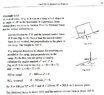
That should be the vertical force i.e acting perpendiculor to the road. ...let me check on this ..what i have on my textbook notes is a bit confusing...see the attachment ...
 

Attachments

  • CamScanner 02-12-2024 17.33_1.jpg
    CamScanner 02-12-2024 17.33_1.jpg
    59.4 KB · Views: 97
Last edited:
chwala said:
That should be the vertical force i.e acting perpendiculor to the road. ...let me check on this ..what i have on my textbook notes is a bit confusing...see the attachment ...
But what causes this force? It's interesting that your book doesn't mention it! Look at digram in post #4. It's the gravitational force.
2024_02_12 1_23 PM Office Lens.jpg


In your solution ##F_0=mgsin \theta ##.
 
  • Informative
Likes   Reactions: chwala
MatinSAR said:
But what causes this force? It's interesting that your book doesn't mention it! Look at digram in post #4. It's the gravitational force.
View attachment 340203
aaaargh i think i've seen it.

##\cos 72^0 = \dfrac{mg}{8500}## therefore ##mg = 1767.25## N
 
  • #10
chwala said:
aaaargh i think i've seen it.

##\cos 72^0 = \dfrac{mg}{8500}## therefore ##mg = 1767.25## N
No. Rethink.
 
  • Like
Likes   Reactions: chwala
  • #11
mg has 2 components. One perpendicular to the surface and one parallel to the surface.
##mgcos 72 ## is one of the components.
 
  • Like
Likes   Reactions: chwala
  • #12
I can have my equation as,

##D= R+F+ma##

and noting that

##[ \cos 78^0 = \sin 12^0]##

then,

##D= mg \cos 78^0 + 250+ 255 = 2272.25##N
 
Last edited:
  • #13
chwala said:
I think in my book ##mg## is what they are calling ##N## and ##R-N=0## and ##N## using the right angle triangle is given by ##\cos 72^0 = \dfrac{N}{8500}##.

Do confirm again on this.
Your book doesn't use ##N##. It used ##R## to show the normal force.
Let's solve the problems one by one. For question in post #7:
2024_02_12 1_57 PM Office Lens.jpg

If there is any problem I'll be happy to help
 
  • Like
Likes   Reactions: chwala
  • #14
chwala said:
I can have my equation as,

##D= R+F+ma##

and noting that

##[ \cos 78^0 = \sin 12^0]##

then,

##D= mg \cos 78^0 + 250+ 255 = 2272.25##N
I guess you're answering question in post #1 now. Is everything clear with question in post #7?
What is ##R## in your solution? If it is the normal force then you are wrong. See post #8 and note that I've showed normal force using ## N## instead of ##R##.
 
  • #15
MatinSAR said:
I guess you're answering question in post #1 now. Is everything clear with question in post #7?
What is ##R## in your solution? If it is the normal force then you are wrong. See post #8 and note that I've showed normal force using ## N## instead of ##R##.
... Let me check and go through the literature... will get back in a few hours...
 
Last edited by a moderator:
  • Like
Likes   Reactions: MatinSAR
  • #16
MatinSAR said:
Your book doesn't use ##N##. It used ##R## to show the normal force.
Let's solve the problems one by one. For question in post #7:
View attachment 340206
If there is any problem I'll be happy to help
This part is now clear; i was mixing up the two forces...now using my attachment in post ##7## as reference, it is clear that the force acting parallel to the ramp is given by:
Firstly, ##F=ma## since the crate is at rest then ##a=0##.
now
There are two opposing forces that will enable equilibrium, let me have them as,
##F_1 - F_0 =0## where ##F_1## is the frictional force. ##F_1## makes an angle ##θ## with the parallel direction ##F_0## where ##F_0## using pythagoras theorem is given by ##F_0=300 \cos 72^0## or ##F_0 = 300\sin 18^0##.
Similarly, the force acting perpendicularly to the ramp is given by:
##R -N=0## where ##R## is the Normal contact force and ##N## is the force acting perpendicularly to ramp,
##N=300 \cos 18^0## using the pythagoras theorem. From here the steps to solution are straightforward.

Now to my problem, using Newton's second law of motion, i shall have,

##D-F_1 -F_0 =ma##

##D-250-8500 \cos 78^0 = 850×0.3## or

##D-250-8500 \sin 12^0 = 850×0.3##

##D=250+1767.25+255##

##D=2272.25##N.

Cheers man!
 
Last edited:
  • Like
Likes   Reactions: MatinSAR

Similar threads

Replies
17
Views
3K
Replies
6
Views
4K
  • · Replies 15 ·
Replies
15
Views
4K
  • · Replies 3 ·
Replies
3
Views
10K
  • · Replies 3 ·
Replies
3
Views
2K
  • · Replies 20 ·
Replies
20
Views
11K
  • · Replies 4 ·
Replies
4
Views
8K
  • · Replies 2 ·
Replies
2
Views
2K
  • · Replies 4 ·
Replies
4
Views
2K
  • · Replies 4 ·
Replies
4
Views
17K