Calculating Force for Spark Plug Installation

Click For Summary

Homework Help Overview

The discussion revolves around calculating the force required to tighten a spark plug to a specified torque. The problem involves understanding the relationship between torque, force, and the angle of application, specifically in the context of automotive mechanics.

Discussion Character

  • Exploratory, Assumption checking, Conceptual clarification

Approaches and Questions Raised

  • Participants explore the relationship between torque and the angle of force application, questioning the validity of using cosine for the angle in the torque equation. There is a discussion about the implications of setting the angle to zero and how that affects the torque calculation.

Discussion Status

The discussion is active, with participants offering insights into the correct interpretation of the angle in relation to the force and displacement. Some have suggested alternative approaches to calculating the force, indicating a productive exploration of the problem.

Contextual Notes

There are indications that participants are grappling with the definitions of angles in the context of torque and the geometry of the situation, which may not be fully represented in the provided information.

dragon18
Messages
12
Reaction score
0
You are installing a new spark plug in your car, and the manual specifies that it be tightened to a torque that has a magnitude of 45.0 N*m. Using the data in the figure below (L = 0.300 m and ? = 52.6°), determine the magnitude F of the force that you must exert on the wrench.
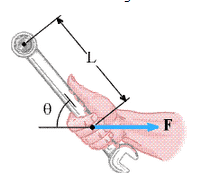
chaning your spark plugs.png


Relevant Equations
T = F * d

Attempt
45 = F * cos 52.6º * 0.300m
F = 246.96 N
 
Physics news on Phys.org
What if θ was zero? According to your formula, this would give a torque of Fd (because cos(0) = 1). But, if you look at the picture, if θ = 0, shouldn't the torque be 0 as well? You are just pulling straight out; this shouldn't turn the bolt at all.

Hint: is θ really the angle between the force and the displacement?
 
Poley said:
What if θ was zero? According to your formula, this would give a torque of Fd (because cos(0) = 1). But, if you look at the picture, if θ = 0, shouldn't the torque be 0 as well? You are just pulling straight out; this shouldn't turn the bolt at all.

Hint: is θ really the angle between the force and the displacement?

If θ=0, then the force would be 150N. θ isn't the angle between the force and displacement, but what am I looking for instead of 52.6°?
 
dragon18 said:
If θ=0, then the force would be 150N. θ isn't the angle between the force and displacement, but what am I looking for instead of 52.6°?

Basically, you want the component of F that is PERPENDICULAR to the displacement. Personally, I wouldn't use cosine but sine. Draw a right triangle with theta, F, and d, and find an expression for the component of F pointing away from d.
 
I figured out that the answer is 1.898102N
F=45F*m/(0.300m*sin(52.6°))
 

Similar threads

  • · Replies 4 ·
Replies
4
Views
4K
Replies
3
Views
7K
  • · Replies 7 ·
Replies
7
Views
3K
  • · Replies 11 ·
Replies
11
Views
2K
Replies
3
Views
6K
Replies
4
Views
2K
  • · Replies 4 ·
Replies
4
Views
8K
  • · Replies 14 ·
Replies
14
Views
3K
  • · Replies 5 ·
Replies
5
Views
3K
Replies
3
Views
2K