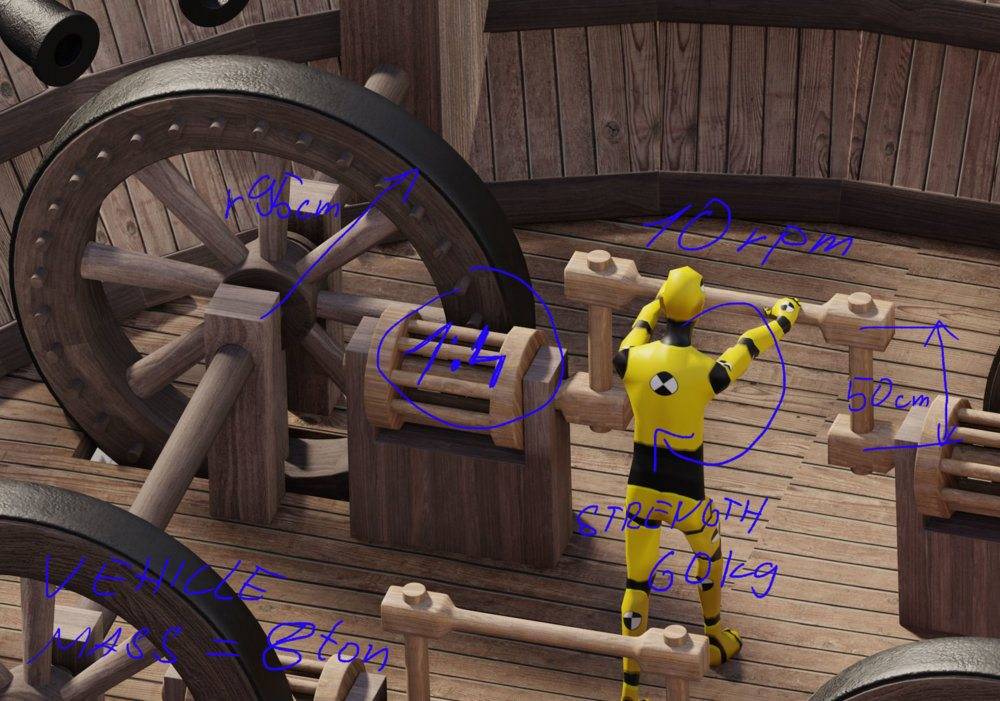
Start by estimating the rolling resistance. Wood/iron wheels will sink into any ground softer than solid bedrock. I suggest running an experiment. Pump the tire pressure in your car to sidewall maximum (typically 50 PSI or so). Then get a rope and some friends and pull the car over ground similar to that which the tank would travel. Estimate the pull force, or measure using a deer scale (spring scale). Divide into the weight of the car to get a coefficient of rolling friction. You now have a number for rubber tires, multiply by two or three for solid wheels on the same ground.
Estimate the force to move the tank by multiplying the total weight times the coefficient of rolling friction from above. Multiply by the wheel radius to get the necessary driving torque at the wheels.
The wheels are mounted on an axle. The axle is supported by simple wood bearings. Those bearings, if well built and lubricated, will have a friction coefficient about 0.2. Calculate the friction torque of the axle, and add it to the wheel driving torque. This is the torque at the driven gear. Keep in mind that the bearing friction force is at the axle radius.
The right angle gears have a lot of sliding action, so have a lot of friction. Rather than calculating that friction, just add 50% to the driven gear torque. Divide by the gear ratio to get torque at the pinion (the small driving gear).
The torque at the pinion shaft is higher than the torque at the pinion because of friction in the pinion shaft bearings. The bearing load on the pinion shaft gears is the torque at the pinion divided by the pinion radius. Now that you have the bearing load, you can calculate the bearing friction (lubricated wood on wood, same as above), and the torque due to that friction. Add the pinion shaft bearing friction torque to the pinion torque to get the total torque to turn the pinion shaft.
The pinion shaft torque divided by the radius of the hand crank gives the force needed on the hand crank. Your estimate of man strength is way high. Get a spring scale and pull on it at angles representing various positions of the hand crank to estimate arm strength. You now have the necessary force, and the force that one man can provide. Divide to get the number of men.
I hope that you pulled the test car over representative ground, including worst case uphill grade.