Torque and power calculation for a crank wheel

Click For Summary

Discussion Overview

The discussion revolves around calculating torque and power for a crank wheel system, given specific inputs such as gear ratio, weight, and wheel diameter. The context includes both theoretical calculations and practical implications related to energy generation.

Discussion Character

  • Homework-related
  • Debate/contested

Main Points Raised

  • One participant requests formulas to calculate torque and power based on a gear ratio of 1:6, a 10kg weight, and a 30-inch diameter wheel.
  • Another participant questions whether the inquiry is related to homework.
  • The original poster confirms it is homework but expresses curiosity about the potential for extra energy generation, referencing online videos about flywheel electricity generation.
  • One participant asserts that free energy is not possible and suggests that the topic is a waste of time, indicating it is banned on the forum.
  • A later reply provides a formula for the energy required to raise the weight, stating it as mgh, and mentions that energy may be recovered as the weight descends, while noting losses due to friction.

Areas of Agreement / Disagreement

Participants generally agree that the topic of free energy is not valid, with one participant explicitly stating it is a banned topic. However, there is no consensus on the calculations for torque and power, as the discussion remains unresolved regarding the specifics of the homework request.

Contextual Notes

The discussion includes assumptions about energy recovery and the effects of gearing, but these are not fully explored or resolved. The implications of friction and other losses are acknowledged but not quantified.

Sudhakar Naidu
Messages
7
Reaction score
0
How to calculate torque and power at 'drive wheel' with following inputs and also requirement shown in below picture-
a. Gear ratio, 1: 6
b. Attached 10Kg weight for bigger wheel to make as a crank wheel and diameter is 30inch.
c. Bigger wheel: Consider 180 degree is freely rotates(due to 10kg attached) and remaining 180 degree only we need to drive.
d. if any thing missed, please consider by your self. so i will co-relate later.
Please provide me formulas for the above request?( my background is electrical engineering, so needs help)

Thanks in Advance for your support.
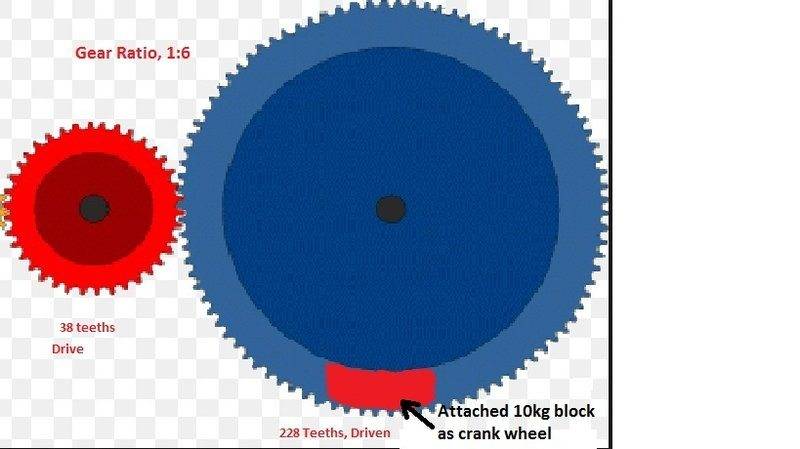
Gear_with_Crank_wheel1.jpg
 

Attachments

  • Gear_with_Crank_wheel1.jpg
    Gear_with_Crank_wheel1.jpg
    33.6 KB · Views: 1,521
Engineering news on Phys.org
This sounds like homework or a school assignment. Is it?
 
Yes, it's homework but trying for something extra energy do we get or not?, If we see in youtube there are lots of flyweel free electricity generation but not able to believe those so am trying mathematically is really possible or not.
Thanks for your thought.
 
Not. Free energy isn't possible. It's such a waste of time that it's a banned topic on this forum.
 
The energy require to raise the 10kg will be =mgh where m=10kg, g=9.81m/s/s and h is the diameter of the wheel.

You might get that energy back as the weight returns to the bottom, less losses due to friction etc.

The gearing has no effect on this.
 
Sudhakar Naidu said:
Yes, it's homework but trying for something extra energy do we get or not?, If we see in youtube there are lots of flyweel free electricity generation but not able to believe those so am trying mathematically is really possible or not.
Thanks for your thought.

@CWatters is correct. Free energy is a forbidden topic on PF. Thread closed.
 
  • Like
Likes   Reactions: jim hardy

Similar threads

  • · Replies 1 ·
Replies
1
Views
1K
Replies
9
Views
2K
  • · Replies 58 ·
2
Replies
58
Views
9K
  • · Replies 9 ·
Replies
9
Views
2K
  • · Replies 8 ·
Replies
8
Views
7K
  • · Replies 6 ·
Replies
6
Views
4K
  • · Replies 2 ·
Replies
2
Views
2K
Replies
5
Views
3K
  • · Replies 6 ·
Replies
6
Views
3K
  • · Replies 47 ·
2
Replies
47
Views
7K