Calculate the torsion of a silver thread

Click For Summary
SUMMARY

The discussion centers on calculating the torsion of a silver thread in a torsion balance setup involving lead balls. The relevant equations include the gravitational force equation F=G*m1*m2/r^2 and the torque equation T=r*F. The final solution for the angle of torsion is θ = 0.00422º, derived from the formula θ=2*T*L/(π*G*R^4), where T is the torque, L is the length of the thread, R is the radius, and G is the shear modulus. Participants emphasize the need to determine the shear modulus for silver to complete the calculation.

PREREQUISITES
  • Understanding of gravitational force equations (F=G*m1*m2/r^2)
  • Knowledge of torque and moment calculations (T=r*F)
  • Familiarity with shear modulus and its application in torsion calculations
  • Basic concepts of elasticity, including Young's modulus and Poisson's ratio
NEXT STEPS
  • Research how to calculate the shear modulus for silver using Young's modulus and Poisson's ratio
  • Study the concept of torsional rigidity and its applications in mechanics
  • Learn about the relationship between torque and angle of twist in torsion systems
  • Examine Example 43 and Example 44 in the provided textbook for practical applications of torsion calculations
USEFUL FOR

Students studying mechanics, physics educators, and engineers involved in materials science or mechanical design, particularly those focusing on torsion and elasticity in materials.

AlejandreBurgues908
Messages
9
Reaction score
0

Homework Statement


The torsion balance shown in the figure consists of a 40 cm long bar with lead balls with a diameter of 2 cm on each end. The rod is hanging by a 100 cm long silver thread with a diameter of 0.5 mm. When two bigger lead balls (density = 11.4 g/cm3) with a diameter of 30 cm are placed very close to each one of the balls, on opposite sides, their gravitational attraction tend to make the rod rotate in the same direction. What will the silver thread torsion be?

Fisica.png


Homework Equations


F=[/B]G.m1.m2/r^2
T=r.F
Shear modulus

The Attempt at a Solution


The answer is θ = 0,00422º, but I don't know how to solve it.
 

Attachments

  • Fisica.png
    Fisica.png
    7.1 KB · Views: 587
Last edited:
Physics news on Phys.org
AlejandreBurgues908 said:
Relevant equations
What equations do you know relating masses to gravitational attraction and forces to torques?
Do you know how torsion is defined?
 
haruspex said:
What equations do you know relating masses to gravitational attraction and forces to torques?
Do you know how torsion is defined?
I am kinda lost, honestly is the hardest question I ever had, right now we were learning about elasticity, Young's modulus and Poisson's modulus. This is the kind of stuff we are learning (is in spanish):
http://repositorio.pucp.edu.pe/inde...56789/7140/Medina_Fisica2_Cap1.pdf?sequence=2
 
haruspex said:
What equations do you know relating masses to gravitational attraction and forces to torques?
Do you know how torsion is defined?
By the way I do know how the torsion is defined
 
AlejandreBurgues908 said:
By the way I do know how the torsion is defined
So post that.
 
haruspex said:
So post that.
Ok
 
Do you know how to determine the force on each ball? Do you know how to determine the moment of a force?
 
Chestermiller said:
Do you know how to determine the force on each ball? Do you know how to determine the moment of a force?
Yes, I know
 
  • #10
OK. What is the sum of the moments caused by the gravitational forces on the rod?
 
  • Like
Likes   Reactions: AlejandreBurgues908
  • #11
Chestermiller said:
OK. What is the sum of the moments caused by the gravitational forces on the rod?
I don't Know if this solution to your question is fine T=(2*0.2)G*m1*m2/(r1+r2)^2
 
  • #12
AlejandreBurgues908 said:
I don't Know if this solution to your question is fine T=(2*0.2)G*m1*m2/(r1+r2)^2
Yes. Very nice. Now, if the system is in equilibrium, the string has to apply an equal and opposite torque to the rod. This torque is determined by the elastic properties and geometry of the string, and the amount that one end of the string rotates relative to the other end. For the analysis in your textbook on how to determine the angle of rotation, see Example 43 on pages 23-24.

Incidentally, your textbook is done very well. I like it a lot.
 
  • Like
Likes   Reactions: AlejandreBurgues908
  • #13
Chestermiller said:
Yes. Very nice. Now, if the system is in equilibrium, the string has to apply an equal and opposite torque to the rod. This torque is determined by the elastic properties and geometry of the string, and the amount that one end of the string rotates relative to the other end. For the analysis in your textbook on how to determine the angle of rotation, see Example 43 on pages 23-24.

Incidentally, your textbook is done very well. I like it a lot.
Ok, now I understand the problem, the solution would be θ=2*T*L/(π*G*R^4) where T=(2*0.2)G*m1*m2/(r1+r2)^2 L is the lenght, R the radius and G the shear modulus, but how to calculate θ if the problem doesn't give me G?
 
  • #14
AlejandreBurgues908 said:
By the way I do know how the torsion is defined
The reason I asked is that I do not know how "torsion", as a quantity, is defined. What I can find on the net is most unclear.
At https://en.wikipedia.org/wiki/Torsion_(mechanics) I learn that its dimension is the same as that of pressure,
"Torsion is expressed in either the Pascal (Pa) ..."
but nowhere in the equations does it indicate what constitutes the torsion:
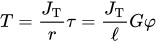
f722cee06d54c595fbf3fd8793962d06a7c64a9a

where:
  • T is the applied torque or moment of torsion in Nm.
  • 38a7dcde9730ef0853809fefc18d88771f95206c
    is the maximum shear stress at the outer surface
  • JT is the torsion constant for the section. It is almost equal to the second moment of area about the neutral axis.
  • r (tau) is the distance between the rotational axis and the farthest point in the section (at the outer surface).
  • is the length of the object the torque is being applied to or over.
  • φ (phi) is the angle of twist in radians.
  • G is the shear modulus, also called the modulus of rigidity, and is usually given in gigapascals (GPa)
  • The product JTG is called the torsional rigidity wT.
Based on the dimensionality, I would guess that the torsion is ##\frac{Tl}{J_T}##. For a cylinder, ##J_T=\frac \pi 2r^4##.
If that is correct, you do not need to know the shear modulus. You would only need to know that if you had to find the angle of twist.

Edit: just noticed you later added the book answer as an angle, so it seems there is not universal agreement on the definition of torsion.
 
Last edited:
  • #15
AlejandreBurgues908 said:
Ok, now I understand the problem, the solution would be θ=2*T*L/(π*G*R^4) where T=(2*0.2)G*m1*m2/(r1+r2)^2 L is the lenght, R the radius and G the shear modulus, but how to calculate θ if the problem doesn't give me G?
You need to look up the young’s modulus and poisson ratio for silver, and use these to calculate G. The equation is given in your book.
 
  • Like
Likes   Reactions: AlejandreBurgues908
  • #16
Chestermiller said:
You need to look up the young’s modulus and poisson ratio for silver, and use these to calculate G. The equation is given in your book.
Got it, thank you very much for your help
 
  • #17
haruspex said:
The reason I asked is that I do not know how "torsion", as a quantity, is defined. What I can find on the net is most unclear.
At https://en.wikipedia.org/wiki/Torsion_(mechanics) I learn that its dimension is the same as that of pressure,
"Torsion is expressed in either the Pascal (Pa) ..."
but nowhere in the equations does it indicate what constitutes the torsion:
f722cee06d54c595fbf3fd8793962d06a7c64a9a

where:
  • T is the applied torque or moment of torsion in Nm.
  • 38a7dcde9730ef0853809fefc18d88771f95206c
    is the maximum shear stress at the outer surface
  • JT is the torsion constant for the section. It is almost equal to the second moment of area about the neutral axis.
  • r (tau) is the distance between the rotational axis and the farthest point in the section (at the outer surface).
  • is the length of the object the torque is being applied to or over.
  • φ (phi) is the angle of twist in radians.
  • G is the shear modulus, also called the modulus of rigidity, and is usually given in gigapascals (GPa)
  • The product JTG is called the torsional rigidity wT.
Based on the dimensionality, I would guess that the torsion is ##\frac{Tl}{J_T}##. For a cylinder, ##J_T=\frac \pi 2r^4##.
If that is correct, you do not need to know the shear modulus. You would only need to know that if you had to find the angle of twist.

Edit: just noticed you later added the book answer as an angle, so it seems there is not universal agreement on the definition of torsion.
Something is wrong with the wiki article saying that torsion has units of Pa. Later it says Nm, which is correct. The torsion per unit volume has units of Pa. I always use torsion and moment as synonyms.
 
  • #18
Chestermiller said:
Something is wrong with the wiki article saying that torsion has units of Pa. Later it says Nm, which is correct. The torsion per unit volume has units of Pa. I always use torsion and moment as synonyms.
Ok, thanks.
Strange that I could not find any reference that defined such a quantity. All the others only used 'torsion' in an abstract sense, naming the topic rather than a quantity.
Do you know if that textbook defines it?
 
  • #19
haruspex said:
Ok, thanks.
Strange that I could not find any reference that defined such a quantity. All the others only used 'torsion' in an abstract sense, naming the topic rather than a quantity.
Do you know if that textbook defines it?
Are you referring to the OP's textbook? I can't answer this because the book is in Spanish.
 
  • #20
Chestermiller said:
Are you referring to the OP's textbook? I can't answer this because the book is in Spanish.
From your comment in post #12 I thought you might have access to a copy. But I guess you were just basing it on the link provided.

Edit:
I just Google-translated the doc at the link. The translation does not use the word "torsion", let alone define it.
Presumably the question is not from the textbook. Maybe it comes down to the OP's translation of the actual question.
 
Last edited:
  • #21
haruspex said:
From your comment in post #12 I thought you might have access to a copy. But I guess you were just basing it on the link provided.

Edit:
I just Google-translated the doc at the link. The translation does not use the word "torsion", let alone define it.
Presumably the question is not from the textbook. Maybe it comes down to the OP's translation of the actual question.

Torsion in Spanish is also torsión, maybe Google translated to twist or something related, and isn't a real book, is just a PDF with some exercises that my teacher used as examples, the exercise 43 basically defines torsion but It doesn´t say the units.
 
  • #22
Google translate to the rescue again!

If you look at Example 44 in the same paper you will see that "torsion" is sometimes used where "twist" would be used in English.

Also Example 44 shows how to calculate the twist (torsion) angle for a solid cylinder.

Cheers,
Tom
 

Similar threads

Replies
6
Views
4K
  • · Replies 4 ·
Replies
4
Views
5K
Replies
3
Views
4K
Replies
6
Views
8K
  • · Replies 8 ·
Replies
8
Views
4K
  • · Replies 4 ·
Replies
4
Views
8K
  • · Replies 15 ·
Replies
15
Views
4K
  • · Replies 5 ·
Replies
5
Views
6K
  • · Replies 21 ·
Replies
21
Views
7K
Replies
25
Views
3K