Calculating Charge: Expert Tips & Techniques for Accurate Results

  • Thread starter Thread starter chrisych
  • Start date Start date
  • Tags Tags
    Charge
Click For Summary

Homework Help Overview

The discussion revolves around calculating electric field strength and potential differences related to point charges. Participants are exploring the relationships between electric field, charge, and work done, as well as the vector nature of electric fields.

Discussion Character

  • Exploratory, Conceptual clarification, Mathematical reasoning, Assumption checking

Approaches and Questions Raised

  • Participants discuss formulas for electric field and potential, questioning how to derive values for work done and electric field strength. There are attempts to clarify the vector nature of electric fields and how to combine components.

Discussion Status

Some participants have provided guidance on using vector components and have pointed out potential errors in reasoning. Multiple interpretations of the problem are being explored, particularly regarding the calculation of resultant electric fields.

Contextual Notes

There is an emphasis on showing work and identifying where participants are struggling, as well as a reminder to consider the vector nature of electric fields. The discussion includes specific values and assumptions related to the setup of the problem.

chrisych
Messages
32
Reaction score
0
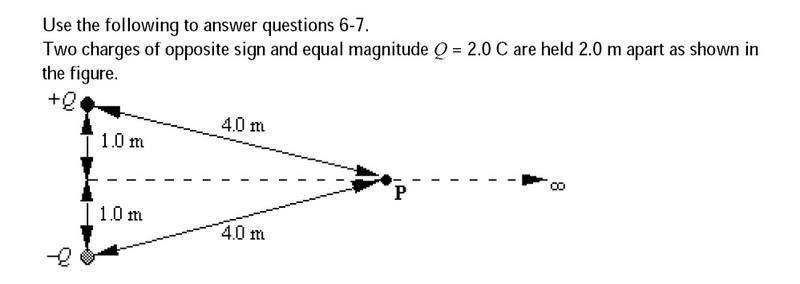
Does anyone know how to calculate these questions?
01.jpg


02.jpg
 
Physics news on Phys.org
Do your own work, show what you did and where you got stuck, and then you'll get plenty of help.
 
Doc Al said:
Do your own work, show what you did and where you got stuck, and then you'll get plenty of help.

E = V / d (E is electric field strength; V is potential difference; d is separation distance);

W = Q x V (W is workdone; Q is charge; V is potential difference);

Thus, E = W / Q / d = W / (Q x d) and d = 4.0 m;

But I don't know the value of W. How can I find the value of electric field strength at P?
 
You are dealing with point charges here: Look up expressions for the electric field and electric potential at a given distance from a point charge. Note that electric field is a vector, but potential is a scalar.
 
Doc Al said:
You are dealing with point charges here: Look up expressions for the electric field and electric potential at a given distance from a point charge. Note that electric field is a vector, but potential is a scalar.

E = Q / (4 pi eo r^2)

For +Q, E1 = Q / (4 pi eo 4^2) = Q / (64 pi eo)

For -Q, E2 = -Q / (4 pi eo 4^2) = -Q / (64 pi eo)

E1 + E2 = ?

V = Q / (4 pi eo r)

For +Q, V1 = Q / (4 pi eo 4) = Q / (16 pi eo)

For -Q, V2 = -Q / (4 pi eo 4) = -Q / (16 pi eo)

V1 + V2 = 0 and so this is the correct answer?
 
chrisych said:
E = Q / (4 pi eo r^2)

For +Q, E1 = Q / (4 pi eo 4^2) = Q / (64 pi eo)

For -Q, E2 = -Q / (4 pi eo 4^2) = -Q / (64 pi eo)

E1 + E2 = ?
Electric field is a vector, so direction counts. Add them like vectors.

V = Q / (4 pi eo r)

For +Q, V1 = Q / (4 pi eo 4) = Q / (16 pi eo)

For -Q, V2 = -Q / (4 pi eo 4) = -Q / (16 pi eo)

V1 + V2 = 0 and so this is the correct answer?
Good!
 
|E| = sqrt (E1^2 + E2^2)

E1 = 2 / (64 x 3.14 x 8.854 x 10^-12)

E2 = -E1

Thus, |E|

= sqrt (E1^2 + (-E1)^2)

= sqrt (2 x E1^2)

= sqrt (2 x (2 / (64 x 3.14 x 8.854 x 10^-12))^2)

= 15.90 x 10^8 V/m

(But the answer isn't correct)
 
chrisych said:
|E| = sqrt (E1^2 + E2^2)
That would be true if E1 and E2 were perpendicular, but they are not. Consider the horizontal & vertical components of each.
 
Doc Al said:
That would be true if E1 and E2 were perpendicular, but they are not. Consider the horizontal & vertical components of each.

Let theta be the angle between the horizontal line and the hypotenuse,

sin theta = 1 / 4 = 0.25

Take right/upward directions as positive and left/downward directions as negative,

Horizontally,

For +Q, component of E = E cos theta

For -Q, component of E = -E cos theta

Their sums = E cos theta - E cos theta = 0

Vertically,

For +Q, component of E = -E sin theta

For -Q, component of E = -E sin theta

Their sums = -E sin theta -E sin theta = -2E sin theta

|E| = |Horizontal Component of E| + |Vertical Component of E|

|E|

= sqrt ((Horizontal Component of E)^2 + (Vertical Component of E)^2)

= sqrt (0^2 + (-2E sin theta)^2)

= 2E sin theta

= 2E (0.25)

= E / 2

= 5.6 x 10^8 V/m

Am I correct?
 
Last edited:
  • #10
You got it!
chrisych said:
|E| = |Horizontal Component of E| + |Vertical Component of E|
Typo here; this should be:
|E|^2 = |Horizontal Component of E|^2 + |Vertical Component of E|^2
 
  • #11
Doc Al said:
You got it!

Typo here; this should be:
|E|^2 = |Horizontal Component of E|^2 + |Vertical Component of E|^2

Thank you very much!
 

Similar threads

  • · Replies 10 ·
Replies
10
Views
1K
Replies
1
Views
1K
  • · Replies 11 ·
Replies
11
Views
2K
  • · Replies 24 ·
Replies
24
Views
3K
Replies
4
Views
2K
  • · Replies 12 ·
Replies
12
Views
1K
Replies
1
Views
2K
  • · Replies 1 ·
Replies
1
Views
957
Replies
7
Views
2K
Replies
28
Views
4K