Calculating Charge on Metallic Plates with Open and Closed Switches

  • Thread starter Thread starter Saitama
  • Start date Start date
  • Tags Tags
    Charge Plates
Click For Summary

Homework Help Overview

The discussion revolves around calculating the charge distribution on metallic plates in a circuit with switches, focusing on scenarios with open and closed switches. The subject area includes electrostatics and circuit theory.

Discussion Character

  • Mixed

Approaches and Questions Raised

  • Participants explore the implications of closing switches on charge movement between plates and potential differences. Questions arise regarding the reasoning behind charge distributions, particularly when switches are open or closed.

Discussion Status

Participants are actively engaging with the problem, raising questions about assumptions and the effects of plate proximity on charge distribution. Some have suggested methods for analyzing the charge movement and potential differences, while others express uncertainty about how to proceed with specific questions.

Contextual Notes

There are constraints related to the assumptions made about charge distribution and the effects of the electric field within the plates. Participants are also considering the implications of the geometry of the plates and the arrangement of the circuit components.

Saitama
Messages
4,244
Reaction score
93
Homework Statement
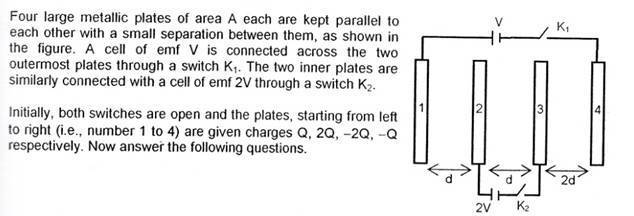
attachment.php?attachmentid=59094&stc=1&d=1369770918.jpg

Following are the questions based on the above paragraph

Q1)The charge appearing on the outer surface of plate 1, when switches K1 and K2 are open
A)zero
B)Q
C)-Q
D)-3Q

Q2)If K1 is closed and K2 is open, the charge appearing on the right surface of plate 2 is
A) ##Q/2+(\epsilon_0A/d)V/4##
B)##(\epsilon_0A/d)V/4+3Q/2##
C)##(\epsilon_0A/d)V/4-Q/2##
D)##3Q/2##

Q3)If both switches are closed, the charge appearing on plate 4 is
A)##(\epsilon_0A/d)V##
B)##(\epsilon_0A/d)V/2+Q##
C)##Q-(\epsilon_0A/d)V/2##
D)##(\epsilon_0A/d)V/3##

Homework Equations


The Attempt at a Solution


For Q1), it can be easily done by equating the electric field at any point inside the plate equal to zero but the solution solves it in a single line. It is written that "Charge on outermost surface=(net charge on system/2)=0". How did it arrive at this result? :confused:

About Q2) and Q3), I have no idea. I am clueless on how to even begin with them.

Any help is appreciated. Thanks!
 

Attachments

  • paragraph.jpg
    paragraph.jpg
    22 KB · Views: 540
Physics news on Phys.org
For (2), when the switch is closed you will get a movement of charge between plates 1 and 4, right? And the quantity moved will be so as to produce a potential difference of V between them?
 
I am just posting to be kept in touch on this. Hope our Smart Ones chime in!

On Question 1 I would have said that the surface charge on the left side of plate 1 = Q/2. If there is charge on plate 1 the charges have to be on the surface. If plate 1 were isolated then certainly half the excess charge woud reside on the left side. Why would the proximity of plates 2 et alia change that? How small does d have to be to change all that? Certainly, a gaussian "box" running from just outside the left side of plate 1 to just outside the right side of plate 4 would yield zero net flux as required if the right side of plate 4 held surface charge -Q/2.
 
rude man said:
Why would the proximity of plates 2 et alia change that? How small does d have to be to change all that?
For part 1, the close proximity allows you to treat the fields as orthogonal to the plates everywhere.
 
haruspex said:
For (2), when the switch is closed you will get a movement of charge between plates 1 and 4, right? And the quantity moved will be so as to produce a potential difference of V between them?

I am still not sure what to do. When the switch is closed, let an extra charge ##q_1## flow to plate 1, so the new charges on plate 1 and plate 4 are ##Q+q_1## and ##-Q-q_1##. Should I do the usual practice of equating electric field to zero inside the plate? And what about the solution to Q1?
 
haruspex said:
For part 1, the close proximity allows you to treat the fields as orthogonal to the plates everywhere.

That was implicit in my statement about the gaussian box. No leakage out the sides, and the flux pointing to the left on both the left and right ends.
 
Pranav-Arora said:
I am still not sure what to do. When the switch is closed, let an extra charge ##q_1## flow to plate 1, so the new charges on plate 1 and plate 4 are ##Q+q_1## and ##-Q-q_1##. Should I do the usual practice of equating electric field to zero inside the plate?
You need to get an expression for the potential inside each of the end plates, since you need to use the fact that the difference between them is V.
For Q1, I don't think there's really an easier way than the way you did it. But it's easy to see that you can generalise it to an arbitrary stack of plates with some given total charge, and it may be that the author considers this a known standard result.
 
haruspex said:
You need to get an expression for the potential inside each of the end plates, since you need to use the fact that the difference between them is V.

I am still unsure what to do here. Can you please explain a bit more? :confused:
 
In terms of the initial charges and the unknown transfer of charge q between the end plates, you can determine the charge on each face of each sheet, right? Taking the plates to be thin compared with d, and setting the potential of the left hand plate as V0, say, you can compute in these terms the potential inside the other end plate. The difference in potential between the two end plates is V, giving you an equation for q. You can now deduce the charge on each face of each sheet.
 
  • #10
haruspex said:
In terms of the initial charges and the unknown transfer of charge q between the end plates, you can determine the charge on each face of each sheet, right? Taking the plates to be thin compared with d, and setting the potential of the left hand plate as V0, say, you can compute in these terms the potential inside the other end plate. The difference in potential between the two end plates is V, giving you an equation for q. You can now deduce the charge on each face of each sheet.

The charge on the left face of plate 1 and right face of plate 4 is zero from the result of previous solution. The new charge distribution is shown in the following figure.
attachment.php?attachmentid=59144&stc=1&d=1369891244.png

Looks good?
 

Attachments

  • charges.png
    charges.png
    13.5 KB · Views: 555
  • #11
Right, that's the new charge distribution. So what's the potential difference (in terms of the Qs and ds) between plates 1 and 4?
 
  • #12
haruspex said:
Right, that's the new charge distribution. So what's the potential difference (in terms of the Qs and ds) between plates 1 and 4?

\frac{q_1}{C}+\frac{2Q+q_1}{C}+\frac{q_1}{C/2}=V
where ##C=A\epsilon_o/d##

Looks correct?
 
  • #13
There is another simpler way to solve these problems. Ok I'm giving you a hint. Transform this arrangement to a circuit consisting of 3 capacitors, 2 switches and 2 batteries. Now by looking at the circuit you can easily find the charge distribution on the capacitors.
 
  • #14
Pranav-Arora said:
\frac{q_1}{C}+\frac{2Q+q_1}{C}+\frac{q_1}{C/2}=V
where ##C=A\epsilon_o/d##

Looks correct?
Sorry for the delay - was busy.
Yes, that's what I get. Unfortunately, it doesn't correspond to any of the offered answers. Seems to me there has to be a factor 1/3 in the answer.
 
  • #15
haruspex said:
Sorry for the delay - was busy.
Please take your time, there is no hurry. :)

haruspex said:
Yes, that's what I get. Unfortunately, it doesn't correspond to any of the offered answers. Seems to me there has to be a factor 1/3 in the answer.
I do get option B) as my answer. Solving the above equation,
q_1=\frac{CV}{4}-\frac{Q}{2}
We require the charge on the right surface of plate 2 which is ##2Q+q_1##. Substituting ##q_1##, I get B.
 
  • #16
Pranav-Arora said:
Please take your time, there is no hurry. :)


I do get option B) as my answer. Solving the above equation,
q_1=\frac{CV}{4}-\frac{Q}{2}
We require the charge on the right surface of plate 2 which is ##2Q+q_1##. Substituting ##q_1##, I get B.
Just realized I didn't notice the 2d width - I thought they were all just d.
So, on to the last part :biggrin:
 
  • #17
haruspex said:
Just realized I didn't notice the 2d width - I thought they were all just d.
So, on to the last part :biggrin:

Here's how I think the charges arrange,
attachment.php?attachmentid=59160&stc=1&d=1369974349.png

Correct?
 

Attachments

  • charge.png
    charge.png
    28.5 KB · Views: 514
  • #18
With both switches closed, Q cannot matter any more. The charges will rebalance between 1 and 4 and between 2 and 3 in a way that's entirely driven by the applied potentials. Your diagram shows the total charge on plate 2 being 2Q, so I don't think it can be right.
You do know that plates 1 and 4 will have opposite total charges, and plates 2 and 3 will have opposite total charges. Try assigning unknowns to those and solving.
 
  • #19
haruspex said:
With both switches closed, Q cannot matter any more. The charges will rebalance between 1 and 4 and between 2 and 3 in a way that's entirely driven by the applied potentials. Your diagram shows the total charge on plate 2 being 2Q, so I don't think it can be right.
You do know that plates 1 and 4 will have opposite total charges, and plates 2 and 3 will have opposite total charges. Try assigning unknowns to those and solving.

How about this one:
attachment.php?attachmentid=59162&stc=1&d=1369981005.png
 

Attachments

  • charge.png
    charge.png
    14.2 KB · Views: 541
  • #20
Yes, that looks right. Now deduce the relationship between q and q2 from the potential differences.
 
  • Like
Likes   Reactions: 1 person
  • #21
haruspex said:
Yes, that looks right. Now deduce the relationship between q and q2 from the potential differences.

I get
V-\frac{q}{C}-2V-\frac{q}{C/2}=0
Solving this,
q=\frac{-CV}{3}
Hence, the charge on plate 4 is -q=CV/4.

Thank you, haruspex! :smile:
 

Similar threads

  • · Replies 31 ·
2
Replies
31
Views
4K
  • · Replies 18 ·
Replies
18
Views
3K
  • · Replies 10 ·
Replies
10
Views
3K
Replies
11
Views
4K
  • · Replies 2 ·
Replies
2
Views
2K
Replies
10
Views
5K
  • · Replies 16 ·
Replies
16
Views
4K
  • · Replies 16 ·
Replies
16
Views
2K
  • · Replies 11 ·
Replies
11
Views
2K