Calculating crossbow spring constant from arrow velocity
- Thread starter pevi70
- Start date
-
- Tags
- Physics
52 replies · 16K views · last reply
pevi70
- Messages
- 22
- Reaction score
- 0
This is the set-up:
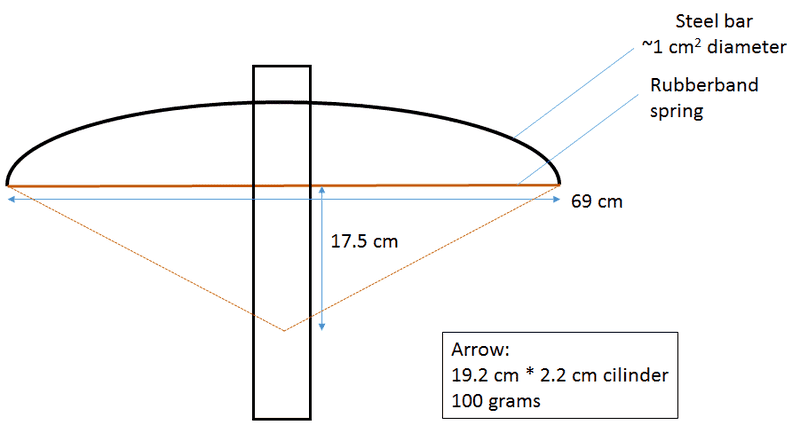
I can measure the velocity of the departing arrow. The mass of the rubberband spring is unknown and not practical to measure.
I would be interested to use the velocity and the other known parameters to calculate bow characteristics including the power of the bow.
Let me know if you need more information!
Attachments

pevi70
- Messages
- 22
- Reaction score
- 0
The rubberband has a round shape (rod shape) with a diameter of about 5 mm. I will post a picture of the actual bow later today.
I have no equipment to measure extensions under different loads, so I don't have or can easily collect that information.
I have no equipment to measure extensions under different loads, so I don't have or can easily collect that information.
pevi70
- Messages
- 22
- Reaction score
- 0
Despite the picture, quite some assumptions need to made: no recoil for example.
If you would assume that the propulsion is coming only from a mass less rubber spring, no friction exists, how would you calculate the time it would take for the arrow to cross the 17.5 cm (knowing the final speed)?
How could I approach that?
Thanks for your thoughts!
If you would assume that the propulsion is coming only from a mass less rubber spring, no friction exists, how would you calculate the time it would take for the arrow to cross the 17.5 cm (knowing the final speed)?
How could I approach that?
Thanks for your thoughts!
Science Advisor
- Messages
- 3,643
- Reaction score
- 3,347
Extension of the rubber band can be measured easily enough with a ruler. If you don't have a dynamometer on hand, you can measure draw force the way it was traditionally measured - hang the crossbow on a wall, and attach weights of known mass to the spring, measuring the distance the nocking point moves for each weight (hence the traditional nomenclature for bow power - 'draw weight'), as well as the associated extension of the rubber band.pevi70 said:I have no equipment to measure extensions under different loads, so I don't have or can easily collect that information.
Different crossbows are then ranked by their draw weight at full draw.
pevi70
- Messages
- 22
- Reaction score
- 0
Thats simply not practical. You need a special lever to lock the spring. I can measure the speed of the arrow.
I would really appreciate it if someone could help me how to calculate the time needed to propel the arrow by the spring in an idealized environment.
I would really appreciate it if someone could help me how to calculate the time needed to propel the arrow by the spring in an idealized environment.
Science Advisor
- Messages
- 3,643
- Reaction score
- 3,347
?
Why would you need to lock the string? Get a bottle, fill it with sand, weigh it, then attach it to the string and measure how much it stretches. Then change the bottle for a different weight or add more bottles and repeat.
Why would you need to lock the string? Get a bottle, fill it with sand, weigh it, then attach it to the string and measure how much it stretches. Then change the bottle for a different weight or add more bottles and repeat.
pevi70
- Messages
- 22
- Reaction score
- 0
These bows are so strong, you need a special lever to charge the spring.
Science Advisor
- Messages
- 3,643
- Reaction score
- 3,347
If you do it by hand, sure. But here you're just hanging weights on the string. You can hang as much as it takes. I really don't see the problem here.
I really don't have any experience with stretching strings, but if it's anything like traditional bows in efficiency, then you'll need something like 50-70 kg at full draw for 60m/s bolt (which you don't need, since we just want to find out how the string extension vs draw weight looks like - the first few cm of draw should suffice).
I really don't have any experience with stretching strings, but if it's anything like traditional bows in efficiency, then you'll need something like 50-70 kg at full draw for 60m/s bolt (which you don't need, since we just want to find out how the string extension vs draw weight looks like - the first few cm of draw should suffice).
pevi70
- Messages
- 22
- Reaction score
- 0
Here is a picture of the bow:
(The width of the wooden part of the bow is 4 cm)
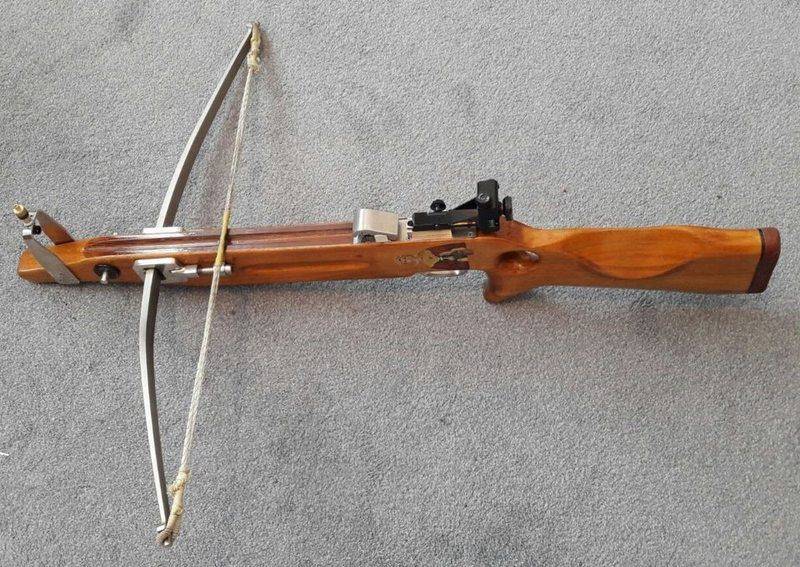
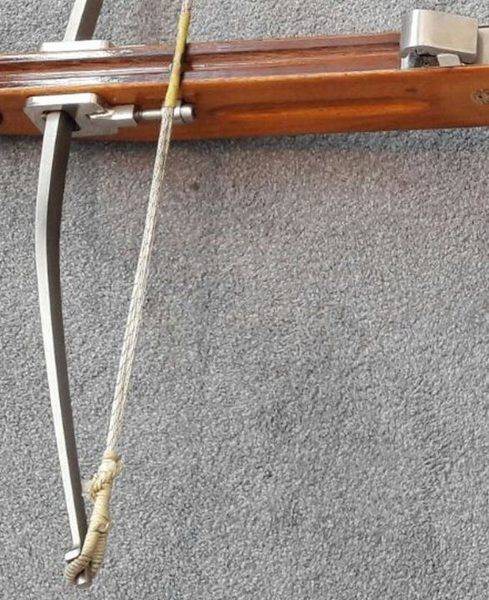
(The width of the wooden part of the bow is 4 cm)
Science Advisor
Gold Member
- Messages
- 1,532
- Reaction score
- 462
Since you can measure v (velocity at the arrow separation); and, for an object accelerating from 0 to v, s= 1/2vt, and with s and v then you can determine t (time of acceleration) and subsequently the acceleration a. If of any benefit, from that using F = ma you can determine the average effective bow force. (if, as you specified, you ignore friction and recoil.)
Edit: I just saw thr bow picture and are you sure there is no flexing of the crossbar? If there is as strong a pull force as you state, it is hard for me not to expect flexing in that component.
Edit: I just saw thr bow picture and are you sure there is no flexing of the crossbar? If there is as strong a pull force as you state, it is hard for me not to expect flexing in that component.
pevi70
- Messages
- 22
- Reaction score
- 0
I think s=1/2vt only applies if the acceleration is constant.
pevi70
- Messages
- 22
- Reaction score
- 0
OK, I thought it didnt apply. Thats great, thanks a million!
pevi70
- Messages
- 22
- Reaction score
- 0
Thanks Nidum, what is it?
Do you agree with JBA?
Do you agree with JBA?
pevi70
- Messages
- 22
- Reaction score
- 0
What does that mean?
And do you agree with JBA?
And do you agree with JBA?
Science Advisor
- Messages
- 2,992
- Reaction score
- 852
Problem is that all responders - including myself - are now a bit uncertain as to what exactly we are trying to analyse .
So I'm trying to get a definite understanding of the mechanics of this cross bow . Is it the metal spring , the rubber rope or a combination of both that provides the driving force ?
So I'm trying to get a definite understanding of the mechanics of this cross bow . Is it the metal spring , the rubber rope or a combination of both that provides the driving force ?
pevi70
- Messages
- 22
- Reaction score
- 0
Do you agree with JBA?
Dr.D
- Messages
- 2,411
- Reaction score
- 723
Nidum said:So I'm trying to get a definite understanding of the mechanics of this cross bow . Is it the metal spring , the rubber rope or a combination of both that provides the driving force ?
Amen!
Similar threads
- haxxorboi
- · Replies 7 ·
- Introductory Physics Homework Help
- Replies
- 7
- KingBigness
- · Replies 4 ·
- Introductory Physics Homework Help
- Replies
- 4
- Physics Dad
- · Replies 4 ·
- Introductory Physics Homework Help
- Replies
- 4
- npu
- · Replies 14 ·
- Introductory Physics Homework Help
- Replies
- 14
- npu
- · Replies 3 ·
- Mechanics
- Replies
- 3
- laxbrah44
- · Replies 1 ·
- Introductory Physics Homework Help
- Replies
- 1
- Ajeezy
- · Replies 1 ·
- Introductory Physics Homework Help
- Replies
- 1
- Oliviam12
- · Replies 2 ·
- Introductory Physics Homework Help
- Replies
- 2
- microdoodle
- · Replies 2 ·
- Introductory Physics Homework Help
- Replies
- 2
- UCrazyBeautifulU
- · Replies 13 ·
- Introductory Physics Homework Help
- Replies
- 13