Calculating Effort Needed for Unevenly-Loaded Class 2 Lever

  • Thread starter Thread starter Jimbo86
  • Start date Start date
  • Tags Tags
    Class Lever
Click For Summary
SUMMARY

The discussion centers on calculating the effort required to maintain equilibrium for a class 2 lever with an unevenly distributed load. Jim calculated that 322.9 kN of effort is needed at a horizontal angle, with the effort point located 11 meters from the fulcrum. As the angle of the lever increases, the required effort decreases due to the shifting center of gravity. The calculations provided by Tom indicate that if the effort remains perpendicular to the beam, the force varies as the cosine of the elevation angle, with specific calculations yielding 215 kN at 48.2 degrees.

PREREQUISITES
  • Understanding of basic physics principles related to levers and equilibrium
  • Familiarity with trigonometric functions such as sine and cosine
  • Knowledge of load distribution and center of gravity concepts
  • Experience with beam loading calculations and schematic design
NEXT STEPS
  • Research "Lever Mechanics and Equilibrium" for foundational knowledge
  • Study "Trigonometric Applications in Physics" to understand angle-related calculations
  • Learn about "Center of Gravity Calculations" for uneven loads
  • Explore "Beam Loading Analysis" techniques for structural engineering
USEFUL FOR

Engineers, physics students, and anyone involved in mechanical design or structural analysis will benefit from this discussion, particularly those working with levers and load calculations.

Jimbo86
Messages
9
Reaction score
0
Hi,

I essentially have a class 2 lever, which holds an unevenly spread load. The lever itself (platform) is however an even weight throughout its length (except for the odd RSJ I've welded in for strength). This is an OLD machine, and hence we're going to build a bigger, stronger and higher capacity machine.

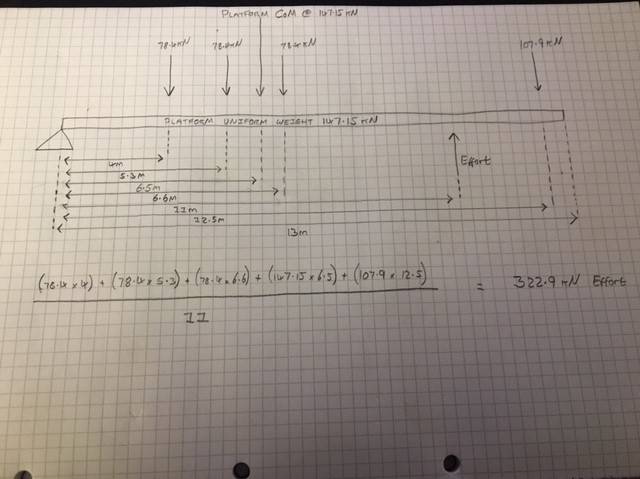
I've done a beam schematic and calculated the required effort to hold the platform with uneven weight in equilibrium. Which I think / hope is right. See below:
1.jpg


So 11 meters from the fulcrum will be the effort, which I've calculated needs to be 322.9kN for equilibrium.

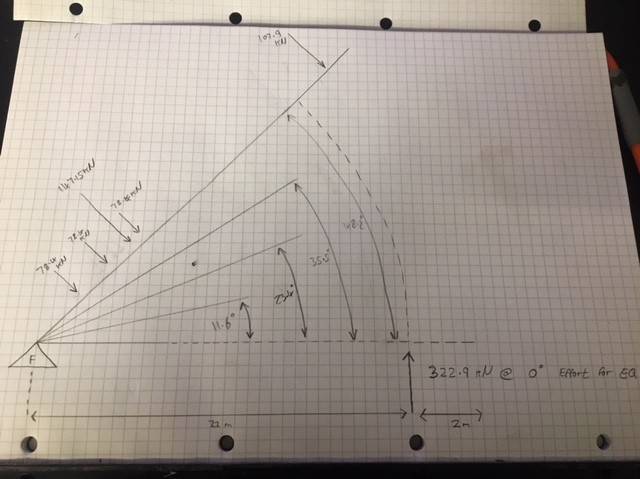
Now below is the bit I'm slightly unsure of. I need to calculate the effort required to maintain equilibrium at different angles of the lift. And I presume as the angle of the lever increases the required effort reduces as the centre of gravity is essentially being shifted closer to the fulcrum? See below.
2.jpg


What would be the best method used to calculate this?

Thanks,
Jim
 

Attachments

  • 1.jpg
    1.jpg
    34.2 KB · Views: 1,288
  • 2.jpg
    2.jpg
    33.2 KB · Views: 1,173
Last edited by a moderator:
Engineering news on Phys.org
I believe you have misstated in your post text that the length to the effort point is 11 meters; when, your diagram indicates that length is 22 meters. Which value is correct?
 
11 meters is correct. Sorry that’s my hand writing.
 
Do the load forces remain perpendicular to the platform when the angle increases ? (you designate them 'weights' and weights usually do maintain their direction)
 
Thanks for the reply.

The movable weight (I think that's right - pull of gravity on an object) is simply resting on the platform and stopped from moving by a beam near to the fulcrum. This beam is perpendicular to the platform at all times.

With regards to the load forces, as the platform rises I would assume that these forces are not perpendicular to the platform as they are when the platform is at 0 degrees (my second diagram force direction could be wrong). Reason being as the platform angle increases, gravity is pulling the load down towards the fulcrum. My thinking is that with platform angle increase the center of gravity of the weight is shifting closer to the fulcrum in a horizontal plane. So the higher the angle, the less effort is required to lift.

Only comparison I can think of is a wheelbarrow full of stone with a lid on it. The initial lift from flat is tough, but as the angle gets higher it becomes easier until it reaches over-center.

Hope this makes sense.

Thanks again
 
Well, since the problem is only partially defined, here is a partial answer.
IF the "Effort" stays perpendicular to the beam, then the force varies as the Cosine of the elevation angle.

If "Effort" does not stay perpendicular to the beam, you will have to account for the angle between "Effort" and the beam.
I'll leave that aspect to the other folks here!

Cheers,
Tom
 
Calculating the loading of lever beam:

(78.4*4)+(78.4*5.3)+(78.4*6.6)+(147.15*6.5)+(107.9*12.5) = 3551.785

Lets, just assume the effort is perpendicular to the load, with the platform @ 48.2 degrees:

(3551.785 * cos(48.2)) / 11 = 215kN effort required as opposed to 322.9kN @ 0 degrees.

In reality the effort would not be perpendicular:

angles.png
((3551.785 * cos(48.2)) / sin(67.28)) / 11 = 233.3kN required to lift platform @ 48.2 degrees with an effort applied @ 67.28 degrees.

Am I on the right track?
 

Attachments

  • angles.png
    angles.png
    40.3 KB · Views: 1,070
Can anyone confirm the above is correct?
 
I agree witht the calculation.
Do 'not' understand how the 10765 appears
 

Similar threads

  • · Replies 9 ·
Replies
9
Views
2K
  • · Replies 4 ·
Replies
4
Views
2K
Replies
9
Views
2K
  • · Replies 6 ·
Replies
6
Views
2K
  • · Replies 2 ·
Replies
2
Views
6K
  • · Replies 5 ·
Replies
5
Views
3K
  • · Replies 6 ·
Replies
6
Views
2K
  • · Replies 5 ·
Replies
5
Views
6K
  • · Replies 11 ·
Replies
11
Views
3K
Replies
3
Views
4K