Calculating Error Bars for Height and Time in Ball Drop Experiment

  • Thread starter Thread starter aron silvester
  • Start date Start date
  • Tags Tags
    Error
Click For Summary
The discussion centers on calculating error bars for the X-axis in a ball drop experiment, where height is plotted on the Y-axis. Participants have recorded drop times from various heights and are seeking clarification on error bar calculations. One member suggests multiplying the average time by the standard deviation to determine the X-axis error, while others argue that error bars should be based on the standard deviation alone or multiplied by a constant. It is noted that the calculation for the X-axis may differ due to the quadratic relationship involved. Ultimately, the consensus is to use the standard deviation with a constant multiplier applied to the actual time readings for accurate error bar representation.
aron silvester
1. The problem statement, all variables, and given/known data
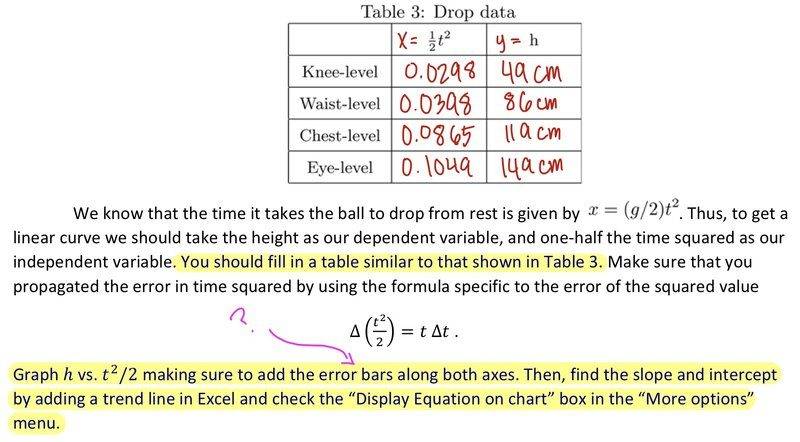
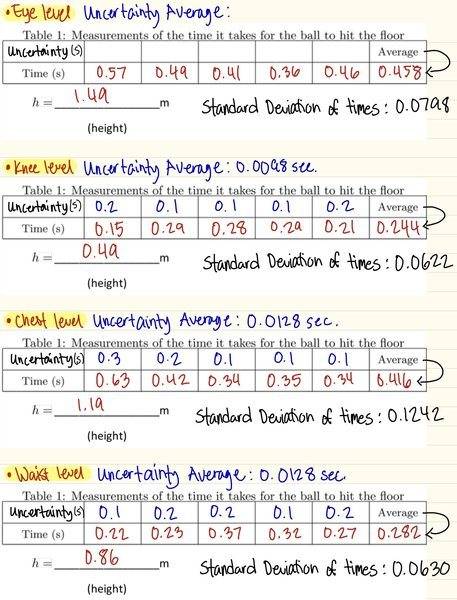
  • Take the ball and drop it from chest level 5 times recording the times and the height. Do this same procedure once again for knee, waist, and eye level. You should now have four data points for your height and four data points for the time, each with uncertainty estimates. We used the average (calculated in the Collecting data section below) of the times to plug in the t variable in the X column for each level. MY QUESTION IS, HOW DO I CALCULATE THE THE ERROR BAR ALONG THE X AXIS? I already know the error bar along the Y axis (height), my group member
IMG_1525.JPG
  • Collecting data
IMG_1524.JPG
  • Data set: Similar to Table 3
IMG_1527.JPG

Homework Equations


IMG_1527.JPG
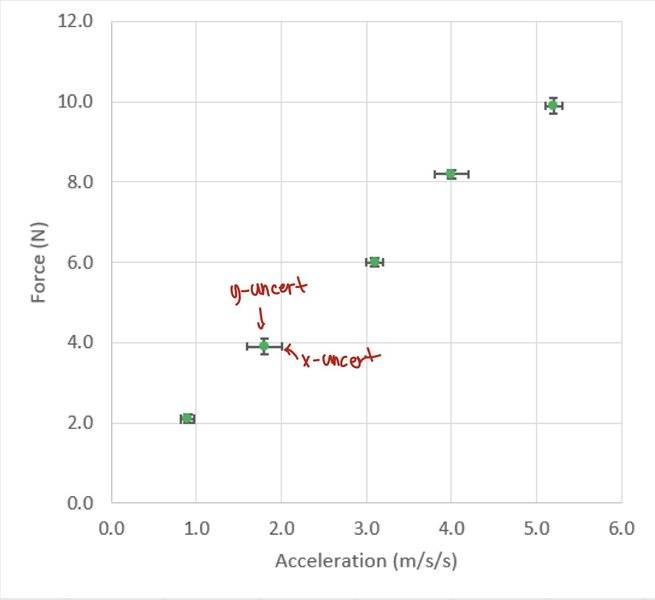
The end goal is to plot a graph on excel that looks something like the image below. I have both the X and Y values, but I just need to figure out the error bars for the X axis.
IMG_1528.JPG
 
Physics news on Phys.org
aron silvester said:
HOW DO I CALCULATE THE THE ERROR BAR ALONG THE X AXIS?
How did you calculate them for the Y axis?
 
haruspex said:
How did you calculate them for the Y axis?
My partner just eyed the uncertainty when she measured the height (height is used as the y-axis later for the graph) from which to drop the ball. My partner said in order to get the uncertainty for the x-axis, she multiplied the standard deviation by the average times. For example, to get the error bar for the knee level she multiplied the average time for knee-level, 0.244, and multiplied it with the standard deviation of 0.0622. These measurements are recorded in the Collecting Data of my post. Does that make sense? Isn't the error bar just the standard deviation? I'm not sure why she's multiplying it by the average.
 
For Y, I would take the standard deviation, or some constant multiple of it, like 2 or 3, as the error bar length. Certainly makes no sense to multiply by the average.
But as the text says, it is a bit different for the X axis because of the quadratic term. For that you should use the same constant multiplier as you used for the Y, and multiply by the actual t reading (not the average).
 
The book claims the answer is that all the magnitudes are the same because "the gravitational force on the penguin is the same". I'm having trouble understanding this. I thought the buoyant force was equal to the weight of the fluid displaced. Weight depends on mass which depends on density. Therefore, due to the differing densities the buoyant force will be different in each case? Is this incorrect?

Similar threads

  • · Replies 4 ·
Replies
4
Views
3K
Replies
14
Views
2K
  • · Replies 16 ·
Replies
16
Views
6K
  • · Replies 8 ·
Replies
8
Views
9K
  • · Replies 8 ·
Replies
8
Views
2K
  • · Replies 2 ·
Replies
2
Views
2K
  • · Replies 1 ·
Replies
1
Views
1K
Replies
5
Views
3K
Replies
6
Views
3K
  • · Replies 2 ·
Replies
2
Views
2K