Discussion Overview
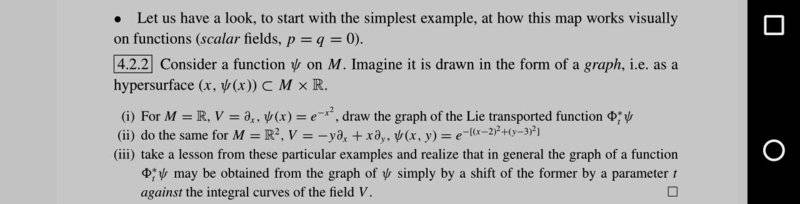
The discussion revolves around the calculation of the Lie derivative in the context of differential geometry, specifically focusing on an exercise from Fecko's textbook. Participants are exploring how to apply the pullback operator ##\phi^*## to a given function ##\psi## and the implications of integral curves of vector fields on this process.
Discussion Character
- Exploratory
- Technical explanation
- Mathematical reasoning
Main Points Raised
- One participant expresses uncertainty about how to apply the pullback operator ##\phi^*## to the function ##\psi## and seeks assistance.
- Another participant prompts for clarification by asking what the textbook states regarding the application of ##\phi^*##.
- A participant describes an integral curve of a vector field and discusses how a point is shifted and how a function ##\psi(x)## transforms under this shift.
- There is a proposal that the function becomes ##\phi = e^{-(x+t)^2}##, and a request for a procedure to calculate the Lie derivative for a different case is made.
- A later reply provides a definition of the Lie derivative and outlines steps to calculate it, including finding integral curves and displacing them by an infinitesimal amount.
- Participants discuss the specific case (i) and its implications for the function ##f(x) = \exp(-x^2)##, leading to a calculation of the Lie derivative.
- One participant encourages others to attempt the calculation for case (ii) themselves.
Areas of Agreement / Disagreement
The discussion does not reach a consensus, as participants express varying levels of understanding and propose different approaches to the problem. There is an ongoing exploration of the concepts without a definitive resolution.
Contextual Notes
Participants are working with specific examples and definitions from the textbook, which may limit the generalizability of their discussions. The calculations and transformations discussed depend on the definitions and assumptions made about the vector fields and functions involved.