Calculating moment of inertia about z axis

  • Context: Engineering 
  • Thread starter Thread starter cherry
  • Start date Start date
  • Tags Tags
    Inertia Moment
Join the discussion
Ask a follow-up here, or get your own question answered by working scientists, mathematicians and engineers — people, not an autocomplete.
Real named experts · corrections over time · the nuance an AI answer skips
5 replies · 6K views
cherry
Messages
25
Reaction score
6
Homework Statement
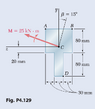
The couple M is applied to a beam of the cross section shown in a plane forming an angle with the vertical. Determine the stress at (a) point A, (b) point B, (c) point D.
Relevant Equations
I_rectangle = (1/12)bh^3
Screenshot 2025-02-11 at 12.51.50 AM.png

Hi, I'm a little confused on calculating the moment of inertia about the z-axis.
For calculating the moment of inertia about the y-axis, I did the following (verified to be correct):
Iy = 1/12 * 80 * 90^3 + 1/12 * 80 * 30^3

I did the same for the z-axis but it turned out to be wrong.
The correct equation for Iz is 1/3 * 90 * 60^3 + 1/3 * 60 * 20^3 + 1/3 * 30 * 100^3

This is my first time seeing a second moment of inertia equation like that with a denominator of 3.
If someone could post an explanation regarding the equation for Iz, I'd greatly appreciate it.

Thanks!
 

Attachments
  • Screenshot 2025-02-11 at 12.51.50 AM.png
    Screenshot 2025-02-11 at 12.51.50 AM.png
    18.9 KB · Views: 135
Physics news on Phys.org
cherry said:
Homework Statement: The couple M is applied to a beam of the cross section shown in a plane forming an angle with the vertical. Determine the stress at (a) point A, (b) point B, (c) point D.
Relevant Equations: I_rectangle = (1/12)bh^3

View attachment 357146
Hi, I'm a little confused on calculating the moment of inertia about the z-axis.
For calculating the moment of inertia about the y-axis, I did the following (verified to be correct):
Iy = 1/12 * 80 * 90^3 + 1/12 * 80 * 30^3

I did the same for the z-axis but it turned out to be wrong.
The correct equation for Iz is 1/3 * 90 * 60^3 + 1/3 * 60 * 20^3 + 1/3 * 30 * 100^3

This is my first time seeing a second moment of inertia equation like that with a denominator of 3.
If someone could post an explanation regarding the equation for Iz, I'd greatly appreciate it.

Thanks!
Please go ahead and show your work for ##I_z##. Also see LaTeX Guide to format the equations.
 
cherry said:
Relevant Equations: I_rectangle = (1/12)bh^3
The above equation gives the (area or second) moment of inertia of a rectangle (measuring ##b \times h##) about an axis when:

a) the axis passes through the rectangle's centroid and lies in the plane of the rectangle;

b) the sides of length ##b## are parallel to the axis (so the sides of length ##h## are perpendicular to the axis).

If the above conditions do not apply, you need a different formula.
 
We've not heard back from the OP. However, note that the 'official' answer given in Post #2 as:
cherry said:
The correct equation for Iz is 1/3 * 90 * 60^3 + 1/3 * 60 * 20^3 + 1/3 * 30 * 100^3
can be written down immediately.

We consider the shape broken into several pieces such that the z-axis lies along an edge of each piece:

1739538277043.png

The standard equation for the second moment of inertia when the axis lies along the edge of a rectangle is ##I = \frac 13 bh^3## where ##b## is the length of the side along the axis. (The formula, if not supplied, can be derived using the parallel axis theorem.)

To get the 'official' answer (above) the two yellow rectangles are treated as a single one measuring 60 mm x 20 mm.
 
Reply
  • Like
Likes   Reactions: Lnewqban