Calculating moments about a support point

Click For Summary
SUMMARY

This discussion focuses on calculating moments about a support point in a static equilibrium scenario involving a ladder and a concentrated weight of 250N. The correct approach to find the force at point X1 is to consider the center of mass (CoM) and apply the equilibrium condition that the sum of moments about any point must equal zero. The calculated force at X1 is 110N, while the force at X2 is determined to be 140N, ensuring the total vertical forces equal 250N. Misunderstandings regarding the application of torque and the concept of couples in mechanics were clarified throughout the discussion.

PREREQUISITES
  • Understanding of static equilibrium principles
  • Knowledge of torque and moments in mechanics
  • Familiarity with center of mass (CoM) concepts
  • Basic calculations involving forces and distances
NEXT STEPS
  • Study the principles of static equilibrium in mechanics
  • Learn about calculating torque and moments in various scenarios
  • Explore the concept of center of mass and its applications in physics
  • Investigate the differences between couples and balanced forces in mechanics
USEFUL FOR

Students of physics, engineering professionals, and anyone involved in mechanics or structural analysis will benefit from this discussion, particularly those focusing on static equilibrium and force calculations.

Shaye
Messages
20
Reaction score
7
Homework Statement
I am required to calculate the upward contact forces that two men are exerting carrying a ladder horizontally at fixed points (question 7). I think I should calculating moments about each fixed point (where the men are carrying the ladder)
Relevant Equations
Moment of Force = Force * Perpendicular distance
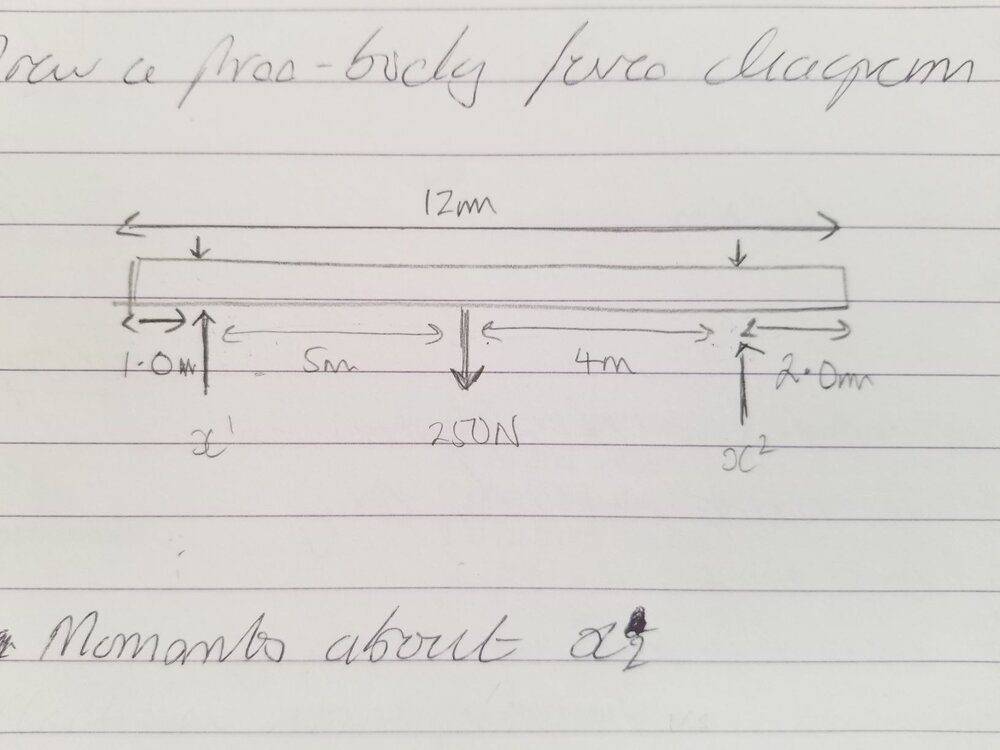
Moment about X2 to calculate force at X1:

x1 * 9 = (250 * 2)
Therefore, x1 = 500/9 = 55.5N

The book however gives force at x1 as 110N. So I figured I have not understood a concept somewhere
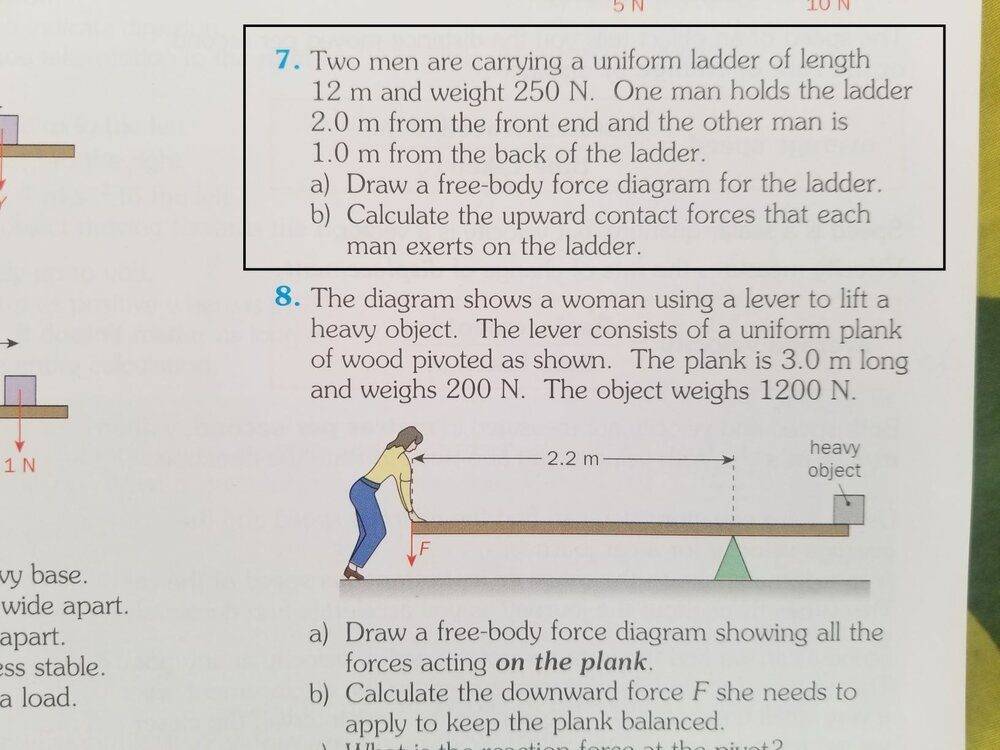
20201206_121544.jpg
20201206_121552a.jpg
 
  • Like
Likes Delta2
Physics news on Phys.org
Your mistake seems simple to me and it makes me wonder. Why do you take the torque (moment) of weight of the ladder as ##250N\cdot 2m##? This is wrong. What's the distance of the point of application of weight (Center of mass, CoM) from the point X2? Therefore what is the correct torque of weight?
 
  • Like
Likes Shaye
Thanks Delta2. Sorry I got confused. I didn't think about the CoM/CoG where all the weight is acting. But now it's fine :-) The sum of the moments about the CoM should total 250N
 
Shaye said:
Thanks Delta2. Sorry I got confused. I didn't think about the CoM/CoG where all the weight is acting. But now it's fine :-) The sum of the moments about the CoM should total 250N
Er the sum of moments about the CoM/CoG should total zero. Since we have equilibrium, the sum of moments about any point is zero.

Please answer my questions in post #2.
 
Delta2 said:
Er the sum of moments about the CoM/CoG should total zero. Since we have equilibrium, the sum of moments about any point is zero.

Please answer my questions in post #2.

The books solution says to take moments about x2 to find the force of x1 as 110N to 2 significant figures. Then by equilibrium: X1 + X2 = 250N therefore x2 = 250N - 110N = 140N.

I understood this to be (4/9)*250 = 110 2 s.f.

Similar to the reasoning of a couple i.e. (Couple = F*d) for example the forces acting on each end (in opposite directions) of a 1 meter ruler being 12N will produce a couple equal to 12N e.g.

Couple
12N*1 = 12Nm

Moments should always sum to the couple
(12*0.5)+(12*0.5) = 12 Nm
(12*0.4)+(12*0.6) = 12 Nm etc...

In answer to your question in post #2. That was a complete mistake. I was calculating the moment incorrectly assuming the ladder was on a pivot and in equilibrium and trying to find a balancing figure for the other force.
 
Shaye said:
I understood this to be (4/9)*250 = 110 2 s.f.
That is correct. So the moment of weight about x2 is equal to 4x250.
Shaye said:
Similar to the reasoning of a couple
I don't understand what you find similar to the moment of a couple, the forces we have here are not a couple.
 
  • Like
Likes Lnewqban
Delta2 said:
That is correct. So the moment of weight about x2 is equal to 4x250.

I don't understand what you find similar to the moment of a couple, the forces we have here are not a couple.
I mean what I found similar was the fact that you could take moments about any point on the ruler example e.g. at [0.2,0.8], [0.4.0.6] etc. and when you add the moments up they should always equal the couple...
 
Shaye said:
I mean what I found similar was the fact that you could take moments about any point on the ruler example e.g. at [0.2,0.8], [0.4.0.6] etc. and when you add the moments up they should always equal the couple...
There is a dfference between the concepts of couple of forces and balance of moments.

Please, see:
https://en.m.wikipedia.org/wiki/Couple_(mechanics)

https://en.m.wikipedia.org/wiki/Torque#Static_equilibrium

You could visualize the situation shown by the problem like two men, holding a 9-meter long bar horizontally (there is balance of vertical forces), inducing no rotation onto it (there is balance of moments).

A concentrated weight of 250 Newtons is free to slide along the bar.
If the sliding weight is located exactly midway, each man is holding 125 N.
If the weight slides all the way to one end, one man is holding 250 N and the second man 0 N.
 
  • Like
Likes Delta2

Similar threads

  • · Replies 14 ·
Replies
14
Views
1K
  • · Replies 5 ·
Replies
5
Views
2K
  • · Replies 7 ·
Replies
7
Views
2K
  • · Replies 19 ·
Replies
19
Views
3K
  • · Replies 7 ·
Replies
7
Views
2K
Replies
1
Views
2K
Replies
3
Views
1K
  • · Replies 15 ·
Replies
15
Views
7K
  • · Replies 4 ·
Replies
4
Views
1K
  • · Replies 7 ·
Replies
7
Views
1K