Calculating Number of Moles & Ions in CaCI2

  • Context: Chemistry 
  • Thread starter Thread starter rachelmaddiee
  • Start date Start date
  • Tags Tags
    Ions Moles
Click For Summary

Discussion Overview

The discussion revolves around calculating the number of moles and ions in calcium chloride (CaCl2), focusing on the correct application of molar mass and stoichiometry. Participants are addressing a homework problem related to this topic.

Discussion Character

  • Homework-related
  • Technical explanation
  • Debate/contested

Main Points Raised

  • One participant presents a calculation for the molar mass of CaCl2 and derives the number of moles from a given mass, concluding with the number of chloride ions.
  • Another participant questions the clarity of the chemical symbols used, specifically pointing out the incorrect use of "CI" instead of "Cl" for chlorine.
  • A later reply emphasizes the need to calculate the number of chloride ions based on approximately ¼ mole of CaCl2, suggesting the initial calculation may not address the problem correctly.
  • One participant expresses frustration with the perceived lack of attention to detail in the calculations and suggests revisiting basic arithmetic and chemistry concepts.

Areas of Agreement / Disagreement

Participants express differing views on the correctness of the calculations presented, with some pointing out errors and others defending the approach. The discussion remains unresolved regarding the accuracy of the initial calculations and the clarity of the chemical notation.

Contextual Notes

There are unresolved issues regarding the proper representation of chemical symbols and the assumptions made in the calculations, particularly concerning the number of moles and ions derived from the mass of CaCl2.

rachelmaddiee
Messages
67
Reaction score
5
Homework Statement
I have a question
Relevant Equations
N/A
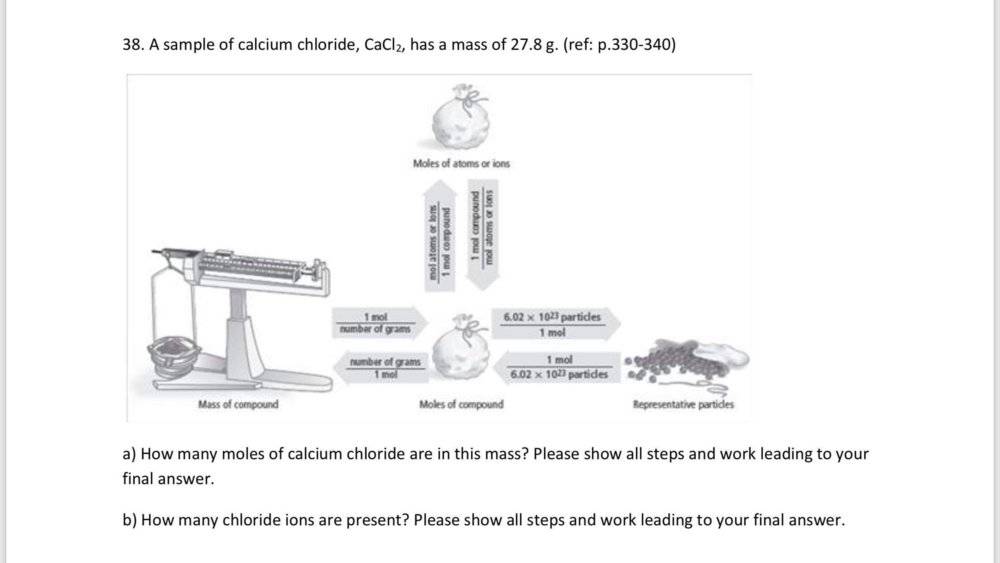
Here is my work** Can someone please tell me if this is correct?

mass = 27.8 g CaCI2
Number of CaCI2 in the compound = (unknown)
Number of CI- ions in the compound = (unknown)
Number of moles = mass/molar mass
To find the number of moles of CaCI2 first you find the molar mass of the compound.
1 mole Ca x 40.08 g Ca/1 mole Ca = 40.08 g
1 mole CI x 30.45 g CI/1 mole CI = 30.45 g
molar mass = (40.08 g + 35.45 g + 35.45 g) = 110.98 g/mol CaCI2
27.8 g CaCI2 x 1 mol CaCI2/110.98 g CaCI2 = 0.250 mol CaCI2
Now from equation No of Chloride ions are : 6.02 x 10^23 x 2 CI- ions =
1.204 x 10^23 CI- ions
01ADA860-6448-41DA-87B5-75FE08AFA4DE.jpeg
 
  • Like
Likes   Reactions: dshoup
Physics news on Phys.org
rachelmaddiee said:
Homework Statement:: I have a question you mean: 'see below for the problem statement'
Homework Equations:: N/A Oh ?

Now from equation No of Chloride ions are : 6.02 x 10^23 x 2 CI- ions =
1.204 x 10^23 CI- ions
can you explain this ?

PS kudos for dealing with the dimensions properly in part a) !
 
rachelmaddiee said:
Homework Statement:: I have a question
Homework Equations:: N/A

mass = 27.8 g CaCI2
Number of CaCI2 in the compound = (unknown)
Number of CI- ions in the compound = (unknown)
Please be more careful in writing the chemical symbols, particularly when you write I in place of l (lower-case letter ell).
##CI_2## would be a compound made up of a carbon (C) atom and two atoms of Iodine (I), which might or might not be an actual compound. Chlorine's symbol is Cl, not CI.
 
In addition there is a subscript entry in the ... drop down menu :

1578009776411.png


CaCl2 is so much easier on the eye :wink:
 
You have calculated the number of Cl- ions in a mole of CaCl2.
The job was to calculate the number in what is approximately ¼ mole of it.
Is it that difficult? :oldconfused:

Is it difficult to see the answer is wrong?

It seems to me in several exercises you are making heavy weather of some rather tedious and pedantic exercises. All that is involved is some simple proportions. I suggest if necessary you revise on an elementary arithmetic book. (OK you need the concept of moles, Dalton's number, chemical compound.) But maybe you are making such a bad mistakes because it is very boring and mind-numbing. Maybe the way out is to tell yourself I want to learn about and understand some real chemistry. E.g. About these elements and compounds you are doing these calculations on. And read ahead in the textbook (hoping it is not all like this)!
 
  • Like
Likes   Reactions: BvU

Similar threads

  • · Replies 51 ·
2
Replies
51
Views
7K
Replies
2
Views
4K
  • · Replies 2 ·
Replies
2
Views
2K
  • · Replies 5 ·
Replies
5
Views
2K
  • · Replies 1 ·
Replies
1
Views
2K
  • · Replies 14 ·
Replies
14
Views
12K
  • · Replies 6 ·
Replies
6
Views
4K
  • · Replies 7 ·
Replies
7
Views
3K
  • · Replies 2 ·
Replies
2
Views
4K
  • · Replies 3 ·
Replies
3
Views
3K