Find Empirical Formula of Unknown Substance

  • Context: Chemistry 
  • Thread starter Thread starter rachelmaddiee
  • Start date Start date
  • Tags Tags
    Formula
Click For Summary

Discussion Overview

The discussion revolves around determining the empirical formula of an unknown substance based on its percent composition by mass of carbon, hydrogen, and oxygen. Participants explore the calculations involved in converting mass percentages to moles and deriving the empirical formula, while also noting the distinction between empirical and molecular formulas.

Discussion Character

  • Technical explanation
  • Homework-related
  • Debate/contested

Main Points Raised

  • One participant presents a calculation for the empirical formula based on given mass percentages, arriving at a ratio of C2H3O2.
  • Several participants express skepticism about the originality of the solution, suggesting it resembles textbook answers.
  • Another participant confirms the calculations and notes that the molecular formula is C4H6O4, indicating that empirical and molecular formulas can differ.
  • There is uncertainty expressed regarding the correctness of the initial calculations, with one participant stating they followed an example from a book but are unsure of its accuracy.

Areas of Agreement / Disagreement

Participants generally agree on the calculations presented, but there is disagreement regarding the originality of the approach and the confidence in the correctness of the empirical formula derived.

Contextual Notes

Some participants express uncertainty about the correctness of the empirical formula calculation, and there is a lack of consensus on whether the approach taken is appropriate or if it aligns with textbook methods.

Who May Find This Useful

This discussion may be useful for students learning about empirical and molecular formulas, as well as those interested in the calculations involved in determining chemical compositions from mass percentages.

rachelmaddiee
Messages
67
Reaction score
5
Homework Statement
I need help with a question
Relevant Equations
N/A
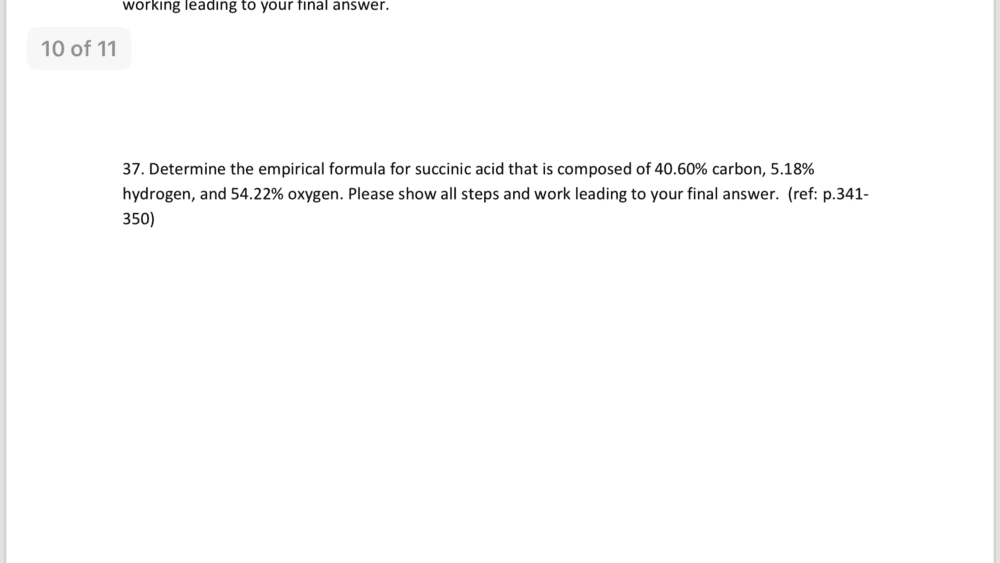
Is everything correct?
Percent by mass C = 40.60%
Percent by mass H = 5.18%
Percent by mass O = 54.22%
Empirical formula = ? (unknown)

Inverse molar mass C = 1 mol/12.01 g
Inverse molar mass H = 1 mol/1.008 g
Inverse molar mass O = 1 mol/16.00 g

Convert the masses to moles.
C = 40.60 g/12.01 g/mol = 3.380 mol
H = 5.18 g/1.008 g/mol = 5.138 mol
O = 54.22 g/16.00 g/mol = 3.388 mol

Divide by the lowest, seeking the smallest whole-number ratio
C = 3.380/3.380 = 1 = 1 mol C
H = 5.138/3.380 = 1.52 = 1.5 mol H
O = 3.388/3.380 = 1.00 = 1 mol O
The simplest mole ratio is (1 mol C):(1.5 mol H):(1 mol O).

2 x 1 mol C = 2 mol C
2 x 1.5 mol H = 3 mol H
2 x 1 mol O = 2 mol O
The simplest whole-number ratio of atoms is (2 atoms C):(3 atoms H):(2 atoms O). The empirical formula of succinic acid is C2H3O2.
84F408B9-8124-49F8-B2C9-B3F0D490F513.png
 
Physics news on Phys.org
That is a textbook answer to that problem!
 
chemisttree said:
That is a textbook answer to that problem!
A textbook answer??
 
Like you authored the answer in the textbook’s solution manual!
👍🏻
 
chemisttree said:
Like you authored the answer in the textbook’s solution manual!
👍🏻
I followed an example in my book but I’m not sure if it’s correct..
 
good job. Correct!
Also note that the correct molecular formula is C4H6O4

So, empirical formula is not always the same as molecular formula.
 
  • Like
Likes   Reactions: rachelmaddiee

Similar threads

  • · Replies 8 ·
Replies
8
Views
4K
  • · Replies 3 ·
Replies
3
Views
4K
  • · Replies 2 ·
Replies
2
Views
2K
  • · Replies 51 ·
2
Replies
51
Views
7K
  • · Replies 2 ·
Replies
2
Views
14K
  • · Replies 2 ·
Replies
2
Views
2K
Replies
2
Views
4K
  • · Replies 14 ·
Replies
14
Views
12K
  • · Replies 5 ·
Replies
5
Views
3K
  • · Replies 4 ·
Replies
4
Views
3K