ricardoainati
- 1
- 0
Hello!
I don't know if this is the right forum to post this doubt, but here it goes:
I would like to know how to calculate perspective precedence in 3D space. (I'm not a mathematician, so I don't know if it's the correct term, but I will try to explain what I need).
I have an observer in space (px, py, pz).
I also have a Rubik’s Cube, with 27 "little cubes". Rubik’s Cube can rotate any direction.
I have to calculate the sequence of the nearer cubes, from observer's perspective.
I tried to use the distance's formula to calculate this precedence between the 27 little cubes, but it doesn't help when I have some cubes rotated. I believe that there is something else to calculate, but I don't know what it is. The problem is shown in the figure below, when I try to rotate the cubes with gray faces vertically.
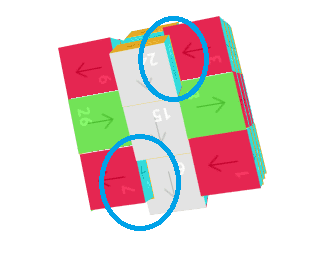
The distance formula I use is in http://www.flashandmath.com/flashcs4/zsort/sortpic.jpg
Thanks, and sorry if I wasn't so clear.
I don't know if this is the right forum to post this doubt, but here it goes:
I would like to know how to calculate perspective precedence in 3D space. (I'm not a mathematician, so I don't know if it's the correct term, but I will try to explain what I need).
I have an observer in space (px, py, pz).
I also have a Rubik’s Cube, with 27 "little cubes". Rubik’s Cube can rotate any direction.
I have to calculate the sequence of the nearer cubes, from observer's perspective.
I tried to use the distance's formula to calculate this precedence between the 27 little cubes, but it doesn't help when I have some cubes rotated. I believe that there is something else to calculate, but I don't know what it is. The problem is shown in the figure below, when I try to rotate the cubes with gray faces vertically.
The distance formula I use is in http://www.flashandmath.com/flashcs4/zsort/sortpic.jpg
Thanks, and sorry if I wasn't so clear.