Calculating phase shift between two sinusoidal waves

Click For Summary

Discussion Overview

The discussion revolves around calculating the phase shift between two sinusoidal waves, specifically focusing on the relationships between displacement, velocity, and acceleration. Participants explore the definitions of leading and lagging waves, the interpretation of phase angles, and the methods for determining phase shifts in various contexts.

Discussion Character

  • Exploratory
  • Technical explanation
  • Conceptual clarification
  • Debate/contested

Main Points Raised

  • Some participants express confusion over how to determine which wave is leading or lagging based on phase shift calculations, particularly when comparing displacement and velocity.
  • It is noted that a negative phase shift may indicate a lagging wave, but this interpretation is contested, as some argue that it could also suggest leading depending on the context.
  • Participants discuss the relationship between acceleration and displacement, with some asserting that acceleration lags displacement, while others question this interpretation based on the timing of wave peaks.
  • One participant suggests that the relationship between velocity and displacement is complex, proposing that velocity lags displacement by 270 degrees or leads by 90 degrees, depending on how one interprets the phase shift.
  • Another participant emphasizes the importance of understanding the cause-and-effect relationship in waveforms, stating that acceleration leads velocity, and velocity leads displacement.
  • There is mention of different conventions for calculating phase lead/lag, indicating that interpretations may vary based on context and methodology.
  • A suggestion is made to plot waves as phasors to visually assess leading and lagging relationships, rather than relying solely on angle calculations.
  • One participant introduces a method for measuring phase shift using multiplication and low pass filtering, suggesting that this approach may clarify the sign of the phase shift.

Areas of Agreement / Disagreement

Participants generally agree on the relationships between acceleration, velocity, and displacement, but there is significant disagreement regarding the interpretation of phase shifts and the definitions of leading and lagging. The discussion remains unresolved with multiple competing views on how to approach phase shift calculations.

Contextual Notes

Participants highlight the potential confusion arising from different conventions in defining phase lead and lag, as well as the complexity of interpreting phase shifts without clear context or knowledge of the waveforms involved.

ngn
Messages
20
Reaction score
1
TL;DR
Question about how to calculate phase shift between to sine waves from textbook. Does the book have the correct method?
Hello,
Came across this picture and passage from a textbook. Although the text lays out a method for calculating the phase shift between displacement and acceleration, I am not sure how they are calculating which wave is leading and which is lagging. From their description, it seems like a negative value would suggest that the wave is lagging compared to the reference. However, when I run the same method comparing velocity to displacement (using displacement as the reference), I get:

Displacement = 90+360+180 = 630
Velocity = 180+360+180 = 720

630 - 720 = -90

If negative means lagging, then this would suggest that velocity is lagging displacement by 90 degrees. But is that the case? It seems like the positive peaks for velocity occur earlier in time compared to the positive peaks for displacement? So, shouldn't velocity be leading displacement? Acceleration does look to be lagging displacement, so is there a problem with this method, or am I not considering the waveforms/method correctly?

Thanks!
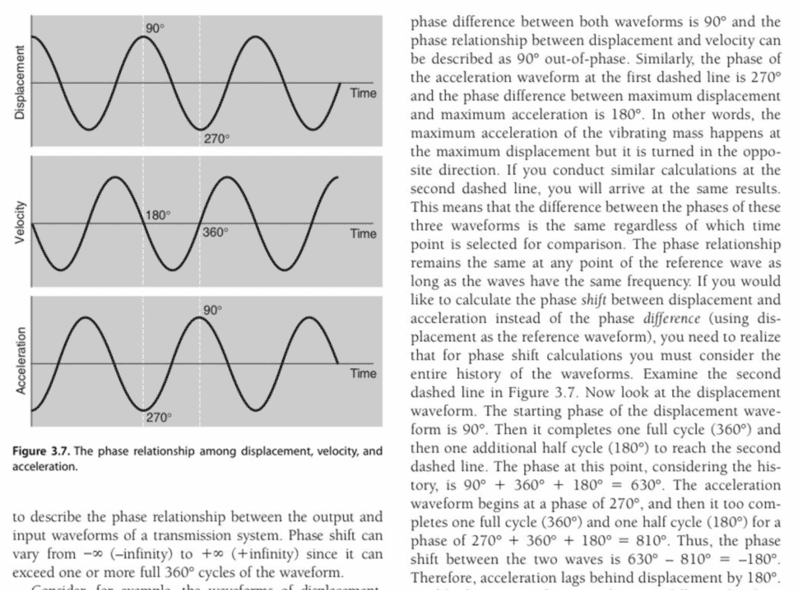
Phase Shift.png
 
Physics news on Phys.org
I agree that the acceleration is lagging displacement, but the way I learned it - lagging would be a positive phase angle.
 
scottdave said:
I agree that the acceleration is lagging displacement, but the way I learned it - lagging would be a positive phase angle.
Hi, thank you for the response! So, acceleration is LAGGING, and the text is correct? I am a bit confused then as to what is meant by leading and lagging. I was wondering if you could explain why it is lagging given that by the time the waves reach that point in time, acceleration is further along in its cycling. Wouldn't this suggest that acceleration has "started earlier in time" so to speak and is thus leading? Is there a good way to define what is meant by "leading" and "lagging"? A good definition would allow me to see why one wave is considered to be in the lead.

Also, does that mean that velocity is also lagging?
 
ngn said:
Hi, thank you for the response! So, acceleration is LAGGING, and the text is correct? I am a bit confused then as to what is meant by leading and lagging. I was wondering if you could explain why it is lagging given that by the time the waves reach that point in time, acceleration is further along in its cycling. Wouldn't this suggest that acceleration has "started earlier in time" so to speak and is thus leading? Is there a good way to define what is meant by "leading" and "lagging"? A good definition would allow me to see why one wave is considered to be in the lead.

Also, does that mean that velocity is also lagging?
It's 180° out of phase, so it could be leading or lagging, and the waveforms would appear the same, in steady state.

Since they depict displacement as a Cosine wave, it starts at the positive peak. Using this as a reference, how far do you need to travel to get to the same place (positive peak) for acceleration. This happens later in time, so it is lagging.

The relationship between Velocity and Displacement is tricky. You have to move forward in time 270° on the velocity curve to get to the positive peak, so it lags by 270°?
 
You can think of this as the cause leading the effect or the effect lagging the cause.

Start with the graph of displacement; s. First notice that:
The slope of the displacement graph is velocity; v = ds / dt.
The slope of the velocity graph is acceleration; a = dv / dt.

Given acceleration.
The integral of acceleration, is velocity + initial velocity.
The integral of velocity, is displacement + initial displacement.

You will see that acceleration causes velocity to change,
so acceleration leads velocity, and velocity lags acceleration.

Also, velocity causes displacement to change, so velocity leads displacement, and displacement lags velocity.
 
Baluncore said:
You can think of this as the cause leading the effect or the effect lagging the cause.

Start with the graph of displacement; s. First notice that:
The slope of the displacement graph is velocity; v = ds / dt.
The slope of the velocity graph is acceleration; a = dv / dt.

Given acceleration.
The integral of acceleration, is velocity + initial velocity.
The integral of velocity, is displacement + initial displacement.

You will see that acceleration causes velocity to change,
so acceleration leads velocity, and velocity lags acceleration.

Also, velocity causes displacement to change, so velocity leads displacement, and displacement lags velocity.
This is a good method when you know the relationships among the phenomena you are studying, but what if you are just given two waves and don't know anything about them or what they plot? Given just two waves, and one is the reference, then which is the best method to calculate the phase shift? Do you take the reference minus the second wave, or the second wave minus the reference, and how do you interpret the positive or negative outcome (i.e., does negative or positive = leading or lagging?). I've gotten different responses about this from different sources so it is a confusing issue.
 
Avoid adding or subtracting angles, that will only confuse you.
An integrator or differentiator will restrict the phase shift of a sinusoid to 90°. That makes it easy.

A 180° shift is an inversion, so does not lead or lag.

Plot the waves as phasors, with the reference along the +x axis.
You can then look to see if another leads or lags the reference.
 
Thank you for the replies. They were very helpful. I think there are different conventions for calculating phase lead/lag. Thus, one can either interpret the displacement/velocity shift as either velocity lagging by 270 degrees or leading by 90 degrees. It would depend on the context, how you interpret the phenomena you are measuring, and the method you use to determine the shift (i.e., how you interpret what a lead is and what a lag is).
 
The phase θ between two sin waves can be measured by (four quadrant = proper) multiplication of the two and then low pass filtering. The trig identity for cos(A). cos(B) gives you
##Cos(ωt + θ) . Cos(ωt) = {\frac {Cos(2ωt + θ) + Cos(θ)} { 2} }##

There are phase meters which can do it this way. You can calculate it using enough samples and then summing the results. The sign of the phase seems to be as you'd expect.
 

Similar threads

Replies
1
Views
914
  • · Replies 7 ·
Replies
7
Views
3K
  • · Replies 2 ·
Replies
2
Views
15K
  • · Replies 5 ·
Replies
5
Views
2K
  • · Replies 6 ·
Replies
6
Views
5K
  • · Replies 3 ·
Replies
3
Views
2K
  • · Replies 10 ·
Replies
10
Views
1K
  • · Replies 2 ·
Replies
2
Views
6K
  • · Replies 1 ·
Replies
1
Views
9K
  • · Replies 2 ·
Replies
2
Views
4K