Calculating Power Dissipation in a Parallel Circuit

Click For Summary
The discussion focuses on calculating the power dissipated by a 5-ohm resistor in a parallel circuit where a 10-ohm resistor dissipates 40W. The participants use the formula P = I^2 * R to derive the current through the resistors, noting that the current splits at the junction in a parallel configuration. By applying the junction rule and loop rule, they determine the current through the 5-ohm resistor to be 3 amps. Consequently, the power dissipated by the 5-ohm resistor is calculated to be 45 watts. The conversation emphasizes the importance of understanding current distribution in parallel circuits for accurate power calculations.
Linus Pauling
Messages
187
Reaction score
0
1. The 10 ohm resistor in the figure is dissipating 40W of power. How much power is the 5ohm resistor dissipating?
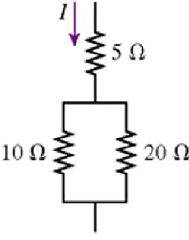
knight_Figure_31_52.jpg


2. P = I2*R


3. I = sqrt(P/R) = 2. I then did P = I2R = (4)(5) = 20 which is incorrect.
 
Physics news on Phys.org
well, I have exactly same problem and I solved only one case:

So, we have 10 ohm and 40 watt.

the Power = V^2/ Ohm then we can calculate the volt on 10 ohm.


The power on 20 ohm then, is // resistor with 10 ohm.


Then they should have same potential difference.


So you can find the power at 20 ohm...


BUt...


I am lost with 5 ohm too... anybody else?
 
The current through the 5 ohm resistor is not equal to the current through the 10 ohm resistor, because the current "splits" at the junction where the circuit becomes parallel. Let the current through the 5 ohm resistor be I1, through 10 ohm be I2 and through 20 ohm be I3. Let the junction A be where the circuit first branches off into the 2 parallel circuits. Then, by the junction rule, the current going into junction A must be equal to the sum of the currents out of junction A and into the two parallel resistors.

Junction @ A : I1 = I2 + I3

Since P = I^2 R, we need to find I1 in order to calculate the power dissipated by the 5 ohm resistor. We use the loop rule to find current I3, since we already know I2 = 2 amps. So draw Loop 1 clockwise around the inside of the parallel part of the circuit (containing the 10 ohm and 20 ohm resistors). The sum of the voltage drops (V=IR) across the circuit equals zero. We start at the junction A, and determine the voltage drop across each resistor around the loop.

Loop 1 @ A: -(20 ohm)(I3) + (10 ohm)(I2) = 0

The Loop 1 equation gives I3 = (1/2)I2. Substituting I3 into the junction A equation, with I2 = 2 amps, we get I1 = (3/2)I2 = 3 amps. So the power dissipated by the 5 ohm resistor is P = I^2 R = (3 amps)^2 * (5 ohms) = 45 watts. Feel free to make any corrections.
 
The book claims the answer is that all the magnitudes are the same because "the gravitational force on the penguin is the same". I'm having trouble understanding this. I thought the buoyant force was equal to the weight of the fluid displaced. Weight depends on mass which depends on density. Therefore, due to the differing densities the buoyant force will be different in each case? Is this incorrect?

Similar threads

  • · Replies 1 ·
Replies
1
Views
2K
Replies
22
Views
4K
  • · Replies 3 ·
Replies
3
Views
1K
  • · Replies 8 ·
Replies
8
Views
2K
  • · Replies 4 ·
Replies
4
Views
3K
  • · Replies 1 ·
Replies
1
Views
2K
  • · Replies 6 ·
Replies
6
Views
8K
Replies
4
Views
5K
  • · Replies 5 ·
Replies
5
Views
7K
Replies
9
Views
3K