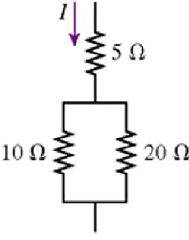
The current through the 5 ohm resistor is not equal to the current through the 10 ohm resistor, because the current "splits" at the junction where the circuit becomes parallel. Let the current through the 5 ohm resistor be I1, through 10 ohm be I2 and through 20 ohm be I3. Let the junction A be where the circuit first branches off into the 2 parallel circuits. Then, by the junction rule, the current going into junction A must be equal to the sum of the currents out of junction A and into the two parallel resistors.
Junction @ A : I1 = I2 + I3
Since P = I^2 R, we need to find I1 in order to calculate the power dissipated by the 5 ohm resistor. We use the loop rule to find current I3, since we already know I2 = 2 amps. So draw Loop 1 clockwise around the inside of the parallel part of the circuit (containing the 10 ohm and 20 ohm resistors). The sum of the voltage drops (V=IR) across the circuit equals zero. We start at the junction A, and determine the voltage drop across each resistor around the loop.
Loop 1 @ A: -(20 ohm)(I3) + (10 ohm)(I2) = 0
The Loop 1 equation gives I3 = (1/2)I2. Substituting I3 into the junction A equation, with I2 = 2 amps, we get I1 = (3/2)I2 = 3 amps. So the power dissipated by the 5 ohm resistor is P = I^2 R = (3 amps)^2 * (5 ohms) = 45 watts. Feel free to make any corrections.