Calculating RMS Using Integral Method

  • Thread starter Thread starter nhrock3
  • Start date Start date
  • Tags Tags
    Mean Root Square
Click For Summary

Discussion Overview

The discussion revolves around calculating the root mean square (RMS) of a function using an integral method. Participants explore the application of the RMS formula, the interpretation of the function's graph, and the reasoning behind certain mathematical steps involved in the calculation.

Discussion Character

  • Technical explanation
  • Mathematical reasoning
  • Debate/contested

Main Points Raised

  • One participant questions the use of the integral in the RMS calculation and the origin of the term (4t) in the formula.
  • Another participant clarifies that the graph's peaks are assumed to be 4 units above and below zero, leading to the conclusion that each triangle contributes equally to the mean square.
  • A participant explains the integration of the first triangle's area under the line V = 4t and provides the calculation for the contribution of this triangle.
  • There is confusion regarding the function of C1 and the assumption that V(1) = 4, with a later reply suggesting that this value should not be assumed without reference to the original graph.
  • One participant acknowledges understanding the integral of C1 and the reasoning behind multiplying by 4 for contributions and dividing by 4 for the period.

Areas of Agreement / Disagreement

Participants express uncertainty about the assumptions made regarding the function values and the use of the integral method. There is no consensus on the interpretation of the graph or the necessity of certain calculations.

Contextual Notes

Limitations include the lack of clarity on the original graph's details, particularly the vertical scale and specific function values, which are critical for accurate calculations.

nhrock3
Messages
403
Reaction score
0
calculate the RMS (root mean square) of this function.
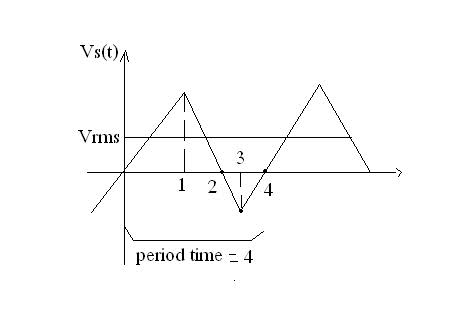
2iuq80x.jpg

the period T=4
the formula is

[tex]V_{rms}=\sqrt{\frac{1}{T}\int_{0}^{T}V_r^2dt}[/tex]
[tex]V_{rms}=\frac{1}{4}4\int_{0}^{T}(4t)^2dt}[/tex]
[tex]V_rms=\sqrt{s}=\sqrt{\frac{16}{3}}[/tex]
the solution says that they divide the graph into 4 traingles
and they sum their areas

but they don't use the integral?
why they say (4t)^2
from where the 4t comes from?

why they say that its the root of the area
why they don't divide by the period?
 
Last edited:
Physics news on Phys.org
nhrock3 said:
calculate the RMS (root mean square) of this function.
http://i50.tinypic.com/2iuq80x.jpg
the period T=4
the formula is

[tex]V_{rms}=\sqrt{\frac{1}{T}\int_{0}^{T}V_r^2dt}[/tex]
[tex]V_{rms}=\frac{1}{4}4\int_{0}^{T}(4t)^2dt}[/tex]
[tex]V_rms=\sqrt{s}=\sqrt{\frac{16}{3}}[/tex]
the solution says that they divide the graph into 4 traingles
and they sum their areas

but they don't use the integral?
why they say (4t)^2
from where the 4t comes from?

why they say that its the root of the area
why they don't divide by the period?

Note you can include the picture inline by bracketing with IMG and /IMG like this:
2iuq80x.jpg


Your picture doesn't show the vertical scale. I assume from the answer you are getting that the peaks are 4 units above and below zero and so (though it doesn't look like it in the graph) all four triangles in question are the same dimensions 4x1.

Since you are squaring the amplitudes you'll note that each trangle contributes the same amount to the mean square (and thus RMS).
(They shouldn't say you add the areas but rather add the contributions = integrals of the square magnitudes. That may be what confused you.)

The first triangle is the area under the line V = 4t
(solve for line through the origin and through [tex]V(1)=4[/tex])
and thus they integrate the square of this to get:

[tex]C_1 = \int_{0}^{1}V(t)^2dt = \int_0^1 16t^2dt = \left. \frac{16t^3}{3}\right|_{t=0}^{t=1} = \frac{16}{3}[/tex]

The [tex]C_1[/tex] stand for "contribution of 1". You get 4 such contributions from each triangle. That's the multiplicative 4. They also divide by 4 since that's the period.


[tex](V_{rms})^2 = \frac{4_{(contributions)}}{4_{(period)}}\cdot \frac{16}{3}[/tex]
so
[tex]V_{rms} = \sqrt{\frac{16}{3}}[/tex]

Understand?
 
i don't understand what is the function of C1
why V(1)=4
?

after that i understood the integral of C1 and it result.
next you multiply by 4 because of 4 such contributions
and you divide by 4 because period=4
 
nhrock3 said:
i don't understand what is the function of C1
why V(1)=4
?

Why is because it gave the same answer as you quoted. I assumed V(1) = 4 and V(3) = -4.
But we shouldn't be assuming this. The problem must have given this value, probably in the original graph.

That gives V(t) = 4t for the first unit of time which is what is being squared in the integrand.

If not then let V(1) = u = -V(3) and V(t) = ut for 0<t<1. Then your answer is:
[tex]V_{rms} = \sqrt{\frac{u^2}{3}}[/tex]
 
thanks :)
 

Similar threads

  • · Replies 8 ·
Replies
8
Views
8K
  • · Replies 1 ·
Replies
1
Views
3K
  • · Replies 20 ·
Replies
20
Views
5K
  • · Replies 4 ·
Replies
4
Views
8K
  • · Replies 7 ·
Replies
7
Views
2K
  • · Replies 11 ·
Replies
11
Views
4K
  • · Replies 19 ·
Replies
19
Views
3K
Replies
6
Views
3K
  • · Replies 7 ·
Replies
7
Views
2K
  • · Replies 1 ·
Replies
1
Views
2K