Calculating Second Order Derivative of w at t=1

Click For Summary
SUMMARY

The forum discussion focuses on calculating the second order derivative of the function \( w = \ln(x+y) \) at \( t=1 \), where \( x = e^t \) and \( y = e^{-t} \). The correct second order derivative is confirmed to be \( \frac{4}{(e^t + e^{-t})^2} \). Participants discuss the application of the chain rule and product rule in differentiation, leading to the identification of a mistake in the final derivative calculation, specifically in the handling of the hyperbolic tangent function.

PREREQUISITES
  • Understanding of calculus, specifically differentiation techniques.
  • Familiarity with the chain rule and product rule in calculus.
  • Knowledge of hyperbolic functions, particularly the hyperbolic tangent function.
  • Experience with symbolic computation tools like Maple for verification of derivatives.
NEXT STEPS
  • Study the application of the chain rule in multivariable calculus.
  • Learn about the properties and derivatives of hyperbolic functions.
  • Explore the use of Maple for symbolic differentiation and verification of calculus problems.
  • Review the product rule and quotient rule in detail to avoid common mistakes in differentiation.
USEFUL FOR

Students and professionals in mathematics, particularly those studying calculus, as well as educators looking for clarification on differentiation techniques involving logarithmic and exponential functions.

Yankel
Messages
390
Reaction score
0
Hello all,

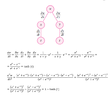
I need to find the second order derivative of w by t, and to calculate it's value at t=1.

This is what I know about w, x and y.

\[w=ln(x+y)\]

\[x=e^{t}\]

\[y=e^{-t}\]The answer in the book is:

\[\frac{4}{(e^{t}+e^{-t})^{2}}\]

I got another answer and I don't know what I did wrong, my solution is attached as an image.

View attachment 1997

Would appreciate your help with it. Thank you.

P.S According to Maple I am correct
 

Attachments

  • Capture.PNG
    Capture.PNG
    9.5 KB · Views: 113
Last edited:
Physics news on Phys.org
Your calculations are all the way through OK. It is just the very end of your equations, that needs a lift:

Try to calculate the difference:

\[(e^t+e^{-t})^2-(e^t-e^{-t})^2\]

what do you get?
 
Last edited:
Start with a function $f(x,y)$. Substitute two functions $x=g(t)$ and $y=h(t)$ to get the composite function $F(t) = f(g(t),h(t))$. The chain rule says that,
$$ \frac{dF}{dt} = \frac{\partial f}{\partial x}\frac{dx}{dt} + \frac{\partial f}{\partial y}\frac{dy}{dt} $$
Now when you compute the second derivative you use the product rule, so,
$$ \frac{d^2 F}{dt^2} = \frac{d}{dt} \left( \frac{\partial f}{\partial x} \right) \frac{dx}{dt} + \frac{\partial f}{\partial x}\frac{d^2 x}{dt^2} + \frac{d}{dt} \left( \frac{\partial f}{\partial y} \right) \frac{dy}{dt} + \frac{\partial f}{\partial y}\frac{d^2y}{dt^2} $$
To make things easier to follow let $A = \frac{\partial f}{\partial x}$, so,
$$ \frac{d}{dt}\left( \frac{\partial f}{\partial x}\right) = \frac{dA}{dt} = \frac{\partial A}{\partial x} \frac{dx}{dt} + \frac{\partial A}{\partial y} \frac{dy}{dt} = f_{xx} \frac{dx}{dt} + f_{xy}\frac{dy}{dt} $$
In a similar way if we have,
$$ \frac{d}{dt}\left( \frac{\partial f}{\partial y} \right) = f_{yx}\frac{dx}{dt} + f_{yy} \frac{dy}{dt} $$
Therefore our 2nd derivative formula is,
$$ \frac{d^2F}{dt} = (f_{xx} x' + f_{xy}y')x' + f_x \cdot x'' + (f_{yx}x' + f_{yy}y')y' + f_y \cdot y'' $$
This simplifies to, (recall that $f_{xy} = f_{yx}$),
$$ \frac{d^2 F}{dt} = f_{xx} (x')^2 + 2f_{xy}x'y' + f_{yy}(y')^2 + f_x\cdot x'' + f_y\cdot y'' $$
Now if you substitute your functions you will get your answer.
 
Yankel said:
Hello all,

I need to find the second order derivative of w by t, and to calculate it's value at t=1.

This is what I know about w, x and y.

\[w=ln(x+y)\]

\[x=e^{t}\]

\[y=e^{-t}\]The answer in the book is:

\[\frac{4}{(e^{t}+e^{-t})^{2}}\]

I got another answer and I don't know what I did wrong, my solution is attached as an image.

View attachment 1997

Would appreciate your help with it. Thank you.

P.S According to Maple I am correct

The derivative of $x+y$ is $e^t-e^{-t}$. Using the chain rule therefore, the derivative of w is $e^t-e^{-t}$ multiplied by $\frac{1}{x+y}$ which is equal to $\frac{e^t-e^{-t}}{e^t+e^{-t}}$ Then use quotient rule. x and y are just labels- easier to bypass them
 
lfdahl,

what I get is: 2e^(-2t) where does it lead me ?

ThePerfectHacker, honestly, you lost me :confused:

and Boromir, isn't what I did identical to what you suggest ?

guys, I am quite confused, did I get it wrong or right ? I can't see what I did wrong here.
 
Yankel said:
lfdahl,

what I get is: 2e^(-2t) where does it lead me ?

ThePerfectHacker, honestly, you lost me :confused:

and Boromir, isn't what I did identical to what you suggest ?

guys, I am quite confused, did I get it wrong or right ? I can't see what I did wrong here.

\[(e^t+e^{-t})^2-(e^t-e^{-t})^2 = (x+y)^2-(x-y)^2 = x^2+y^2+2xy-(x^2+y^2-2xy)\]

Can you continue?
 
Right, I get 4, I see what you mean. But I can't see where my last move was incorrect. Can it be that both expressions are equal ?

Look at it more simply, if my first derivative is tanh(t), doesn't it mean that it's derivative should be 1-tanh(t) ? Even without calculating all the way ?
 
I would expect:

tanh'(t) = 1 - tanh2(t)

- and this is also the result you get.
 
Thanks, you were very helpful, and I found my mistake thanks to you.

It is 1-tanh(t)^2 and I wrote 1-tanh(t) without the power, that's why Maple told me the expressions are not identical...
 

Similar threads

  • · Replies 6 ·
Replies
6
Views
4K
  • · Replies 3 ·
Replies
3
Views
2K
  • · Replies 3 ·
Replies
3
Views
3K
  • · Replies 3 ·
Replies
3
Views
11K
  • · Replies 5 ·
Replies
5
Views
3K
  • · Replies 2 ·
Replies
2
Views
3K
  • · Replies 15 ·
Replies
15
Views
3K
  • · Replies 1 ·
Replies
1
Views
2K
  • · Replies 2 ·
Replies
2
Views
1K
  • · Replies 10 ·
Replies
10
Views
2K