Calculating Tension & Buoyancy in Water

  • Context: High School 
  • Thread starter Thread starter Boxlife27
  • Start date Start date
  • Tags Tags
    Buoyancy Tension
Click For Summary

Discussion Overview

The discussion revolves around calculating the tension in a string suspending a rubber stopper that is partially submerged in water. Participants explore the forces acting on the stopper, the application of Archimedes' Principle, and the implications of the stopper being half in and half out of the water. The context includes conceptual understanding and application of physics principles relevant to buoyancy and tension.

Discussion Character

  • Exploratory
  • Technical explanation
  • Conceptual clarification
  • Homework-related

Main Points Raised

  • One participant outlines the basic approach to calculate tension, mentioning the need for displaced volume, density, and mass of the stopper.
  • Another participant questions the forces acting on the rubber stopper and the origin of the tension in the string.
  • A suggestion is made to use free body diagrams (FBDs) to analyze the situation, implying that this method should clarify the forces involved.
  • A participant expresses confusion about how to adjust the tension calculation when the stopper is only half-submerged, contrasting it with a fully submerged scenario.
  • Archimedes' Principle is mentioned, indicating its relevance to understanding buoyant force.
  • One participant notes that being half-submerged affects the magnitude of the buoyant force but does not change the qualitative aspects of the free body diagram.
  • There is a request for clarification on how the buoyant force's magnitude is affected by the stopper's partial submersion.
  • A participant reflects on their initial overthinking of the problem after receiving assistance.

Areas of Agreement / Disagreement

Participants generally agree on the relevance of buoyant force and free body diagrams, but there is uncertainty regarding the specific calculations and implications of the stopper being half-submerged. The discussion remains unresolved regarding the exact impact on the buoyant force's magnitude.

Contextual Notes

Participants express varying levels of understanding regarding the application of Archimedes' Principle and the calculation of forces in this specific scenario. There are unresolved aspects related to the assumptions about the buoyant force when the stopper is partially submerged.

Boxlife27
Messages
12
Reaction score
0
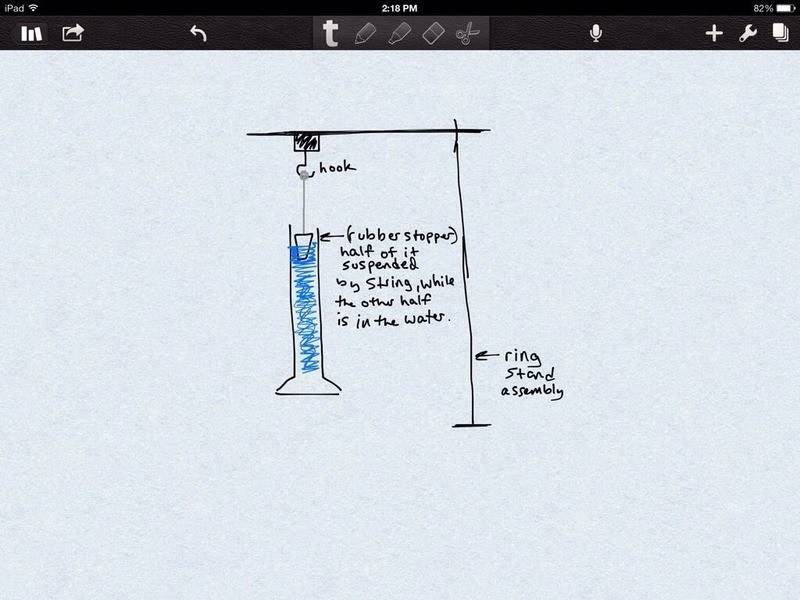
Hello, if I were to suspend a rubber stopper into a graduated cylinder filled with water, with the stopper half in the h2o and half out of it, how would i calculate the tension in the string? Experimentally, i would collect the displaced volume, density (1000kg/m3), and mass of stopper. I am only in AP physics B, so i cannot use an extremely intense formula. I know buoyant force is rho x volume x gravity and weight is mass x gravity obviously. Any help on this soon would be great. Thank you!
ImageUploadedByPhysics Forums1385065647.393557.jpg
 
Physics news on Phys.org
What forces are acting on the rubber stopper? What is causing the tension in the string in the first place?
 
Have you been taught to use free body diagrams? If so, you should have no trouble answering SteamKing's question.
 
Yes I know how to use fbds, however only half of the rubber stopper is in the water. It is not submerged. For the submerged experiment, I would do T equals W minus Force buoyancy. But when only half of the stopper is in the water (and it is not floating, it's being suspended by the string), how would this equation change? Thank you
 
Archimedes Principle
 
Boxlife27 said:
Yes I know how to use fbds, however only half of the rubber stopper is in the water. It is not submerged. For the submerged experiment, I would do T equals W minus Force buoyancy. But when only half of the stopper is in the water (and it is not floating, it's being suspended by the string), how would this equation change? Thank you
If it's only half-submerged, that only affects the magnitude of the buoyant force on the stopper. It doesn't affect qualitatively the free body diagram or the identification of the forces acting on the stopper.
 
Thank you very much for answering. How would the magnitude be affected? Would the buoyant force be in half? Or something of that nature.. Thanks
 
Boxlife27 said:
Thank you very much for answering. How would the magnitude be affected? Would the buoyant force be in half? Or something of that nature.. Thanks
Can you articulate Archimedes Principle? If you can state the principle, you should have no trouble determining the buoyant force.
 
Oh yes, I was overthinking it. Thank you all for the help
 

Similar threads

  • · Replies 7 ·
Replies
7
Views
2K
  • · Replies 3 ·
Replies
3
Views
2K
  • · Replies 14 ·
Replies
14
Views
10K
  • · Replies 14 ·
Replies
14
Views
3K
  • · Replies 9 ·
Replies
9
Views
2K
  • · Replies 2 ·
Replies
2
Views
774
  • · Replies 5 ·
Replies
5
Views
2K
  • · Replies 11 ·
Replies
11
Views
2K
  • · Replies 29 ·
Replies
29
Views
4K
  • · Replies 6 ·
Replies
6
Views
6K