Blad9
- 14
- 0
I would like to attach bearings on a shaft, see: https://www.physicsforums.com/showthread.php?p=3856547#post3856547
Therefore I would like to calculate the axial and radial force on the shaft, so I can select the right bearings.
The picture looks a as following: http://i39.tinypic.com/kd1naq.jpg
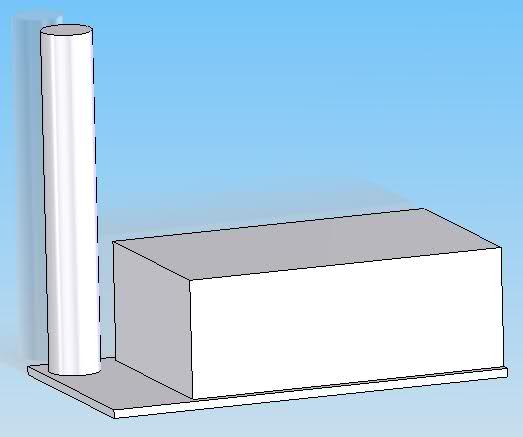
So I have a shaft, with a plate attached on it with a weight of 10kg. A load will be putted on the plate wit a weight of 37,5kg. Now I would like to calculate the axial and radial force on the shaft.
Sketch:
http://i41.tinypic.com/kd1iqx.jpg
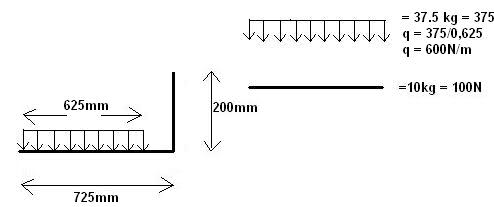
Sum Fx to A = o
Fxa = o
Sum Fy to A = o
(-375N x 0,625 x 0,3125) – (100 x (0,725/2)) + Fya x 0,725 = 0
-73,2 - 37,6 + Fya x 0,725 = 0
-110,8 + Fya x 0,725 = 0
Fya = 110,8 / 0.725
Fya = 153N
Som M t.o.v. A = o
M in a = 375 x (0,725 – 0,3125) + 100 x 0,3625
M in a = (375 x 0,4125) + 36,25
M in a = 191Nm
The shaft would have an axial force of F = 153 N and radial momentus of M = 191 Nm according to this calcuation.
Does this look ok, or should I calculate it completely differently?
[/quote]
Therefore I would like to calculate the axial and radial force on the shaft, so I can select the right bearings.
The picture looks a as following: http://i39.tinypic.com/kd1naq.jpg
So I have a shaft, with a plate attached on it with a weight of 10kg. A load will be putted on the plate wit a weight of 37,5kg. Now I would like to calculate the axial and radial force on the shaft.
Sketch:
http://i41.tinypic.com/kd1iqx.jpg
Sum Fx to A = o
Fxa = o
Sum Fy to A = o
(-375N x 0,625 x 0,3125) – (100 x (0,725/2)) + Fya x 0,725 = 0
-73,2 - 37,6 + Fya x 0,725 = 0
-110,8 + Fya x 0,725 = 0
Fya = 110,8 / 0.725
Fya = 153N
Som M t.o.v. A = o
M in a = 375 x (0,725 – 0,3125) + 100 x 0,3625
M in a = (375 x 0,4125) + 36,25
M in a = 191Nm
The shaft would have an axial force of F = 153 N and radial momentus of M = 191 Nm according to this calcuation.
Does this look ok, or should I calculate it completely differently?
[/quote]