Marcos Leo
Hi,
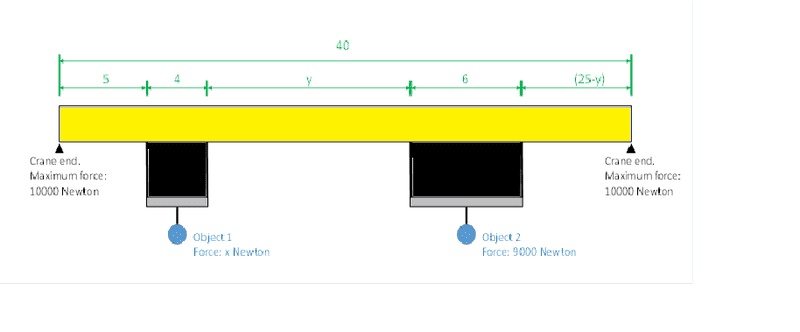
I am busy now for a couple of days with a physics problem. I am not really into physics, so I hope you can help me out. Its about the maximum force of an object (object 1 in this case). I included an illustration.
* The left and right pivot have an max of ten thousand N (upwards);
* The force of the second object is nine thousand N (downwards);
* The force of the first object is unknown (downwards)
Furthermore:
* Distances in meters are given, but ‘y’ is unknown;
* Also the first object has an fixed position, while the second can be moved, but has to be rightsided and within 20m of object one.
I am looking for the maximum force x in N of object 1.
I studied some basics physics about ‘moments’ and know that clockwise = anticlockwise. From that perspective I first thought that maybe the simple solution was that the max of x is the maximum of the left and right pivot – the force of object 2, so 11 thousand N.
But that’s maybe too simple. So, I did some additional calculations, where I included the widths and distances into the calculations, and my final answer was that x=9000 and y=2. But, the more I think about this, how more I become confused.
Could someone help me out on this ‘puzzle’ and explain what the maximum of x is, and more importantly, why?
I am busy now for a couple of days with a physics problem. I am not really into physics, so I hope you can help me out. Its about the maximum force of an object (object 1 in this case). I included an illustration.
Homework Statement
* The left and right pivot have an max of ten thousand N (upwards);
* The force of the second object is nine thousand N (downwards);
* The force of the first object is unknown (downwards)
Furthermore:
* Distances in meters are given, but ‘y’ is unknown;
* Also the first object has an fixed position, while the second can be moved, but has to be rightsided and within 20m of object one.
I am looking for the maximum force x in N of object 1.
The Attempt at a Solution
I studied some basics physics about ‘moments’ and know that clockwise = anticlockwise. From that perspective I first thought that maybe the simple solution was that the max of x is the maximum of the left and right pivot – the force of object 2, so 11 thousand N.
But that’s maybe too simple. So, I did some additional calculations, where I included the widths and distances into the calculations, and my final answer was that x=9000 and y=2. But, the more I think about this, how more I become confused.
Could someone help me out on this ‘puzzle’ and explain what the maximum of x is, and more importantly, why?