Calculating the points of tangency for two circles given a picture

Join the discussion
Registration is free. Start your own thread to ask a follow-up.
10 replies · 3K views
arashmobilebo
Messages
7
Reaction score
0
I have two circles with the same radius and I want to calculate the points of tangency.
For example, in the picture below, I want to calculate [FONT=MathJax_Main]([FONT=MathJax_Math]x[FONT=MathJax_Main]3[FONT=MathJax_Main],[FONT=MathJax_Math]y[FONT=MathJax_Main]3[FONT=MathJax_Main]) and [FONT=MathJax_Main]([FONT=MathJax_Math]x[FONT=MathJax_Main]4[FONT=MathJax_Main],[FONT=MathJax_Math]y[FONT=MathJax_Main]4[FONT=MathJax_Main]). I have the radius and the distance between the two circles as shown below:
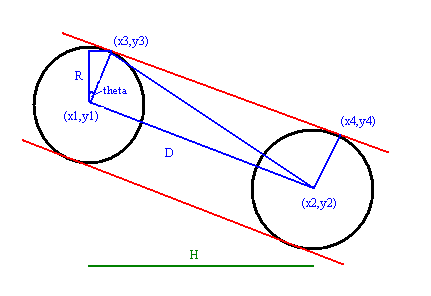
tQ2qu.png
​
 
Physics news on Phys.org
What can be said about the angle between a radius and the tangent line that it touches?
 
You can calculate the vector ##\vec D## between the centers. Can you make a vector perpendicular to it the radius units long to get from the centers to the tangent points?
 
LCKurtz said:
Can you make a vector perpendicular to it the radius units long to get from the centers to the tangent points?

thanks,can you explain me more about what should i do?
 
Villyer said:
What can be said about the angle between a radius and the tangent line that it touches?

i think they are Perpendicular
 
LCKurtz said:
You can calculate the vector ##\vec D## between the centers. Can you make a vector perpendicular to it the radius units long to get from the centers to the tangent points?

arashmobilebo said:
thanks,can you explain me more about what should i do?

I think I just told you. Do you understand vectors? Can you calculate ##\vec D\, ##? Do you know how to make a perpendicular vector?

You have to show some effort.
 
LCKurtz said:
I think I just told you. Do you understand vectors? Can you calculate ##\vec D\, ##? Do you know how to make a perpendicular vector?

You have to show some effort.

Yes I know them!
 
arashmobilebo said:
i think they are Perpendicular

They are.

So consider just the quadrilateral formed by the tangent line, the line connecting the centers, and the two radii that touch the tangent segment.

You know two ends of this figure (the centers of the circles), and the other two points are the two you are interested in.

If you identiy what type of quadrilateral it is, finding the last two points shouldn't be that hard.
 
That looks like where you got the problem from. Do you understand the work that they did?
 
Villyer said:
That looks like where you got the problem from. Do you understand the work that they did?

i asked the question there.yes i got it