Calculating the speed of hammer to drive a nail in the wall

Click For Summary
SUMMARY

The forum discussion centers on calculating the required speed of a 500g hammer to drive a nail 2.5 cm into a wall, with a force of 5000N. The correct approach involves using the work-energy theorem, where the work done (W) is equal to the force multiplied by the displacement. The final calculations reveal that the hammer must strike at approximately 19.365 m/s, factoring in the variable force applied during the impact rather than a constant force.

PREREQUISITES
  • Understanding of Newton's Second Law (F=ma)
  • Familiarity with the work-energy theorem
  • Basic knowledge of units and conversions (N to J, g to kg)
  • Ability to interpret force-displacement graphs
NEXT STEPS
  • Study the work-energy theorem in detail
  • Learn about variable forces and their impact on motion
  • Explore the concept of impulse and momentum
  • Practice problems involving force-displacement graphs
USEFUL FOR

Physics students, mechanical engineers, and anyone interested in understanding the dynamics of impact forces and energy transfer in mechanical systems.

ermcnoobphysics
Messages
6
Reaction score
0
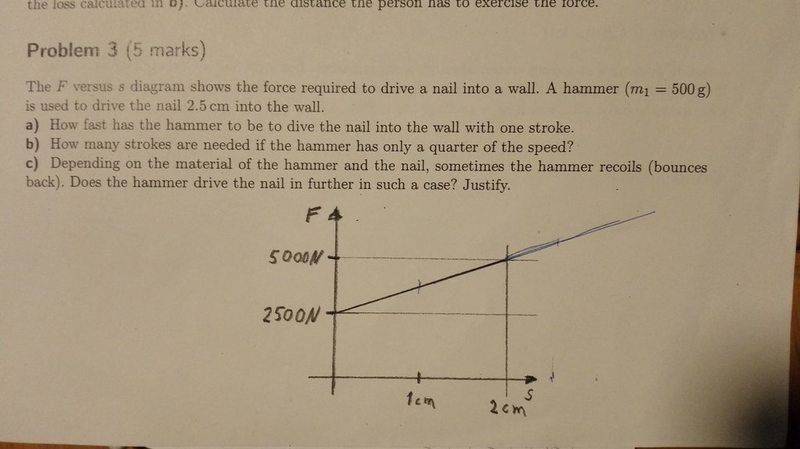
1. We know that we need 5000N to drive a nail 2.5 cm into a wall. How fast does a hammer of 500g mass have to be in order to drive the nail in the wall in one stroke?(look at the picture if it is unclear. The 2 cm in the picture should be 2.5cm)
KR5KUIrh.jpg


2.
F=m*a
W=F*x
x=distance

3. I thought it would simply be 10m/s
since 5000N=10m/s*500g.
But my teacher said it is wrong. Now I have to get to the solution which is 19m/s and show him how I did it.
 
Last edited:
Physics news on Phys.org
A picture has not been attached. Does the hammer strike perpendicular to the wall?
 
PWiz said:
A picture has not been attached. Does the hammer strike perpendicular to the wall?
Now it should be there. Sorry I thought I had uploaded it.
 
I presume that the graph extends all the way to s=2.5 cm ?
 
PWiz said:
I presume that the graph extends all the way to s=2.5 cm ?
Well the 2 cm should be 2.5cm. So 2.5 cm corresonds to the 5000N,
 
ermcnoobphysics said:
Well the 2 cm should be 2.5cm. So 2.5 cm corresonds to the 5000N,
That simplifies things considerably. You've been given the force and the displacement in the direction of the force. Does any conservation law come to your mind? How is this related to the velocity at which that 0.5kg hammer needs to be moving at?
 
PWiz said:
That simplifies things considerably. You've been given the force and the displacement in the direction of the force. Does any conservation law come to your mind? How is this related to the velocity at which that 0.5kg hammer needs to be moving at?
So the work is: 2.5cm*5000N =12500J
So then the work energy theorem says:
W=KEf-KE0
We can eliminate KE0 so it is
W=0.5*m*v^2
√(W/0.5*m)=v
So we get v=7.071m/s
This looks correct to me, but apparantely it is 19.0m/s
 
ermcnoobphysics said:
So the work is: 2.5cm*5000N =12500J
So then the work energy theorem says:
W=KEf-KE0
We can eliminate KE0 so it is
W=0.5*m*v^2
√(W/0.5*m)=v
So we get v=7.071m/s
This looks correct to me, but apparantely it is 19.0m/s
No, a constant force is not applied along the 2.5 cm displacement! The force increases linearly as can be seen in the F-s graph. Try calculating the area under the graph.
 
O
PWiz said:
No, a constant force is not applied along the 2.5 cm displacement! The force increases linearly as can be seen in the F-s graph. Try calculating the area under the graph.
Ohhhhh... I understand...
Area under graph is 9375N of course and then
9375N : 500g=18.75 m/s
Thanks a lot, now I get a bonus to my grade :)
Just one last (stupid)question. Why isn't it possible to calculate the 18.75m/s using W=0.5*m*v^2 to calculate the velocity?
 
  • #10
ermcnoobphysics said:
O
Ohhhhh... I understand...
Area under graph is 9375N of course and then
9375N : 500g=18.75 m/s
Thanks a lot, now I get a bonus to my grade :)
Just one last (stupid)question. Why isn't it possible to calculate the 18.75m/s using W=0.5*m*v^2 to calculate the velocity?
Your procedure and answer is incorrect. Firstly, why will the area have the units of N? Also remember that the units along the x-axis are cm, not m. Do you know what the area represents?

I don't understand why you're using ##F=ma## over here: this expression will give you the average force that the hammer exerts on the wall as it decelerates to a stop (while hitting the nail). We are not interested in this result. In fact, the question itself mention the singular word "velocity," which should reveal to you that they are asking the constant speed at which the hammer must be moving to drive the nail in (constant velocity = 0 acceleration)!

The last part of your post is in fact using the correct approach. Try some energy calculations!
 
  • #11
PWiz said:
Your procedure and answer is incorrect. Firstly, why will the area have the units of N? Also remember that the units along the x-axis are cm, not m. Do you know what the area represents?

I don't understand why you're using ##F=ma## over here: this expression will give you the average force that the hammer exerts on the wall as it decelerates to a stop (while hitting the nail). We are not interested in this result. In fact, the question itself mention the singular word "velocity," which should reveal to you that they are asking the constant speed at which the hammer must be moving to drive the nail in (constant velocity = 0 acceleration)!

The last part of your post is in fact using the correct approach. Try some energy calculations!
Okay area under graph is 93.75 J
I use
93.75J = 0.5*0.5kg*v^2
→v =19.365m/s
Okay now I am sure it is correct!
Haha thanks for helping an idiot like me..I make so many simple mistakes with units..I'll keep that in mind for the future.thanks again
 
  • #12
ermcnoobphysics said:
Okay area under graph is 93.75 J
I use
93.75J = 0.5*0.5kg*v^2
→v =19.365m/s
Okay now I am sure it is correct!
Haha thanks for helping an idiot like me..I make so many simple mistakes with units..I'll keep that in mind for the future.thanks again
Don't call yourself an idiot; everyone overlooks some things at one point or another - just keep learning from your mistakes!:biggrin:
 
  • #13
F(2.5cm) = 6250(N). Try again.
 
  • #14
theodoros.mihos said:
F(2.5cm) = 6250(N). Try again.
Please re-read the posts. The OP corrected this mistake...twice.
 

Similar threads

  • · Replies 4 ·
Replies
4
Views
6K
Replies
4
Views
2K
Replies
3
Views
6K
  • · Replies 1 ·
Replies
1
Views
12K
Replies
2
Views
2K
  • · Replies 6 ·
Replies
6
Views
2K
Replies
1
Views
2K
  • · Replies 5 ·
Replies
5
Views
7K
  • · Replies 1 ·
Replies
1
Views
2K
  • · Replies 4 ·
Replies
4
Views
2K