Calculating Torque for Tipping a Block: How Can I Determine the Required Force?

Click For Summary

Homework Help Overview

The discussion revolves around calculating the force required to tip a block by applying a force at a specific height. The problem involves concepts of torque, center of mass, and the relationship between applied force and gravitational force acting on the block.

Discussion Character

  • Exploratory, Conceptual clarification, Mathematical reasoning

Approaches and Questions Raised

  • Participants discuss the calculation of torque from the applied force and the opposing torque due to the block's weight. There are questions about how to quantify the weight above the point of force application and the correct use of trigonometric functions in the torque equations.

Discussion Status

Some participants have provided insights into marking the center of mass and using it to determine the torque due to the weight of the block. There is ongoing clarification about the definitions of variables and the correct application of torque principles, with no clear consensus reached yet.

Contextual Notes

One participant notes their lack of formal training and expresses a desire for guidance, indicating that they are self-studying the topic. There are also mentions of confusion regarding the notation used in the discussion, particularly concerning the variables representing weight and dimensions of the block.

jocose
Messages
12
Reaction score
1
1. The problem statement, all variables, and given/known data
a252029b-ee1e-47ef-8839-4cd82de57757

If I apply a force perpendicular to the side of a 2D block at 1/2 its height with a fixed bottom corner opposite the applied force how much force will be required to tip the block?:
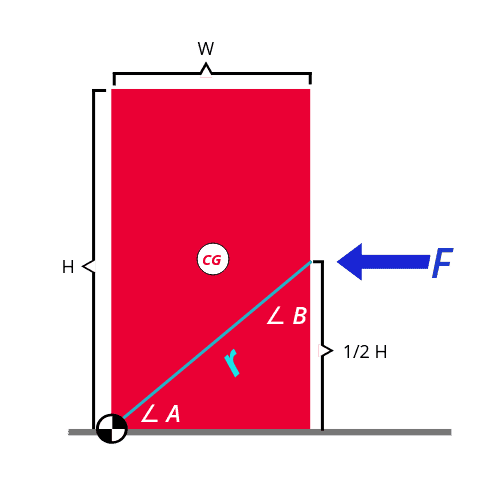
  • Block Mass = M
  • Block Width = W
  • Block Height = H
  • Applied Force = F
  • Distance between force and pivot = r
dijZToRuR.png

Homework Equations

The Attempt at a Solution


[/B]
If I understand correctly the torque of the applied force will equal F⋅ r ⋅ cos( ∠A ). The cos( ∠A ) is used because the force is being applied perpendicular to the side of the block, not the axis it's rotating in. This will reduce the torque by cos( ∠A ).

What I don't understand is how to calculate the opposing force to see if the resulting torque of the applied force is enough to overpower it.

Specifically, I am confused by the fact that the force is being applied half way, and not at the top of the block. How should the weight above the applied force be quantified?

(NOTE: I am not an enrolled student nor do I have any formal training, I am trying to teach myself. I am making an effort to read texts but it's become overwhelming and I'm looking for some guidance )
 
Last edited:
Physics news on Phys.org
RCosA = W

Does that look right to you?
 
Mark the centre of mass on the diagram. Assume the weight force acts at that point.
 
CWatters said:
RCosA = W

Does that look right to you?
Apologies but I'm unfamiliar. Is W weight? If so no that does not look correct. I suppose I'm not understanding what you're getting at.
 
CWatters said:
Mark the center of mass on the diagram. Assume the weight force acts at that point.
I've marked the center of gravity on the diagram. I've assumed its in the center (half the width and half the height). I'm still unclear how to utilize it in this instance.
 
Hi jocose! ;)

Torque is the force times the perpendicular distance (the so called lever arm) to the point of rotation.
The lever arm of the horizontal force ##F## is ##r \cdot \sin( ∠A ) =H/2##.
It is opposed by the torque from the weight of the block, which is ##Mg##, which can be considered to act on the center of gravity (CG).
That weight has a lever arm of ##W/2##.
It means that when the block is about to tip, we must have:
$$F\cdot \frac H 2 = Mg \cdot \frac W 2 \quad\Rightarrow\quad F = Mg \cdot \frac WH$$
 
  • Like
Likes   Reactions: jocose and Dr.D
jocose said:
Apologies but I'm unfamiliar. Is W weight? If so no that does not look correct. I suppose I'm not understanding what you're getting at.
No not weight. W is the width of the block marked on your diagram. I was hoping you would realize that it's not RCosA you need but RSinA that you need to multiply by F to get the torque.
 

Similar threads

Replies
61
Views
3K
Replies
6
Views
2K
  • · Replies 5 ·
Replies
5
Views
3K
  • · Replies 11 ·
Replies
11
Views
2K
Replies
29
Views
3K
  • · Replies 20 ·
Replies
20
Views
3K
  • · Replies 5 ·
Replies
5
Views
2K
  • · Replies 25 ·
Replies
25
Views
2K
Replies
6
Views
3K
Replies
1
Views
1K