What is the general solution for the power series in Calculus 2?

Click For Summary
SUMMARY

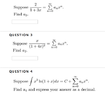
The general solution for the power series in Calculus 2 is derived from the geometric series and exponential series. The series is expressed as $\sum_{n=0}^{\infty} a_n x^n$, with specific coefficients calculated using the relationship $a_n = 2 \cdot (-3)^n$. Key examples include the geometric series $\sum_{n=0}^{\infty} x^n = \frac{1}{1-x}$ for $|x|<1$ and its adaptations for different values of $x$. The coefficients for specific terms, such as $a_3 = -54$ and $a_4 = 162$, are determined through coefficient comparison and integration techniques.

PREREQUISITES
  • Understanding of power series and convergence
  • Familiarity with geometric series and their properties
  • Basic knowledge of calculus, particularly differentiation and integration
  • Ability to manipulate algebraic expressions and solve equations
NEXT STEPS
  • Study the derivation of the geometric series and its applications in calculus
  • Learn about the radius of convergence for power series
  • Explore the relationship between power series and Taylor series expansions
  • Investigate the use of integration techniques in deriving series solutions
USEFUL FOR

Students of calculus, mathematics educators, and anyone interested in understanding power series and their applications in mathematical analysis.
joku1234
Messages
1
Reaction score
0
please help!
 

Attachments

  • Screen Shot 2015-04-12 at 5.26.11 PM.png
    Screen Shot 2015-04-12 at 5.26.11 PM.png
    16.8 KB · Views: 121
Physics news on Phys.org
joku1234 said:
please help!

... wellcome on MHB joku1234!...

The regulations state that you've shown some effort to resolve questions ... to get the result you can refer to two standard examples: the geometric and exponential series ...

Kind regards

$\chi$ $\sigma$
 
joku1234 said:
please help!

(Wave)For your first question:We know that $\sum_{n=0}^{\infty} x^n= \frac{1}{1-x}, \text{ for } |x|<1$Replacing $x$ with $-3x$ we get:

$$\frac{1}{1-(-3x)}=\frac{1}{1+3x}= \sum_{n=0}^{\infty} (-3x)^n, \text{ for } |-3x|<1 \Rightarrow -1<3x<1 \Rightarrow \frac{-1}{3}<x< \frac{1}{3}$$
So what will be the value of $a_3$?
 
evinda said:
$$\frac{1}{1-(-3x)}=\frac{1}{1+3x}= \sum_{n=0}^{\infty} (-3x)^n, \text{ for } |-3x|<1 \Rightarrow -1<3x<1 \Rightarrow \frac{-1}{3}<x< \frac{1}{3}$$

Doesn't that imply $$0^0=1$$ (if $$x=0$$)?
 
greg1313 said:
Doesn't that imply $$0^0=1$$ (if $$x=0$$)?

$0^0 = 1$ is a convention that allows us to extend definitions in different areas of mathematics that otherwise would require treating $0$ as a special case.
 
All the questions can be answered remembering the geometric series...

$\displaystyle \frac{1}{1 + \xi} = \sum_{n=0}^{\infty} (-1)^{n}\ \xi^{n},\ |\xi|< 1\ (1)$

Question 1: setting $\xi = 3\ x$ You have $\displaystyle \frac{2}{1 + 3\ x} = 2\ \sum_{n=0}^{\infty} (-1)^{n}\ (3\ x)^{n} \implies a_{3} = - 54$...

Question 2 : from (1) You derive...

$\displaystyle \frac{d}{d \xi} \frac{1}{1 + \xi} = - \frac{1}{(1 + \xi)^{2}} = \sum_{n=0}^{\infty} (-1)^{n}\ n\ x^{n-1}\ (2)$

... and setting $\xi = 4\ x$ You have $\displaystyle \frac{x}{(1 + 4\ x)^{2}}= \ \sum_{n=0}^{\infty} (-1)^{n}\ n\ 4^{n-1}\ x^{n} \implies a_{2} = 8$...

Question 3: from 1 You derive...

$\displaystyle \int_{0}^{\xi} \frac{d t}{1 + t} = \ln (1 + \xi) = \sum_{n=0}^{\infty} (-1)^{n} \frac{\xi^{n+1}}{n+1}\ (3)$

... so that You have $\displaystyle \int_{0}^{x} \xi^{2}\ \ln (1 + \xi)\ d \xi = \sum_{n=0}^{\infty} (-1)^{n} \frac{x^{n+4}}{(n+1)\ (n+4)} \implies a_{4} = \frac{1}{4}$

Kind regards

$\chi$ $\sigma$
 
Last edited:
Alternatively, for the first problem, an "intuitive" - but not rigorous - derivation is as follows. Suppose that the following holds (given suitable radius of convergence etc etc):
$$\frac{2}{1 + 3x} = \sum_{n = 0}^\infty a_n x^n = a_0 + a_1 x + a_2 x^2 + \cdots$$
Then:
$$2 = (1 + 3x) \left ( a_0 + a_1 x + a_2 x^2 + \cdots \right )$$
Distribute to get:
$$2 = \left ( a_0 + a_1 x + a_2 x^2 + \cdots \right ) + 3x \left ( a_0 + a_1 x + a_2 x^2 + \cdots \right ) = \left ( a_0 + a_1 x + a_2 x^2 + \cdots \right ) + \left ( 3 a_0 x + 3 a_1 x^2 + 3 a_2 x^3 + \cdots \right )$$
Pairing up the coefficients of $x^n$ we get:
$$2 = a_0 + \left ( 3a_0 + a_1 \right ) x + \left ( 3a_1 + a_2 \right ) x^2 + \cdots$$
Or, more clearly:
$$2 + 0 x + 0 x^2 + \cdots = a_0 + \left ( 3a_0 + a_1 \right ) x + \left ( 3a_1 + a_2 \right ) x^2 + \cdots$$
Equate coefficients on both sides to find:
$$a_0 = 2$$
$$3a_0 + a_1 = 0 ~ ~ ~ \Rightarrow ~ ~ ~ a_1 = -3 a_0 = (-3) \times 2 = -6$$
$$3a_1 + a_2 = 0 ~ ~ ~ \Rightarrow ~ ~ ~ a_2 = -3 a_1 = (-3) \times (-6) = 18$$
$$3a_2 + a_3 = 0 ~ ~ ~ \Rightarrow ~ ~ ~ a_3 = -3 a_2 = (-3) \times 18 = -54$$
$$3a_3 + a_4 = 0 ~ ~ ~ \Rightarrow ~ ~ ~ a_4 = -3 a_3 = (-3) \times (-54) = 162$$
And so on. Eventually you find that $a_n = 2 \cdot (-3)^n$ as a general solution.

:D
 

Similar threads

  • · Replies 5 ·
Replies
5
Views
2K
  • · Replies 3 ·
Replies
3
Views
2K
  • · Replies 5 ·
Replies
5
Views
3K
  • · Replies 2 ·
Replies
2
Views
2K
  • · Replies 3 ·
Replies
3
Views
3K
  • · Replies 1 ·
Replies
1
Views
2K
  • · Replies 3 ·
Replies
3
Views
2K
  • · Replies 1 ·
Replies
1
Views
2K
  • · Replies 0 ·
Replies
0
Views
3K
  • · Replies 12 ·
Replies
12
Views
3K