MHB Calc Solved! Get Quick Help With Your Calculus Q

  • Thread starter Thread starter AHMED2021
  • Start date Start date
  • Tags Tags
    Calculus
Click For Summary
SUMMARY

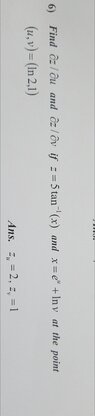
The discussion focuses on solving a calculus problem involving the chain rule and partial derivatives. The function f(x) is defined as arctan(x), with its derivative calculated as df/dx = 1/(x^2 + 1). The variable x is expressed as a function of u and v, specifically x = e^u + ln(v), leading to the partial derivatives ∂x/∂u = e^u and ∂x/∂v = 1/v. This establishes a clear method for applying the chain rule in multivariable calculus.

PREREQUISITES
  • Understanding of the chain rule in calculus
  • Knowledge of partial derivatives
  • Familiarity with the arctangent function
  • Basic concepts of multivariable functions
NEXT STEPS
  • Study the application of the chain rule in multivariable calculus
  • Learn about partial derivatives and their significance
  • Explore the properties and applications of the arctangent function
  • Investigate the relationship between exponential and logarithmic functions
USEFUL FOR

Students enrolled in calculus courses, educators teaching calculus concepts, and anyone looking to deepen their understanding of multivariable calculus and the chain rule.
AHMED2021
Messages
1
Reaction score
0
please I need solve of this question very quickly
 

Attachments

  • upload_2021_03_24_07_26_54_427.jpg
    upload_2021_03_24_07_26_54_427.jpg
    203.7 KB · Views: 118
Physics news on Phys.org
Then you had better get started! Can we at least assume you are taking a Calculus class?

Do you know the "chain rule"?

f is a function of x and x itself is a function of u and v so
$\frac{\partial f}{\partial u}= \frac{df}{dx}\frac{\partial x}{\partial u}$ and $\frac{\partial f}{\partial v}= \frac{df}{dx}\frac{\partial x}{\partial v}$.

f(x)= arctan(x) so $\frac{df}{dx}= \frac{1}{x^2+ 1}$

$x= e^u+ ln(v)$ so $\frac{\partial x}{\partial u}= e^u$ and $\frac{\partial x}{\partial v}= \frac{1}{v}$.
 
Last edited:
Relativistic Momentum, Mass, and Energy Momentum and mass (...), the classic equations for conserving momentum and energy are not adequate for the analysis of high-speed collisions. (...) The momentum of a particle moving with velocity ##v## is given by $$p=\cfrac{mv}{\sqrt{1-(v^2/c^2)}}\qquad{R-10}$$ ENERGY In relativistic mechanics, as in classic mechanics, the net force on a particle is equal to the time rate of change of the momentum of the particle. Considering one-dimensional...

Similar threads

  • · Replies 5 ·
Replies
5
Views
2K
Replies
4
Views
2K
  • · Replies 10 ·
Replies
10
Views
2K
  • · Replies 13 ·
Replies
13
Views
3K
  • · Replies 3 ·
Replies
3
Views
1K
  • · Replies 9 ·
Replies
9
Views
2K
  • · Replies 6 ·
Replies
6
Views
4K
  • · Replies 6 ·
Replies
6
Views
2K
  • · Replies 2 ·
Replies
2
Views
1K
Replies
5
Views
1K