Can a Car Be Powered Indefinitely with Solar Panels and a Motor?

  • Context: Automotive 
  • Thread starter Thread starter raruba
  • Start date Start date
  • Tags Tags
    Car Drive Energy
Click For Summary

Discussion Overview

The discussion revolves around the feasibility of powering a car indefinitely using solar panels and a motor, exploring concepts related to energy efficiency, regenerative braking, and the limitations of energy recovery systems. Participants examine theoretical models and practical implications of such a system.

Discussion Character

  • Exploratory
  • Technical explanation
  • Debate/contested
  • Mathematical reasoning

Main Points Raised

  • Some participants propose a system where a motor powers a generator, which in turn powers the motor, suggesting an efficiency of 80%, supplemented by solar panels for the remaining energy.
  • Others argue that this approach is fundamentally flawed due to inefficiencies, stating that the energy lost in the system would ultimately lead to the battery being depleted.
  • A participant suggests that the design should consider factors such as drag, power requirements for ascending hills, and energy recovery from braking, indicating that the power needed would likely exceed the proposed 20% reinforcement from solar panels.
  • Some contributions highlight that hybrid electric vehicles operate generators primarily during braking to recapture energy, questioning the efficiency of running a generator while cruising.
  • One participant calculates that the combined energy from the motor and solar panels would result in zero power applied to the wheels, questioning the practicality of the proposed system.
  • Another participant discusses the need to evaluate the total power requirements based on speed, resistance, and drag, emphasizing that adding generators would only increase inefficiencies and weight.

Areas of Agreement / Disagreement

Participants express multiple competing views regarding the viability of the proposed system, with no consensus reached on whether it could work effectively. The discussion remains unresolved, with differing opinions on the efficiency and practicality of the concepts presented.

Contextual Notes

Limitations include assumptions about efficiency rates, the impact of environmental factors on energy generation, and the specific conditions under which solar vehicles operate effectively. The discussion does not resolve these complexities.

raruba
Messages
1
Reaction score
0
Hello , this is my first post.

I just had this crazy idea if you can make a car that you can drive forever. I just want to check if this is possible.

I know that the "motor powers the generator and generator powers the motor" thing doesn't work. Cause it isn't 100% efficient and bla bla bla. But what if you still do this and let's say that you can get 80% back. So that the motor powers the generator and the generator powers the motor back by 80% and that the other 20% you power with solar panels.

So my question is will this work and if not why will it not work ?
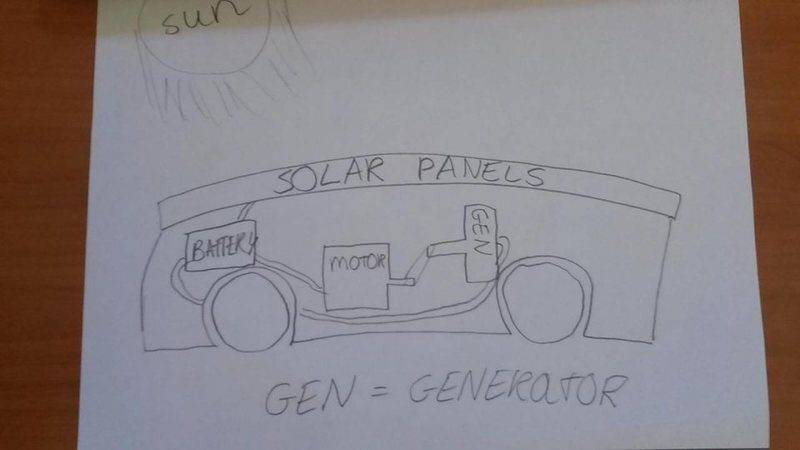
11901568_972849559442760_1061657897_o.jpg
 
Engineering news on Phys.org
What keeps you from lifting yourself by your bootstraps?
 
Your idea is the basis of many solar cars today. They collect solar energy, charge a battery for cloudy times and drive a motor. Some vehicles might even run the generator when braking to recapture some kinetic energy.

So its a great idea but like so many great ideas someone has thought of it before.
 
But the solar panel thing is a good idea. they race 3000 km through Australia from one end to the other ! And it goes fast !

And eh, welcome to PF ! :smile:

It's great and nobody let's himself be discouraged when others say hey this has been thought of before !
 
  • Like
Likes   Reactions: billy_joule
raruba said:
Hello , this is my first post.

I just had this crazy idea if you can make a car that you can drive forever. I just want to check if this is possible.

I know that the "motor powers the generator and generator powers the motor" thing doesn't work. Cause it isn't 100% efficient and bla bla bla. But what if you still do this and let's say that you can get 80% back. So that the motor powers the generator and the generator powers the motor back by 80% and that the other 20% you power with solar panels.

So my question is will this work and if not why will it not work ?View attachment 87286

Yes. It will work. But as you said, it's not 100% efficient, so it's the same thing as driving around in any car with the brakes partially applied. You can still move, but it's a waste of energy. So ultimately, the battery would go dead, and then your 80% efficient motor generator system would imply that the solar panel would only provide 16% of your your original 100% power.
 
These types of questions are a great use of design engineering. I would propose that a better approach is to as closely as possible calculate the drag of the car through the air. Add to this the power required to ascend hills and the parasitic loss of driving the generator. Subtract the approximate gain of %75 recovery in descending hills and braking. What you will know is how much power is required to move your car in the fictional world you modeled. I think that you will find it to be well over %20 reinforcement required. Also then consider more hills or more winds or heavier payload.

The Australian racers get amazing results but only when they operate in their narrowly defined envelope. I am not trying to trample your idea. In theory it works, however many new ideas get a bad reputation as they come to life without a connection to actual service.
 
Raruba, you aren't from NASA are you? Your doodle looks just like a NASA test vehicle I mentioned a while back.

proxy.php?image=http%3A%2F%2Fhome.europa.com%2F~garry%2Fnasa_dryden_research_vehicle.jpg


[ref]
 
If you are running on electricity, it only makes sense to run the generator when breaking. This is what hybrid electric vehicles do, and some fully electric vehicles. If you run the generator while cruising, it will increase the resistance, like riding with the breaks on.
Internal combustion engine cars have small generators which they do run while the car is cruising to generate electricity for things like headlights, controls, and ignition. But there's no point in doing that if your engine runs on electricity, since you get back less than you put in.
 
raruba said:
I know that the "motor powers the generator and generator powers the motor" thing doesn't work. Cause it isn't 100% efficient and bla bla bla. But what if you still do this and let's say that you can get 80% back. So that the motor powers the generator and the generator powers the motor back by 80% and that the other 20% you power with solar panels.

So my question is will this work and if not why will it not work ?View attachment 87286
So, when running on motor, generator and solar panels, you get:
80+20-100 = 0 power applied to the wheels. So this car wouldn't move.

Why not just run straight off the solar panels and skip the waste of the inefficiency of your motor/generator system?
 
  • #10
Regenerating electricity by braking is appx 40% eff. (according to jurassictest,ch) accelerating electricly is appx. 75% eff. Friction and aerodynamic losses are about 12 kwh pr. 100 km (Leaf 2013 figures). That's not counting heat and air conditioning. Then calculate power additions from solar panels. Good luck to you. Really.
 
  • #11
Imagine your car running on solar panels and a motor only. How much power do you need? Well you evaluate your speed, the resistance caused by the wheels rolling and the drag force and calculate the power required, say 10 hp. Now you know that your motor must be able to produce 10 hp, so are your solar panels.

Now imagine you put generators on the wheels that can produce 100 hp with a 120 hp input. This power (120 hp) must be added to the resistance of the wheels and drag (10 hp). So now you need a motor that can handle 130 hp but, because the generators produce 100 hp, you also need solar panels that produce 30 hp.

You could do the same exercise with generators that produce 1000 hp with a 1200 hp input. Then you need a 1210 hp motor and solar panels that can produce 210 hp.

So you see that all you are doing is adding weight ... to introduce inefficiencies that must be compensated! The bigger the generator, the worst it is.

The lesson: The minimum size of your power source (in this case, your solar panels) is equal to the basic requirement of what you are trying to achieve (in this case, fight the wind and rolling resistance of a vehicle at a given speed). Anything you will add to the system will only introduce inefficiencies that you will need to compensate, i.e. you will need a bigger power source.
 
  • Like
Likes   Reactions: Randy Beikmann

Similar threads

  • · Replies 16 ·
Replies
16
Views
3K
  • · Replies 19 ·
Replies
19
Views
4K
Replies
34
Views
5K
Replies
2
Views
2K
  • · Replies 30 ·
2
Replies
30
Views
4K
Replies
6
Views
2K
  • · Replies 3 ·
Replies
3
Views
2K
Replies
2
Views
4K
Replies
58
Views
9K
  • · Replies 20 ·
Replies
20
Views
13K